looking for logic in the chambers of the human heart
Randy Hobbs -- Slowly But SurelyRoosevelt Sykes -- Yes Lawd
Funkadelic -- Maggot Brain [alt mix]
He was alone in the lobby of his hotel in Isla Mujeres, watching Hitchcock's La Ventana Indiscreta and misreading Jeffries' misgivings for disregard, zoning out looking through Lisa's face to the blue and red and green rectangles. Jorge banged on the glass by the door, smiling sleepily, holding his left crutch, his right crutch leaned against his side.
"Jorge," he said. "¿Qué pasa?"
"Nada, man."
"¿Qué tal?"
"Bien, ¿y tú?"
"Bien bien." Jorge lifted himself in off the sidewalk. "What you doing?"
"Nothing. Nothing. Just watching this movie."
"Yeah?" He came around the TV to took a look. "Válgame Dios."
"Yeah."
"Yeah." Jorge turned and hopped backwards twice, then sat down and rested his crutches beside him.
They sat there staring at the screen, red and green and blue rectangles brightening and fading away, brightening and fading away: in the commercials, in the break-in, in the theft, in the climax, in the credits.
"Buena película," Jorge said, halfway through an infomercial.
"Buenísima."
"You flying, man?"
"No, I don't smoke. You?"
"I am ... so flying, man."
"That's cool."
"Shoooooo," Jorge said. "So flying."
Flashes of light, electrons hitting the screen, red-blue-green.
"Do you smoke?" Jorge said.
"No, I don't smoke." I'm staring at a light source, Nick thought. It's furniture and it's a light source and people stare at it. And I do too.
"No smoke?"
"No, gracias."
"So flying."
"Hm...." The tick of the clock on the wall. Somewhere down the street, far off, someone telling Carlos he didn't know anything, ni una putísima cosa, coño. Cars coming by, whoosh.
"Shoo," Jorge said.
"Shoo-wee."
"Buena onda, tú."
"¿Sí?"
"Sí. ¿No fumas?"
"No, no fumo. Let's go."
"Where? To where we go?"
"I want a beer."
"¿Cómo?"
"Cerveza. Lager. Dos Equis. Vámanos."
"Muy bien. Buena onda," he said, pushing himself off the sofa and grabbing his crutches. "¿Listo?"
"Claro. Ko'ox."
"Ko'ox," he said, laughing. "¡Vámonos!"
"Buena película," Jorge said in the bar.
"Muy buena." He knocked back the last of the beer and sat staring at the table: mahogany under a dark varnish, the reflection of the ceiling fan broken by the ring from the bottle, the bottle now cool and slick in his hand as he spun it around and stopped it, spun it again.
"Buena película."
The breeze wafted in from the beach carrying that unmistakable saltwater smell, waves pounding the surf, people chatting a few doors down, Jorge and Nick and the mesero alone in the bar.
"Aren't you hungry?"
"¿Cómo?"
"¿No tienes hambre?"
"Mucha hambre."
"Well, order something then."
"¿Cómo?"
"¿No vas a pedir?"
"¡Camarero!" Jorge said. The waiter came over to take their order. He was wearing stiff leather shoes with faded blue jeans and a tan guayabera. "Dos tamales," Jorge said, and something else Nick didn't catch. The guayabera never caught on stateside, did it? he thought. There was a couple outside, looking in, speaking softly in a Scottish accent. Of course, kilts didn't either.
"¿Algo más?" the waiter said.
"Otra cerveza," Nick said.
"Dos más," Jorge said.
The waiter nodded and left. Nick spun the bottle, let it go, stopped it. Jorge contemplated the table. Nick looked out at the street. The couple had left.
"What are we doing here?" he said.
"Drinking."
"No, in general."
"¿Cómo?"
"Por lo general."
"Drinking."
"No, la gente por lo general."
"Eating, too. Sometimes eating."
"No," Nick said.
"Buena onda," Jorge said.
"¿Qué hacemos aquí? ¿Cómo gente?"
"Vinimos a beber."
He sighed. A beer opened behind him, then another. The door in the counter opened, swung back and forth, came to a stop. The waiter set down a plate of chips, a dish of guacamole, and two more beers.
[Midnite Blues Party @ amazon, and @ emusic]
[The Honeydripper @ amazon, or @ emusic]
[Maggot Brain @ amazon, or @ emusic]
Labels: blues, is fiction, jazz, RnB
posted by Tuwa @
00:15 | permalink |
7 comments
|

Harold Burrage
Harold Burrage -- Betty JeanHarold Burrage -- You Eat Too Much
Harold Burrage was a pianist whose career started in the 1950s and lasted until his untimely death in the mid 1960s; in that time he cut blues, rock'n'roll, and R&B sides for a few labels, including Cobra (which, as you might expect, meant he recorded a bit with Otis Rush and Magic Sam).
"Betty Jean" sounds like the kind of track the good Reverend might post, all roots rock and driving rhythms, whereas "You Eat Too Much" is more rosswords's taste, a comedy song from the fringes of a strained relationship: a lament, a condemnation, a documentation of excess:
A pound of baloney, a gallon of ice cream too[Messed Up: out of print @ amazon. emusic rides to the rescue.]
You ate the sole off of my left shoe
You started in the kitchen and ended in the hall
You chewed up the rug and ate the paper off the wall
You know you eat too much
(I accidentally deleted this post, could not undelete it; had to pull it up from browser cache and republish it. Apologies for dumping an old entry into site feeds, and for losing the accompanying comments.)
Labels: RnB
posted by Tuwa @
21:35 | permalink |
0 comments
|
Brenton Wood -- Oogum Boogum
Brenton Wood -- Oogum BoogumI don't know about the weather where you are, Dear Reader, but here, today, it's been perfect: warm, sun out, high feathery clouds, cool breeze. And here's a song to match, all cotton candy and carefree ebullience.
[Brenton Wood's 18 Best]
Labels: RnB
posted by Tuwa @
17:36 | permalink |
0 comments
|
Frederick Knight -- Trouble

Frederick Knight -- Trouble
Here's a rare unreleased Cee-Lo track.
Erm, no, it's Frederick Knight, best known for writing "Ring My Bell." He should be better known for being an all-around funky soulster with a hip sense of style (dig the coat) or, barring that, for having a damn good ear. "I've Been Lonely for So Long" and "Your Love's All Over Me" are top-notch R&B; and "Trouble" is no slouch either.
The album as a whole is a long revelation, like repeatedly turning the corner and running into an old friend, even if it's someone you've never seen before.
[I've Been Lonely for So Long @ amazon or @ emusic]
Labels: RnB
posted by Tuwa @
00:01 | permalink |
4 comments
|
Bataan and Darondo, cake and ice cream
Darondo -- Let My People GoI love the DIY attitude behind Darondo's music; the audio's a bit muddy; his singing is not highly trained; this song finds a groove and rides it for all it's worth. Still, there's something refreshing about gritty soul, or any music that's not overproduced and autotuned.
"Let My People Go" is a simmering political funk which I'd thought of posting on MLK day but decided not to (perhaps in a bit of unChristian judgment which would shame the reverend's memory--Darondo was a pimp. No, not metaphorically).
I first encountered Darondo on Soul Sides, then got a reminder on Said the Gramophone, both in posting "Didn't I," a plaintive lovelorn song with sour guitar. It's a fascinating song, but for me the star of the show is "Let My People Go."
[Let My People Go @ amazon or at emusic.com.]
Joe Bataan -- It's a Good Feeling (Riot)
Allmusic slams this song in its review of the Riot! and looks on it with a puzzled affection in its review of Mr. New York, but I'm not puzzled or ambivalent about it. It evokes a street party rather than a riot, yes, but I don't think that's any great failing. It makes more sense musically, and unless you're smashing things, riots aren't any great fun anyway.
I first encountered Joe Bataan with the terrific track "Subway Joe" posted on Tofu Hut; Soul Sides followed suit a year later.
[Riot! @ amazon or at emusic.com.]
Catching Up:
I've been catching up on CD purchases for tracks I heard on mp3blogs. Some exceedingly brief reviews:
Abner Jay: Rev. Frost posted the three best tracks, but damn is "I'm So Depressed" a great song, the Arnold Schwarzenegger of blues tunes (the Mr. Olympia Arnold, not the post-heart-surgery Arnold).
Mirah: posted at StG. Very nice, with some unexpected (and welcome) experimentation offsetting the sweetness of it.
Gomez: wow. This one's cheating, maybe, since Sean gave me their first two CDs directly, but Bring It On is just amazing work and Liquid Skin is good too. Their latest (How We Operate) is occasionally very good but is saddled with a couple of radio-pop wankfest emo tracks.
Bruce Springsteen (We Shall Overcome: The Seeger Sessions): Rosswords posted the best track, and there's another knockout, but all the rest are solid and have grown on me with time.
Feist: Let It Die. Finally bought this one after loving the track posted at StG and at fluxblog for, oh, the last three years. Very very mellow, pleasant.
John Fahey: more on him later.
There are a lot of other albums I've bought because of various mp3blog postings, but these are the recent ones I can think of that I've bought that I didn't first hear somewhere else.
posted by Tuwa @
11:21 | permalink |
0 comments
|
California Soul & The Who-Who Song
Marlena Shaw -- California SoulHandclaps, a horn section, violins, a backbeat, and impassioned vocals put together in a funky little soul gem people go crate digging for. Luckily you won't have to go digging for it unless you're a vinyl purist. The track is on a few different CDs, including a rerelease of Shaw's Spice of Life and this Northern Soul compilation I picked up on a whim. Shadow and Cut Chemist sampled it on Brainfreeze; it's the second sample from that set that I stumbled onto (the other was an Eddie Bo track).
Jackie Wilson -- The Who-Who Song
Who? Who? Nobody but my sweet baby. You better believe it.
[The Original Northern Soul Selection: 36 Dancefloor Shakers]
I don't know who allmusic are kidding in calling this CD "electronica";I can only conclude that they haven't listened to it. It is in fact Northern Soul, and generally fit to get the dancefloor moving.
Labels: RnB
posted by Tuwa @
18:40 | permalink |
0 comments
|
body snatchers mix, part 5

Lightnin' Hopkins -- Feel So Bad
Acoustic country-blues with Hopkins' distinctive reedy voice and some banging piano backup.
[Blues Kingpins]
Waylon Jennings -- Crying
Jennings is not quite up to the melody; his reach isn't as agile as Orbison's, his touch not as deft. He's like a blackhat hacker whose social engineering fails and so he decides to brute force it. It's inelegant but it works.
[Country Giant @ emusic]
Rebekah Del Rio -- Llorando (Crying)
This one's from Mulholland Drive; supposedly it was a one-take recording, which (if true) is all the more amazing considering how well it turned out. This performance is like an angel, watching mute for six thousand years, then deciding it has something to say about sadness.
[Mulholland Drive: Original Motion Picture Score]
Lee Dorsey -- Tears, Tears and More Tears
Lee Dorsey just sounds so damn affable in his songs, like somebody's hip grandfather in sharp shoes and a fedora, incorrigible, bawdy, a metric ton of fun. He's known for working with Allen Toussaint and also the Meters; this one is a Toussaint production with the bass and muted guitars holding down the rhythm and pianos low in the mix accenting it. The horns are in tiptop shape and the vocals give them a run for their money.
[Yes We Can/Night People]
James & Bobby Purify -- You Don't Love Me
Uptempo soul number from James and Bobby Purify, most known for "I'm Your Puppet." This one's a rowdy track with knockout vocals.
[Shake a Tail Feather]
Bo Diddley -- You Don't Love Me (You Don't Care)
Bo Diddley can sing songs that don't contain the words "Bo Diddley," and they're often good, too. Love the harp on this one, especially the echo, and the pounding piano solo is good too. The song has an interesting structure: several verses, a solo, an outro.
[Bo's Blues ]
Oingo Boingo -- Imposter
This song is not afraid. Not afraid of you, or your mama, or your cyborg from the future with the chip in the head. It's from Only a Lad, an album with a gleefully creepy song about a pedophiles, but this isn't that one. This one's about music critics, who are painted less sympathetically than pedophiles. "You take the credit while others do all the work / You like to think you discovered them first / We all know you moved in after it was safe / That way you can never get hurt / You like to play God / You don't believe what you write / You're an imposter" and later, "Your head is firmly lodged way up your butt / Where it belongs."
[Only a Lad ]
(Discussion of Kaufman's film, with spoilers, follows.)
Philip Kaufman, in his remake of Invasion of the Body Snatchers, changed the setting from a small town outside San Francisco to San Francisco itself: at the start of the film, pods drift up off the surface of a barren planet, float through space, and descend on earth, the Golden Gate Bridge in the background. There they cover various plants with a gelatinous, translucent substance and begin putting out first roots and then flowers.
Elisabeth Driscoll finds one of the flowers, picks it, gets stared at by a teacher encouraging her young students to pick them, and goes home, where she tells her boyfriend Geoffrey that it might be a completely new species of plant that cross-pollinated from two others, something invasive and dangerous. Unlike in the first film and in the text versions, Elisabeth (the Becky character) is not divorced, but there are signs early on that their relationship is in trouble--the first thing Elisabeth says to Geoffrey is "Too much trouble to pick the mail up off the floor, Geoffrey?" She goes over to him and he pulls her into his lap; they kiss, and Geoffrey interrupts it to shout about the basketball game on the TV behind her.
Matthew Bennell, for his part, is not a doctor but a health inspector working for the Department of Health; he angers the wrong restaurant workers with a promise to have their permit revoked and then spends the rest of the film driving a car with a busted windshield. Elisabeth also works at the Department of Health, and though it's not clear if they've dated before, it is clear that they are attracted to each other. This attraction lends a certain tension to the early scenes in the film, when Elisabeth is still trying to make her relationship with Geoffrey work.
For someone who's seen the original film and noticed the teacher's interest in getting the children to take the flowers home it's probably no surprise that the next morning Geoffrey isn't acting like himself, that Elisabeth is curious and alarmed about it, and that Matthew has a psychologist friend with a number of fairly convincing explanations about why they might be imagining things. In this case the friend is David Kibner, played by Leonard Nimoy. It's an unusual casting choice, especially given the success of the original Star Trek series: Kaufman no doubt expected audiences to be unsurprised at his coolly logical demeanor and perhaps to wonder if it's too obvious that he would be a pod person.
Kaufman also makes a few recontextualizations: not just in changing the setting from suburban to urban but also in making explicit comparisons to disease, evolution, and pollution. All of the topics are covered in dialogue, generally more than once; so the subjects are not subtext but text itself. The change in Matthew's job is interesting, as it shifts him from private practice to civil servant, implying a certain amount of faith in the government yet maintaining the character's interest in contagion and infection. And while Jack is still an author (in this film a poet), he and his wife Nancy also own a mud bath. Nancy is explicitly concerned about environmental damage, at one point commenting that they don't know how the aliens invade humans--"We would never even notice it, not from the impurities we have. I mean we eat junk, we breathe junk--" And Elisabeth's interruption: "Look, I don't know where they're coming from. But I feel as though I've been poisoned today. We've got to take those flowers in and have them analyzed. This is the only thing we know; there is something here."
A number of critics and horror fans have commented that the new urban setting doesn't work (Stephen King, for instance, stating in Danse Macabre that Kaufman lost more than he gained in the change), but I suspect that's a matter of taste. Kaufman is not working on the same scale as Siegel or Finney: Finney's story is a somewhat harrowing but ultimately hopeful story. Siegel aimed for something darker--more loss, more betrayals, a grimmer ending--but had a more hopeful ending (or faux-hopeful ending, depending on your interpretation) forced onto the film. Kaufman states very calmly that there is no reason for hope and will be no survivors.
The aliens in this version sweep up and dispose of their human remains, and throughout the film we see garbage trucks compressing grey fluff in clouds of dust. The first vehicle seen in the film is a garbage truck; and the morning after Elisabeth takes home the flower, Geoffrey is already awake, sweeping something up when the alarm clock goes off. He ignores Elisabeth's questions and takes the trashcan downstairs to a waiting garbage truck. They're everywhere in the film, a constant reminder of both consumption and waste.
The film is also concerned with media, like the Siegel version and the various texts: at Matthew's house on top of a hill, Jack can't pick up any radio stations. Matthew tries several times to call for help, and while some of his later calls are intercepted, most of them go through because the people he's contacting have already been changed. They're careful to appear to help, at least until it no longer matters. When it's clear that the aliens are tired of waiting and are going to force the four of them to be changed, Matthew, Elisabeth, Jack, and Nancy flee Matthew's house, chased by a horde of pod people emitting a hair-raising, thoroughly alien, klaxxon-sounding alarm. The four humans run through dark city streets casting giant shadows, chased on foot and by motorcycle police, tracked by helicopter, and once they're cornered Jack decides to split up from them to find help. Nancy runs after him, leaving Matthew and Elisabeth to go in a different direction.
Eventually they hear some music coming from a ship, giving Matthew the idea to sail away. He goes to investigate, as in the previous film; and what he sees is a ship being loaded with pallets of pods. When he returns, Elisabeth has fallen asleep and won't wake up. He tells her comforting lies as her body disintegrates; and then her replacement sits up and tells him he should quit resisting. This scene is similar to the one near the end of the original film, except that in the original Siegel didn't dare show or imply that Becky was naked (most likely the Hayes code wouldn't allow it). As a result, in Siegel's film we're supposed to believe that the pod person came to life, took the clothes off the remains of the original, put them on itself, and then lay down to pretend to be tired for when Miles returned. No, in this one Elisabeth is naked and she doesn't care: not as she stands up, not as she follows Matthew to the greenhouse nearby, not as she walks through it with dozens of workers milling about, paying her no attention whatsoever. Some people take the nudity as gratuitous, but it strikes me as both logically consistent and purposeful, underscoring the complete alienness of the invaders. It's here in the greenhouse that Matthew makes his final stand, destroying some of the pods and causing a fire before fleeing again to hide.
Throughout the film, Matthew and Elisabeth have been the holdouts in government, trying to maintain their humanity against soul-crushing odds. At the very end we see Matthew at work, appearing dispassionate around the pod people, then in his office cutting out an article, as he did at the beginning of the film. And as the pod people begin to leave the Department of Health, Matthew does too: outside, to the plaza where those strange twisted unforgettable trees are growing, where he hears a voice behind him calling his name. It's Nancy. She steps forward, looking stressed and tearful and relieved to find him, and Matthew raises his arm and emits that klaxxon alarm. In a film explicitly concerned with the environment, starring two civil servants, this ending could be read as both a statement about the effectiveness and integrity of government and as a death knell for hippie idealism: the world is doomed; your government will make sure of it.
Labels: blues, body snatchers, country music, horror, movies, RnB, rock, soundtrack
posted by Tuwa @
10:59 | permalink |
4 comments
|
body snatchers mix, part 4
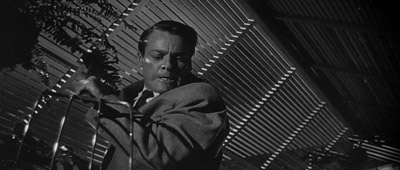
And the pods march on: next: Kaufman, Ferrara, closing thoughts. You're liking the music at least, I hope.
Howard Tate -- Hold Me Tight
Atypical reggae-inflected soul from Howard Tate.
[Howard Tate's Reaction ]
Otis Rush -- My Love Will Never Die (solo take with piano)
This is a slow, somber take, with Rush apparently still trying to figure out whether the song was meant to be a dirge. The occasional laughter in the background, and Rush's own laughter at the end, suggests that maybe it wasn't.
[Mr. Dixon's Workshop]
Otis Rush -- My Love Will Never Die
Otis Rush tries again, giving the song a lurching rhythm, trilling piano, guitar lines that are sinuous and somehow yearning, and banshee-like vocals leaving no doubt about the pain.
[Essential Collection: The Classic Cobra Recordings 1956-1958]
Magic Sam -- My Love Will Never Die
Magic Sam taking an approach very similar to Otis Rush's, ten years after. Sam and Rush were both on Cobra; West Side Soul is one of the classic blues records. (Interestingly enough, Sam used to play with fellow Chicagoan Syl Johnson in the 50s.)
[West Side Soul]
Dallas String Band -- So Tired
I think it might be easy to take this song ironically, but I love it: the washboard, the fretwork, the melody, the harmony, the progression. And the lyrics, at least what I can make out of them: "So tired of crying / so tired of sighing / so tired of being alone" ... "Though we are drifting far apart / My arms are empty but never my heart / So tired of yearning / For your returning / So tired of waiting for you."
[Texas Black Country Dance Music (1927-1935) @ emusic]
Kay Star -- So Tired
Another one you could take ironically, I guess, but I'm not hip enough to do it. I like the song; I hear something in the vocals that's anachronistic; I can't pinpoint it or explain it, but I like it. It's a very sweet song, uncomplicated and sincere.
[Kay Starr: the Best of The Standard Transcriptions @ emusic]
Junior Wells -- So Tired
Very murky sound on this one, no doubt on purpose--it's like the aural equivalent of squelching your way through thick dark muck that keeps trying to eat your shoes. Wonderful song, though, and the blues were meant to be at least a little discontent.
[1957-1966]
Eddie Bo -- I'm So Tired
Gritty early R&B, Bo rolling out piano riffs and howling about love given in vain.
[I Love to Rock 'N' Roll ]
(Ongoing spoiler warning: texts and films, including endings, discussed below.)
Siegel's 1956 filming of The Body Snatchers hews closely to the established text for most of the film: the story still deals with Miles, Becky, Jack, and Theodora (now called "Teddy"); and Miles' friend the pyschiatrist (now called "Danny" rather than "Mannie"). Miles was divorced more recently than in the book (five months rather than five years) and Becky more recently still (the weekend before the start of the story). As in the book, they had dated each other prior to marrying someone else, and, as in the book, they find themselves falling in love again after the divorces. Early in the film, after scattered reports of people feeling that their family members weren't themselves, Miles jokes that he'd hate to wake up and find that Becky wasn't Becky.
"I'm not the high school kid you used to romance," Becky says, "so how could you tell?"
"You really want to know?" he says. Becky does, so he kisses her.
The film has its differences, though, some of them interesting and others less so, and a few just as inconclusive as the differences among the Finney versions. In Siegel's film, Miles' self-doubts are greatly diminished and the concern over neighborhood upkeep almost entirely eliminated; the only mention of anything decrepit is near the beginning as Miles is driving into town from the train station: he nearly runs over Jimmy Grimaldi, the young son of farmers who have recently closed their vegetable stand.
The film follows Miles, Becky, Jack, and Teddy as they begin to suspect that the people claiming the impossible are in fact correct. Halfway through the film, Miles discovers four pods in his greenhouse, splitting open and beginning to look human. Miles urges Jack and Teddy to leave for help, and Becky tries to phone the FBI as Miles tries and fails to dispatch all the pods in the greenhouse. He lingers, pitchfork in hand, over the one turning into Becky, then decides he can't kill it and instead kills the one turning into him.
Outside town, desperate for somewhere to go for help, Miles drives to his receptionist's house, where he overhears some chilling dialogue:
"Baby asleep yet, Sally?"
"Not yet, but she will be soon, and there'll be no more tears."
Hiding in his office with Becky, Miles delivers the director's message:
"In my practice I've seen people who've allowed their humanity to drain away. Only it happened slowly instead of all at once. They didn't seem to mind."
"Just some people, Miles."
"All of us. A little bit. We harden our hearts, grow callous--only when we have to fight to stay human do we realize how precious it is to us, how dear--as you are to me."
 In the morning they see trucks arrive on the plaza and the tarps pulled back, the trucks full of pods. The townspeople collect pods and take them to their cars for distribution. When Jack arrives, their relief is quickly crushed: he's been changed into a pod person; and Danny was one all along. They explain the alien origins of the pods and explain what it's like to be a pod person:
Miles: "I love Becky. Tomorrow will I fell the same?"
Danny shakes his head. "There's no need for love."
"No emotion? Then you have no feelings? Only the instinct to survive. You can't love or be loved, am I right?"
"You say it as if it were terrible; believe me, it isn't. You've been in love before; it didn't last. It never does. Love. Desire. Ambition. Faith. Without them life's so simple, believe me."
And as if one betrayal were not enough, there's the climax of the film: Miles and Becky, exhausted, on the run from the entire town, just like in the book. Except they hide in a tunnel under some slats, rather than under some brush in the fields, and Miles leaves Becky to investigate some beautiful music which Becky says must mean that someone still knows what love is. When he returns he finds Becky in a different location; she's too tired to walk so Miles picks her up and begins to walk out of the tunnel. He trips and they fall into a mud puddle, where they kiss, and Siegel springs a surprise on a 1950s audience familiar with the source material: Becky looks up at Miles exceptionally coolly; Miles pulls away, face registering alarm and disgust. She's been changed. She tells him it's not painful, and he should quit resisting; then as he flees she shouts at the others that he's there.
They let him go to the highway, where he is taken for a drunk or a maniac; he finds the back of a semi loaded with pods and then, on the street, continues to shout his warnings into the camera: "They're coming! You're next!"
And there it would have ended, except that the film tested poorly and the studio forced a change. So Siegel shot a pair of tacky bookends: starting the film with a psychiatrist arriving at a hospital to find Miles panicked and unconvincing; and ending the film with the psychiatrist leaving the room and encountering a truck driver being pushed in on a gurney, with a broken arm and two broken legs. The psychiatrist is informed that the man ran a red light and crashed into a bus, tipping his truck over and spilling a cargo of large and unusual things that look like seed pods. So he goes to the phone, where he shouts at the operator to get him the FBI right away, and yes it's an emergency. And there the film ends.
It's a strange ending for a number of reasons. Generally it's accepted as an inferior ending to the one Siegel intended, which was to leave Miles looking like a stark raving lunatic on the freeway. The new ending might be considered a challenge to the auteur theory in that the studio forced Siegel to add it, against Siegel's wishes. Yet it's also somewhat appropriate in that the new ending hews more closely to the ending to the serial originally optioned: invoking the federal government to come solve local problems with national implications. And yet it's also a sly ending, a subtly suversive ending, on Siegel's part: the pyschiatrist believes Miles and calls for help. "Excellent," we think. "The day is saved." Except we see "The End" before we hear what happens next, and so it's easy to forget that Miles also tried to call for help, and that he could not get through because the pod people already controlled the phone system.
Besides, I'm not sure how many people the new ending relly convinced: I saw the film as a child and didn't see it for a decade afterwards; what I remembered of it was not the call to the FBI but Danny's betrayal and the unveiling of the truck loaded with pods.
In some ways Siegel's The Invasion of the Body Snatchers reminds me of Howard Hawk's The Thing: both deal with an alien invasion of murderous perambulatory plant matter; but The Thing has no patience for the federal government or the visitor, and The Invasion of the Body Snatchers takes a more patient, cautious, watchful stance. There's probably fertile soil there for someone willing to argue that the two films are the Rio Bravo and High Noon of science fiction.
It's common to put Finney's novel and Siegel's film into a Cold War context, and Glen M. Johnson does it as well as anyone. A bit from "'We'd Fight .... We Had to': The Body Snatchers as Novel and Film":
Finney complicates the simplistic them-vs-us forumula by making his invaders invisible--a force or consciousness that conquers by taking over the minds and personalities of ordinary people. So the "body" snatchers become apt symbols for ideological subversion, fear of which was a characterisitc form of anxiety in the American fifties.Johnson, like many authors discussing the story's Cold War origins, mentions brainwashing: "it is suggestive that The Body Snatchers is set in August 1953, immediately after the Korean armistice, when American newspapers were full of incredulous reports about the 'turncoats' who chose Communism over a return home."
At the time of the stories' publication, HUAC's investigation into Communist propaganda in Hollywood, followed by its blacklist of the Hollywood Ten in 1947, was not yet ten years past. Joe McCarthy had spent several years in Congress making rabid declamations against suspected communists as chair of the Subcommittee on Investigations, and only in late 1954, after several years of bellicose and frequently baseless accusations, had he netted a formal censure in the Senate. It's easy to imagine that the alien invasion in the body snatchers stories serves as a metaphor for Cold War anxieties--either as a fear of communism or as a fear of McCarthyism. If there's one thing central to U.S. belief it's rugged individualism, and both sides were no doubt feeling an overwhelming pressure to conform. So it's somewhat common that the series of betrayals in the story, executed by family and friends, reminds people (ironically or not) of J. Edgar Hoover's sensationalist warning in Masters of Deceit that "there are thousands of people in this country now working in secret to make it happen here." Furthermore, it's easy to view the sleep metaphor as freighted with political baggage, especially given the "sleep no more" propaganda common during the Cold War.
Yet as J. Hoberman notes in "Paranoia and the Pods,"
Sorting out the politics of the men who filmed Invasion of the Body Snatchers is not easy. Siegel has described himself as a liberal, although his ouevre is more suggestive of a libertarian belief in rugged individualism. Wanger, a producer with an interest in topically political material, was responsible for both the crypto-fascist Gabriel over the White House (1933) and the prematurely anti-fascist Blockade (1938) as well as for such New Dealish genre exercises as You Only Live Once, Stagecoach, and Foreign Correspondent.Hoberman goes on to note that Mainwaring, the film's screenwriter, had written the "relentlessly perfunctory" anti-communist film A Bullet for Joey and that Invasion of the Body Snatchers' script was rewritten by Richard Collins, "a former Communist Party functionary, co-author of the once notorious Song of Russia (1943), [and] an announced unfriendly witness first subpoenaed by the House Un-American Activities Committee in autumn 1947 among the original Hollywood Nineteen" who later turned witness for the FBI. So the film might be read as an anti-Communist fable, or as a satire of McCarthyism, or simply as a richly metaphorical work authored by a number of men with strikingly different philosophies.
Siegel, for his part, seems content to think of the film as about conformity in general: "It's the same as people who wlecome going into the army or prison. There's regimentation, a lack of having to make up your own mind, face decisions.... People are becoming vegetables. I don't know what the answer is, except an awareness of it. That's what makes a picture like Invasion of the Body Snatchers so important." (Parkes, "There Will Be No Survivors")
And Finney denies all of these interpretations, both here and elsewhere:
For years now, I've been amused by the fairly widely held notion that The Body Snatchers has anything to do with the cold war, McCarthyism, conformity... It does not. I was simply intrigued by the notion of a lot of people insisting that their friends and relatives were impostors.
--"Paranoia and the Pods," Sight and Sound May 1994, p.31
I have read explanations of the "meaning" of this story, which amuse me, because there is no meaning at all; it was just a story meant to entertain, and with no more meaning than that. The first movie version of the book followed the book with great faithfulness, except for the foolish ending; and I've always been amused by the contentions of people connected with the picture that they had a message of some sort in mind. If so, it's a lot more than I ever did, and since they followed my story very closely, it's hard to see how this message crept in. And when the message has been defined, it has always seemed a little simple-minded to me. The idea of writing a whole book in order to say that it's not really a good thing for us all to be alike, and that individuality is a good thing, makes me laugh.So the question is, then, whether the author is the final word on what a text means. I think the author often has a good idea of what he intended, except that even he might not realize all of the intentions and subtleties: I'm reminded of Ray Bradbury's comment in the afterword for Fahrenheit 451 that for decades he didn't notice that Faber was the name of a pencil company and that Montag was the name of a paper company.
--personal letter to Stephen King, December 24, 1979, as cited in Danse Macabre, 1983 Berkeley paperback, p. 306-307
And, too, it's obvious that the reader (or viewer) must understand, process, and interpret the parts of a story for it to have any meaning. Those interpretations are necessarily personal affairs, at times idiosyncratic or conflicted but always dependent on associations with existing knowledge. Is the story about communism? McCarthyism? The Red Scare? The case for each of those could be made, sure, and frequently is. Art is largely an interpretive matter and almost never yields as unequivocal results as math. And should it?
Labels: blues, body snatchers, country blues, horror, movies, RnB, vocal
posted by Tuwa @
21:14 | permalink |
5 comments
|
body snatchers mix, part 3
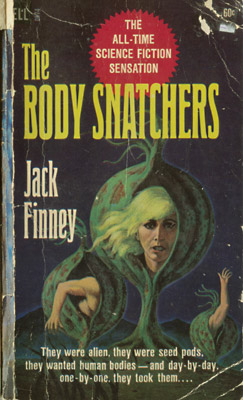
Some more songs tangentially related to the Body Snatchers stories, and more about the stories (with spoilers) below that:
Jimmy Bo Horne -- Get Happy
There's something here that reminds me of much of George McCrae's work, probably in the simple composition and the repetition, but also in the reliance on a sweet hook and an energetic horn section in a poppy R&B track with high-flying vocals. Another happy song, appropriately enough.
[The Legendary Henry Stone Presents: Jimmy Bo Horne @ emusic or @ amazon]
Shirley Bassey -- Hey Big Spender (Wild Oscar mix)
Bassey likes to make these big brassy music numbers that go well with Bond films (Goldfinger, Moonraker, Diamonds are Forever) and that get a deft parody in The Life of Brian ("He had arms ... and legs ... and hands ... and feet / This boy whose name was Brian"). The remix here decides that brassy isn't brassy enough, and so kicks it up a notch: adding breakneck percussion, muted guitar, vocal effects, and tempo changes.
[Shirley Bassey - The Greatest Hits]
J.J. Cale -- Call the Doctor
Countrified blues-rock, subdued delivery, plodding bass, sour horns, and electric guitar swelling into a stoned melancholy solo. The description sounds horrible but Cale pulls it off somehow.
[Naturally]
Eddie Floyd -- Bring It on Home To Me
Easy-going R&B, not pining, not pleading, not arguing a case so much as pointing out what a good time you could be having--hoping you'll come to your senses and come join in.
[Eddie Floyd - Chronicle: Greatest Hits]
Lou Rawls -- Bring It on Home
Nevermind the showboating at the beginning; give the song a minute (actually, 45 seconds). Let the bass come in and the funk get dropped; let Lou gather his evidence and practice his line of argument. It's a smooth-talking dapper performance, pitch-perfect and with just enough edge on it to let you know he's serious, but not so serious as to keep the jurors from clapping.
[Anthology]
Jack Finney has published at least three different versions of Body Snatchers: first as serialized in Collier's in November and December 1954, then as a book in 1955 (expanded and given a different climax) and then with further edits in 1978 to coincide with Philip Kaufman's second film version of the story.
The three have strong similarities, as could be expected. The text versions take place in Santa Mira, a small town outside San Francisco, and feature a doctor named Miles Bennell, a former flame named Becky Driscoll, a psychologist friend named Mannie Kaufman, a writer friend named Jack Belicec, and his wife Theodora. At the start of the story, Becky approaches Miles and tells him of her cousin Wilma who's become convinced that her Uncle Ira is not actually Uncle Ira; when they visit Wilma, she explains that her aunt hasn't noticed because she is also not her aunt. From there the details accrue suggesting that the humans are being besieged by aliens intent on replacing them, and the small group of humans decide to fight.
Along the way Becky and Miles, both divorced, find themselves increasingly attracted to each other. Becky has divorced recently and Miles five years earlier, yet Miles continues to be bothered by his divorce, taking it as a sign of some shameful defeat. There are scattered mentions throughout the novel, most of them wry, and others which seem either self-deluding or callous and sexist:
I'd seen Becky at least every other night all the past week, but not because there was any romance building up between us. It was just better than hanging around the pool hall, playing solitaire, or collecting stamps. She was a pleasant, comfortable way of spending some evenings, nothing more, and that suited me fine.Then there's this more telling passage as Miles is shaving:
--Body Snatchers, '55, p. 24
'You handsome bastard,' I said to my face. 'You can marry them, all right; you just can't stay married, that's your trouble. You are weak. Emotionally unstable. Basically insecure. A latent thumb-sucker. A cesspool of immaturity, unfit for adult responsibility." ... I cut it out, and finished shaving with the uncomfortable feeling that for all I knew it wasn't funny but true, that having failed with one woman, I was getting too involved with another, and that for my sake and hers, she should be anywhere but here under my roof.Both the paperback versions share Miles' self-doubt following his divorce, his penchant for prescribing sedatives, his passive wait-and-see attitude in the face of an obviously mounting crisis, and the curious marker of the body-snatched: an indifference to neighborhood upkeep. A visiting salesman complains that it's hard to get into and out of the town; coffee is hard to come by and tastes bad when a restaurant has it; and Miles notes that his Coca-Cola is warm. And outside the restaurant, on a littered street:
--Body Snatchers, '55, p.76
"Miles," she said in a cautious, lowered tone, "am I imagining it, or does this street look--dead?"Of the three versions, the Collier's version is probably the hardest to find: so far as I know it was never collected and published separately without changes, and it doesn't seem to be available in various academic databases, so finding it most likely requires access to the original magazines. I haven't read this version but I have the other two, and they're fairly similar. One of the more striking differences between the two novels happens early on when Miles mentions his car: "I drive a '52 Ford convertible, one of those fancy green ones, because I don't know of any law absolutely requiring a doctor to drive a small black coupé." (Finney '55, p. 13)
I shook my head. "No. In seven blocks we haven't passed a single house with as much as the trim being repainted; not a roof, porch, or even a cracked window being repaired; not a tree, shrub, or a blade of grass being planted, or even trimmed. Nothing's happening, Becky, nobody's doing anything. And they haven't for days, maybe weeks."
--Body Snatchers '55, p. 108
So early on Miles seems like a big spender, maybe a bit arrogant, maybe living a lavish lifestyle, with no time for Becky. In the 1978 version the passage is changed: "I drive a 1973 Mercedes two-seater, a nice fire-engine red job, bought used, to maintain the popular illusion that all doctors are rich." (Finney '78, p. 13)
Yet most of the differences between the two versions are subtle, perhaps inconsequential--instead of golf and swimming, Miles plays tennis, things like that. (In fact, the two versions seem so similar that the cynic in me suggests that the 1978 revisions were published simply to allow an extension on the copyright--copyright terms at the time were much more limited and the one on Body Snatchers had nearly run out.)
In the two novel versions Miles, Becky, Jack, and Theodora are increasingly persecuted, then flee town only to find that they don't know where to go or what to do. So they return to town, where they are split up. Becky and Miles hide in a field just outside town--the field where, it turns out, a professor had discovered what he thought was most likely an alien plant, and then a few days later retracted his story. It is here where the aliens are growing their pods for distribution, and Miles and Becky make a desperate last stand, setting fire to the fields and smashing pods. The aliens recognize their defeat and the pods detach from the plants, fly up off the ground, and leave the planet. Miles and Becky reunite with Jack and Theodora and discover that the aliens have a curiously short lifespan; most of them die off within a few years.
The serial version is apparently much different: Robert Shelton in "Genre and Closure in the Seven Versions of Invasion of the Body Snatchers" mentions that the 1955 Dell paperback "is based on, and twice the length of, the serial" and that "in the 1954 serial, a posse of FBI agents armed with 'riot guns' and 'small, light, almost dainty-looking machine guns'" arrives on site, attracted by Miles' fire, and helps fend off the alien invasion.
What does it mean that the endings are so different? What point was Finney trying to make, or deciding not to make? Catherine Jurca, in "Of Satire and Sofas," calls the novel "an allegory of postwar suburbanisation," yet the article is too brief to offer much supporting evidence and it's left to the reader to remember the United States' postwar population boom and the move from the cities to the suburbs.
Michael Parkes, in "There Will Be No Survivors," takes the novel as a metaphor for a different kind of encroaching conformity, and the pods as representing a different threat to identity: the introduction of television into American culture. Parkes notes that "between 1948 and 1955, television was installed in nearly two-thirds of the nation's homes and became the mythic and ideological unifier of the fragmented post-war family" and served "as a sign of suburban achievement," yet one that moved the family away from the hearth and conversation to the television and silent viewing. Parkes notes the effect of television on bars and cafes, as well, and its corollary to the cafe scene in the novel when Miles and Becky go to the Sky Terrace in the Siegel film to find few customers and no live music, but instead a jukebox: "the artistry and individuality of the original band has been 'snatched' and replaced by an inferior technological substitute." In this reading, Parkes considers the story's message somewhat ironic, calling it "an anti-media discourse which in itself is contradictory, as the film [and book] itself exists within the media."
This interpretation of the book as an anti-media, Luddite response to technological innovation is interesting; yet by far the most common reading of the story is as a metaphor for the political climate in the United States during the Cold War--whether as one about McCarthyism or as one about the Red Scare. More on that, and on Finney's and Siegel's reactions to it, next post.
Labels: about fiction, body snatchers, country blues, horror, RnB, vocal
posted by Tuwa @
21:41 | permalink |
1 comments
|
body snatchers mix, part 2
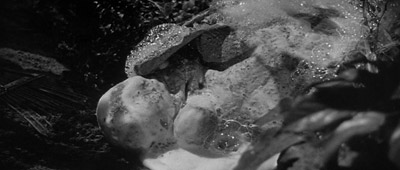
I guess I should have explained a bit more about the mix last time: most of the songs are tangentially related to the Body Snatchers stories at best, and the mix isn't limited to what could fit on a CD (mostly because I'm not one to make tough decisions). Along the way we'll see some songs with a passing resemblance and others that are different from how we remembered them.
Betty Everett and Jerry Butler -- Love Is Strange
I've written about Betty Everett twice before. This one is one of the better tracks off Together--sweet lyrics and a sweet duo, but what sells it for me is when each of them take it solo towards the end. And then I'm completely sold, yes.
(As for the rest of the LP ... no. It's mostly middling, with tracks that tend to stop at competent without making it to genuinely affecting, and I'm not surprised it's gone out of print. I can't speak for the CD linked below, though--haven't heard it and it's awfully pricey for me to pick up.)
[They're Delicious Together]
Little Milton -- If You Love Me
If guitars were animals, PETA would stage a protest about this song.
[Anthology 1953-1961 ]
Little Johnny Taylor -- If You Love Me (Like You Say)
Keeping with the Chicago blues, the horns, the electric guitars, and the general theme--this one has a smoother melody on the vocals, less grit on the delivery, more syncopation on the horns, and an organ buried in the mix.
[Greatest Hits]
Muddy Waters -- I Feel So Good
Blues piano with a harmonica and a drumset rocking the joint, letting the public know that feeling good can be contagious.
[At Newport]
Ann Peebles -- Slipped, Tripped, and Fell in Love
Three great things about this song: the bass, the organ, the background vocals. The first one runs throughout; the next two stop in for tea and leave right after. You'd consider it rude, except now you're friends and you just hope they can stay longer next time.
[The Best of Ann Peebles: The Hi Records Years]
Dreaming permits each and every one of us to be quietly and safely insane every night of our lives.
--William Dement of the Stanford University Sleep Research Centre, Newsweek, November 30 1959
A bare-bones plot description of the Body Snatchers stories (all of them): residents of a community come to suspect that certain loved ones are not themselves, but are perfect physical replicas without any genuine emotional responses. They discover that people are in fact being destroyed and replaced by impostors hatched from alien pods, one by one, as each one of them sleeps. A small group of people decide to fight the aliens, and at least two of them are in love.
From there the details differ--in the characters, locations, resolution, and treatment of themes, with implications about each story's beliefs. But fundamentally the story is about love and vulnerability and the loss of individuality. It's about being human and getting tired and needing to sleep. We're no more vulnerable than when we sleep, as Wes Craven knows, but Finney didn't create a sardonic villain to dispense gory deaths; instead he poses the more psychological question: who will we be when we wake up?
It seems a silly question, easy to laugh off, yet sleeping itself is somewhat troublesome. "We all go a little mad sometimes," sure. We might go a bit unhinged on hearing some devastating news, but that's not all, is it? It's a truism that no one wants to hear about anyone else's dreams, and probably even psychiatrists are faking it, but what are these things? Our brain tells us the earth is a swamp and that people drive Yugos over fallen mossy trees past dully interested brontosauri, and then we get up in the morning and yawn and stretch and go make tea or cofee. Our brain sorts out the desk and dusts the bookshelves and dumps the dreams in the trash. We go around with this tacit agreement that dreams are mostly meaningless, yet the brain keeps making them; and we go to bed knowing that we'll go a bit insane but that it's no big deal, really, that in the morning breakfast and a shower will set us right again. And it does.
Yet in the Body Snatchers stories, sleep doesn't make people temporarily insane; it makes them perfectly and utterly sane, endlessly and coldly logical. It destroys the identity in a more permanent way; falling asleep leads to being replaced by an alien being who has all the same memories but none of the emotion. The consciousness is transfered to another body, the humanity left behind somewhere in the gray fluff, to be swept away and thrown in the trash.
The stories feature alien characters encouraging humans to quit struggling, to give up and accept their fate. It's a conversation that enhances the horror and the sense of betrayal: former friends have changed--changed horribly--and don't mind at all; in fact they want us to join them. Given that humans are fond of thinking that emotions are distinctly human (a dodgy proposition given the evidence that dogs, primates, and countless other mammals show grief, insecurity, jealousy, and indignation), the stories can also be read as an exploration of the fear of evolution. The pods are much more efficient at reproducing than humans are, and they seem to get along much better; and in each version of the story the chances of human survival begin to look slim. Perhaps each story is asking if it's not merely an accident that humans have reigned so long, and if we truly deserve our self-proclaimed perch at the top. If so, it's no surprise that the stories have proved enduringly horrifying.
Labels: about fiction, blues, body snatchers, horror, movies, RnB
posted by Tuwa @
21:59 | permalink |
4 comments
|
body snatchers mix, part 1
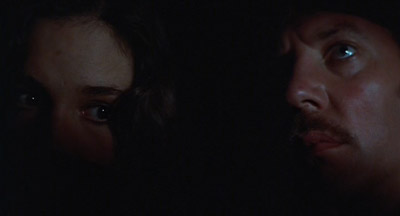
So I've made a Body Snatchers mix which I'll be posting over the next week and a half or so.
Harold Melvin & The Blue Notes -- Wake Up Everybody
Philly soul wearing its heart on its sleeve, confident in its sincerity and optimism and urging positive change. Sing it, Teddy.
The Beatles -- I'm Looking Through You (alt version)
This one is probably one of the most thematically related to the Body Snatchers stories, though written for quite different reasons: "I'm looking through you / where did you go? / I thought I knew you / What did I know? / You don't look different but you have changed / I'm looking through you; you're not the same." It's the alt take off Anthology 2, naturally enough, and it says something for the general quality of the Beatles' work that for most bands this version would have been a perfectly acceptable release.
Sam Roberts -- Paranoia
Radio-friendly pop-rock, the kind of track I wouldn't usually post, but there's something about this one that keeps bringing me back to it. Maybe it's the ooooooohs.
[If You Don't Know Me by Now: The Best of Harold Melvin & the Blue Notes ]
[Anthology 2]
[We Were Born in a Flame]
A brief philosophy of horror fiction: horror is deliberately transgressive and cheerfully untactful; it's not interested in chitchat about the weather, instead it wants to talk (metaphorically, or literally) about taboos. A good horror writer is like a tough-love psychiatrist, finding our most vulnerable spots and prodding them; the horror story is like Ingmar Bergman with optional religious iconography, yet it has no pre-defined point of view and no social obligations beyond investigating and reporting. It may or may not advocate social revolution and may even be reactionary--Night of the Living Dead is not advocating cannibalism; Frankenstein would be a poor witness for science--but it's speculative fiction and it must address taboos, regardless of whether doing so will shock any of the audience.
It's probably an oversimplification to say that horror fiction is about death, since there are some perfectly horrifying horror stories in which no one dies and since, in any case, death is the result of vulnerability. Yet "vulnerability" covers a lot of ground: it's a theme common to the shower scene, being lost in the woods, being chased by a plane, and having an eyeball sliced with a razor.
Of all the kinds of vulnerability, there are a number of horror films about a threat to current identity, about the threat of continuing life in a radically different form: films as diverse as Dracula, The Howling, and Night of the Living Dead; The Fly, The Thing, and The Exorcist; Misery, Rosemary's Baby, and The Invasion of the Body Snatchers.
The ghost, vampire, werewolf, and zombie films have centuries of legends behind them and have the most variants as a result, but Invasion of the Body Snatchers gives a fair showing considering its relative youth. The story was first serialized in Collier's in late 1954 under the title Body Snatchers; Jack Finney expanded it and rewrote the ending for publication as a novel in 1955, and the book was republished with more trivial changes in 1978. As of 2006 the story has had three authorized film versions (with four different endings among them); a fourth film version was finished in October 2006 but was rewritten so much after the novel was optioned that the producers decided it was not actually a version of Finney's work.
All these stories--the body snatchers and the rest--are fertile soil for a writer (any writer, including satirists like Terry Pratchett and the Futurama crew) and are firmly a part of the culture. But what do they mean as cultural artefacts? What do they say about the environment they were made in; what kinds of changes did people fear, and what cultural and historical backgrounds help explain those fears?
I doubt I'll find the answer to all of these questions, but in exploring them I can at least see what other questions crop up along the way. So. The start of the Body Snatchers mix. More later on Finney's three versions, Siegel's two versions, Kaufman's 1978 film, and Ferrara's 1993 film.
Labels: about fiction, body snatchers, horror, movies, RnB, rock
posted by Tuwa @
15:52 | permalink |
0 comments
|
Betty Everett -- I Can't Hear You
Betty Everett -- I Can't Hear YouLike a number of R&B singers, Betty Everett grew up in the church and left it for secular music, though she'd return to gospel several times over her career. Unlike a number of R&B singers, Everett can convincingly carry a blues tune and got her start thanks to Magic Sam inviting her onstage to sing at a club. Everett started out on Cobra (where Magic Sam and Otis Rush were); after Cobra closed shop she worked for Carl Jones and then made her way to Vee Jay.
At Vee Jay she cut a version of Clint Ballad Jr.'s "You're No Good" with background vocals from The Dells. The track charted, stopping at #51. Her biggest hit followed shortly after--"The Shoop Shoop Song (It's in His Kiss)," one of those omnipresent tracks nearly everyone is familiar with even if they don't know its name. She also had hits with "There'll Come a Time" and "Let It Be Me," a duet with Jerry Butler; though she's not a household name, it's hard to equate being a household name with having a solid catalog as a musician.
"I Can't Hear You" is a driving uptempo track with horn stabs and handclaps, Everett's patience lost and her telling a man what's what.
[This track is off The Shoop Shoop Song (It's in His Kiss), which seems to be out of print. A similar (and similarly regarded) best-of comp with the track is Best of Betty Everett: Let It Be Me.]
Labels: RnB
posted by Tuwa @
12:43 | permalink |
4 comments
|
IODA , usability, habeas corpus
Roscoe Shelton -- Worry (1962) (MP3, 192kbps. Left-cllick download.)Allmusic.com tells me that Roscoe Shelton was in the Fairfield Four before joining the spinoff The Skylarks. I'd never heard of The Skylarks, though I'd heard of the Fairfield Four--I saw three of them in O Brother, Where Art Thou? (a Coen brothers joke, since there are five members in the group. Speaking of, the Radio Four also have five members. Is that some peculiar counting system specific to gospel groups?)
I can't help thinking The Skylarks were probably misnamed; Roscoe Shelton's voice, at least, is a trained falcon, snatching notes from the underbrush and soaring away until it's a speck in the sky.
Bloody writhing metaphors aside, this is a very nice soul track that I'm glad to be introduced to.
[Remember Me Baby @ iTunes]
[Remember Me Baby @ eMusic]
The African Brothers -- Practice what you preach (MP3, 192kbps. Left-cllick download.)
Righteous political reggae taking some preachers to task for being hypocrites and leading children astray. Can I hear "amen."
[Want Some Freedom @ iTunes]
[Want Some Freedom @ eMusic]
Embee -- Send Someone Away (feat. José Gonzáles) (MP3, 192kbps. Left-cllick download.)
Embee is the Tin Man and José González is the heart. The producer is the Wizard, one of the few who can magic warmth into electronica.
[EP @ iTunes]
Pierre Ardene -- Cristalina (MP3, 192kbps. Left-cllick download.)
This track has such a warm and effortlessly welcoming feel to it that it puts me in mind of an infinitely generous host with a cozy house, the kind of place that in your weaker moments you might wish you lived. But you know it's absurd; you can't overstay your welcome, so you just thank the host, and mean it, and go on your way.
[Casa de Praia @ iTunes]
[Casa de Praia @ eMusic]
These four are all from IODA/Promonet, the site I mentioned a couple of months ago that lets mp3bloggers poke through their catalogue for tracks to post.
I'm not getting kickbacks (or getting paid for anything I'm doing here); I just like the service more than most of the PR firms that send me tracks. For starters, I get to pick the tracks, rather than having them foisted upon me (most of the ones I get sent are ones I'd never have any interest in posting), and the site's interface is good: the embedded Flash players give a brief sample so you don't have to download an entire track just to find out if you like it.
Speaking of usability, I reworked this site's HTML and CSS recently so that the main column appears before the sidebar in the source but the visual layout is the same. The result should be that the posts appear before the sidebar on PDAs and cellphones, as well as in Lynx and text-to-speech browsers. I've also tried to simplify the site's CSS for handhelds but I notice that Google's and MSN's mobile proxy both serve up the images that the stylesheet instructs it to strip. I'm still trying to figure out why it's done that; I think I have an idea but don't know how to get around it.
I'm still debating whether to strip the sidebar altogether from the information sent to handhelds; if you have one and use it to access the site, I'd love your feedback on it. I probably wouldn't use all my fingers counting the number of times I've used a cell phone, but I'm interested in making the content as accessible as possible.
Even if you don't use a PDA or cellphone to access the site, if you've noticed any bugs in the layout or behavior, or if you have any other suggestions, please send them along.
And now for some politics. Keith Olberman on The Military Commissions Act and the death of habeas corpus. And again. The reaction to this law among the general population seems to have been a protracted yawn, and I can't imagine why. The points in brief: Congress has decided, and Bush has agreed, that people can be thrown into jail, without ever facing charges, and with no legal right to challenge their jailing. Since this new law states that people in jail under the law have no right to challenge their jailing in court, there is also arguably no standing to challenge the law's Constitutionality. Yet the new law goes against our entire history of legal precedent and also is blatantly un-Constitutional since it destroys the balance of power set forth in the Constitution, exceeding the legislative authority and the Presidential authority both also set forth in the Contstitution. It's a stupid, dangerous, reprehensible law, the kind of thing that absolutely must go before the Supreme Court anyway and be defeated.
End rant, climbing off the soapbox.
Labels: electronica, politics, PR, reggae, RnB, world pop
posted by Tuwa @
01:36 | permalink |
0 comments
|
Shuggie Otis -- Aht Uh Mi Hed
Shuggie Otis -- Aht Uh Mi HedIn college I was roommates with someone named Shuggie, a tall muscular man with a moustache and an afro. He said the nickname came from "Sugar," itself a reference to his boxing in high school; apparently he could knock the shit out of somebody. He spent most of his spare time running and at the gym, though I don't know how he had any spare time; he was double majoring in physics and electrical engineering. I spent most of my spare time reading or playing guitar on the plaza; I was majoring in English. I doubt it was as demanding as any of the sciences.
We didn't have a lot in common except for a love of dark comedies; the day The Big Lebowski came out on DVD we'd both bought it. We smoked a sack together watching it; it was safe to say we were friends after that.
He didn't talk about boxing much, though one of my friends downstairs said he still used the punching bag at the gym. Shuggie's conversations always seemed to be about physics or music. In music, he'd get excited talking about ways to mix psychedelia, soul, funk, blues, and jazz. He didn't play anything, though, or at least I didn't think he did, and there weren't yet any good programs for making mashups. I guess it was just the concept that blew his mind so much; I had a cheap 4-track and I tried to get some of his ideas to work but couldn't.
One day I came back from class to find him playing my guitar. We'd been roommates for about three months. He wasn't bad; I wanted to hear more, but he was embarrassed and just apologized and put the guitar away. I didn't press the issue. I don't know how long he'd been playing; if it was only a few months then he learned faster than anyone I'd met. I meant to ask him about it again but I never did.
One night he started talking about the nature of space and time and how a planet's gravity warps the time around it like a ball bearing on rubber sheets. I didn't understand him, but when Shuggie was talking about physics I rarely did. Maybe it was the same for him when I talked about transcendentalist yearnings in pop fiction. I guess he got tired of the conversation; at any rate, he went to his desk and started writing something; and when his CD was done I put on a Charlie Mingus LP. I lay there stoned, listening to the bassline, and dozed off; when I woke up he was soldering some wires to a circuit board. It put an acrid smell in the room but it seemed oddly pleasant.
Over the next few days he set the circuit board into a big metallic box he'd assembled with wires running off in all directions. I was curious about it and he answered my questions, but they were the kind of answers that were highly technical and--to me, at least--unsatisfactory. I decided he probably didn't want me to know, so I'd just leave him alone about it. After all, he wasn't asking me about the non vidi citations in my paper on systemic inhumanity in Catch-22.
The week before Thanksgiving, he asked what I would do if I could go back in time but only about thirty years.
"Why only thirty?" I said.
"Suppose you'd got just enough energy for it."
"What do you mean? Like you had a nine-volt but it took a car battery?"
"Something like that," he said, in the kind of voice he used sometimes when I was trying to keep up but failing.
"I don't know." On TV, The Dude was dancing down a flight of black and white stairs and teaching Maude how to bowl. "I guess I'd try to prevent Martin Luther King from being assassinated."
"You think you could do all that?"
"Maybe. I don't know. Probably not. What would you do?."
"Probably just go to college."
"Well, don't go to Kent State."
He laughed ruefully. "No. And I'd burn my draft card."
"Yeah," I said. "I need another hit"
"We smoked it all."
I prodded the pizza box. "And the pizza is gone."
In the morning Shuggie was gone too. He left all his stuff but he took my guitar. I called his parents two days later to ask if he'd gone home early. They said he hadn't. When he still hadn't come back by the end of the week they showed up in town and the police came around to ask some questions. I didn't mind; I could understand how they felt. At the end of the semester his parents came back to collect his stuff. They seemed dazed but polite. A couple of semesters later we fell out of contact. I don't know what happened to him; you'd think he'd have finished the degree and taken a job teaching physics. Maybe he decided to be a boxer instead.
[Inspiration Information @ amazon.com]
[Inspiration Information @ emusic.com]
None of this post is true, but Inspiration Information is ahead of its time.
Labels: is fiction, RnB
posted by Tuwa @
02:31 | permalink |
8 comments
|
Bettye Swann -- Don't You Ever Get Tired (Of Hurting Me)
Bettye Swann -- Don't You Ever Get Tired (Of Hurting Me)I just saw Battle Royale and I think I can safely say that I don't get it. It's a film in which a classroom of students is gassed and brought to an island, collared with explosive devices, given food and weapons with which to kill each other. The students are warned that trying to remove the collars will cause them to explode, and warned also that the contest will last only three days: if more than one student survies by the end of it, every collar will detonate.
The story strikes me as "The Most Dangerous Game" crossed with Lord of the Flies, but unfortunately it has none of the brevity of the former or the mounting dread of the latter. It has a real visual audacity; and the plot is superficially transgressive but deeply flawed. The scenes range from suspenseful to predictable to downright silly; and the film, in spending so long on gore and spectacle, hints at an intellectual emptiness: a blood-soaked impaling commands the attention, yes, but the more troubling premise is not how to survive, but what to do with yourself after.
The film probably makes most sense when seen as part of a dystopian sci-fi/action tradition, but it doesn't have the satisfying conclusion of either Death Race 3000 or the more recent District B13, in which citizens put through their paces for the gratification of a corrupt government manage through pluck, cleverness, or sheer cussedness to bring that part of the government to its knees. No, these citizens manage to kill their most immediate tormentor and then escape, leaving the system itself intact. It's a callous film not just because of the body count but also because of the inherent selfishness of the conclusion, which considers atavism a briefly shameful memory rather than an ongoing threat and which posits that escape in itself constitutes a happy ending. The characters indicate in dialogue that they just want to sweep the last few days under the rug; and if polite company doesn't talk about barbarism, maybe it should. At least Lord of the Flies was sensible enough to posit paranoia and destruction of community as a tragedy.
Director Kinji Fukasaku was diagnosed with prostate cancer shortly before his last film, a sequel to this one which is generally held in poor regard. He refused treatment so that he could make the sequel, and he died shortly thereafter. I like to imagine the sequel is one in which the surviving contestants spend the entire time in painful unfolding self-realization: a Bergmanesque sequel to a Bruckheimer original.
[Bettye Swann @ amazon.com]
[Battle Royale @ imdb.com]
...
A half-ton of awesome clips at Youtube. Mississippi John Hurt, Howlin' Wolf, Professor Longhair, Muddy Waters, Sister Rosetta Tharpe.... Amazing.
...
15 ways to get more out of Pandora Music.
...
Chavez shows a talent for hyperbole, calls Bush "The Devil." If anything, he's more like a shit demon.
posted by Tuwa @
12:28 | permalink |
0 comments
|
Lee Dorsey -- Confusion
Lee Dorsey -- ConfusionHere's an energetic track about love and confusion--having your world turned upside down and shaken until everything falls out.
According to wikipedia, Lee Dorsey's highest-charting tracks were "Ya Ya," "Working In The Coal Mine," "Holy Cow," "Ride Your Pony," and "Do-Re-Mi," which leaves me wondering what happend to "Night People," "Draining," and "Yes We Can" (yes we can, I know we can, yes we can can).
According to the liner notes of All Ways Funky, Lee Dorsey worked in an auto shop and went out and cut some records whenever the pay was good and he had the time and inclination. And according to Dorsey, usually others would work out the track's instrumentation and arrangement; he would just go in and provide the vocals, occasionally suggesting changes on the rest. It's a disarming admission that he saw himself as nothing more than a hired gun; if it's true, maybe it points to the influence (read: brilliance) of Allen Toussaint that most of Dorsey's work is so good and has aged so well.
Aside from Toussaint, another frequent collaborator (director?) was The Meters. This track has Toussaint but not The Meters--that's Allen Toussaint on piano (but you knew that as soon as you heard it, didn't you?), Frank Trepanier on trumpet, Wendell Eugene on trombone, Nat Perilliat on tenor sax, Carl Blouin on baritone sax, Walter Peyton on bass, and June Gardner on drums. There's some doubt (confusion) about who it is on guitar--Roy Montrell, or maybe Vincent Toussaint, or maybe John Moore.
All Ways Funky is out of print; the track is originally from New Lee Dorsey, which allmusic.com considers to have two great tracks and the rest just good; it's also on Wheelin' and Dealin', a greatest hits collection that allmusic.com has higher regard for.
...
"Funtwo" with Pachelbel's "Canon in D maj". The New York Times looks into it, finds his identity (Jeong-Hyun Lim, from Seoul); NPR covers it, helpfully pointing out the obvious (he plays tastefully & with great skill), then saves the piece with a mention of a man playing a twelve-string guitar with a spoon for a slide. Now this is amazing, and it's also a good tune. As for the man's identity, Beware of the Blog says his name is Hannes Coetzee and the clip is from Karoo Kitaar Blues, which IMDb doesn't know about and which seems to sell for $295, a price guaranteeing that the film will remain obscure.
Labels: RnB
posted by Tuwa @
23:23 | permalink |
3 comments
|
Brook Benton -- Singing the Blues

Brook Benton -- Chains of Love
Brook Benton -- Got You on My Mind
Brook Benton was a baritone known for his smooth R&B tracks, his sassy duets with Dinah Washington, and his melancholy song "Rainy Night in Georgia." His work on Singing the Blues is unlikely to impress listeners expecting a "pure" blues record--the guitar tends towards rhythmic accents, not minor keyed progressions and scorching solos; the vocals are more hot chocolate with marshmallows than unsweetened dark chocolate; the tracks as a whole tend towards the affable: easy melodies, easy harmonies, violins, backbeat, lazy piano. Still, in spite of the misleading title, I've been listening to this LP a lot, because sometimes hot chocolate with marshmallows really hits the spot. And Benton is an excellent vocalist.
[out of print]
...
Neurons and the universe.
...
I recently signed up for a Blogger Beta account, at blogger.com's Help Page suggestion, tinkered with it for a day, was logged out, and then could not log back into the Dashboard to continue testing it. Still, the new features--especially comments feeds and labels for posts--look good, and I'm eager for Blogger to work out the bugs so I can start tagging the posts. As Harry Tuttle pointed out, better still would be feeds for labels--if you're interested only in certain genres you wouldn't have to bother with the rest.
Labels: out of print, RnB
posted by Tuwa @
12:55 | permalink |
3 comments
|
The Staple Singers -- Slow Train
The Staple Singers -- Slow TrainGospel/soul/R&B today from The Staple Singers--a violin, a guitar, a cello, a quartet, sedate drumming--a lullaby for troubled souls.
[Soul Folk in Action]
Wally Wood's 22 Panels That Always Work, and its history.
Assault by racoon.
Are you being astroturfed? The ever-impressive Teresa Nielsen Hayden has a roundup of posts about it.
The communicative power of silence. With my recent silence I wasn't trying to communicate anything, but if I had been, it would have been "I'm out of town because of a family emergency."
On the trip, my thoughts kept circling back to "Bartleby the Scrivener"--nearly every day I was reminded of mankind's fundamental freedom, even to do pointless or harmful things. I'm tempted to relate that to the myth of the omnipresent enemy, and the reality of the enemies that the U.S. does have, but that's only because I'm a dirty hippie who thinks that freedom is good, subjugation and exploitation are bad, and that rage (even insane self-destructive rage) is a common result of the latter.
posted by Tuwa @
13:45 | permalink |
4 comments
|
IODA || Yoda eta pi
Three tracks today from IODA/promonet, a new service to promote independent musicians, allowing use of certain mp3s on mp3blogs and in podcasts. I poked around a bit, found some things I liked, look forward to returning in a few weeks to see how the selection has expanded....The Big Three Trio -- Till The Day I Die (MP3, 192kbps)
This is an early R&B group put together by Willie Dixon. I like the song for the background vocals, the alternating leads, and the anachronistic melody. The piano doesn't hurt either--it's very simple, because sometimes simple is perfect and complicated is not.
[The Best Of Delta Records @ eMusic]
Spot Barnett & Friends -- Fence Walk
Latin soul/funk that tiptoed out of the 1960s all the way to 2006. You'd think that after a walk that long it must be tired, but no. It wants to stay up all night and plan heists. It has the suit, it has the fedora, it has the unfiltered cigarettes and strike-anywhere matches.
[Soul Diggin' @ eMusic.com]
Innerstance.Beatbox -- Helium Disco
Turntables, thick distorted bass, RJD2's soundbanks, a modem connecting, and a whimsical arrangement with looped lyrics encouraging you to dance. What can I say? The song bakes a pineapple-carrot cake and gives it a cream cheese frosting. Who can argue with that? Why would they want to?
[Your Eyes Are Like UFOs My Darling @ iTunes]
Labels: electronica, funk, PR, RnB
posted by Tuwa @
15:35 | permalink |
2 comments
|
Teenager in Love

Bob Marley and the Wailers -- Teenager in Love
This is not the typical Wailers sound here--it was recorded in 1964, well before their most famous work--but it's got that same sense of affable melody and uncluttered composition. The song is a cover of a Dion and the Belmonts tune, but I think there's a real economy and grace to it that saves it from being merely a pre-fame Wailers curiosity.
In any case, I keep listening to it, though I wonder if the lyrics might not be a bit cheesy (answer: the doubt is probably answer enough).
[Simmer Down at Studio One, Vol. 1 ]
...
Video treats:
Post vs. truck. Amazing, even if it is a commercial.
David "Elsewhere" Bernal poppin' and lockin' (the second dancer) and poppin' and lockin' some more.
"Marvelous old man," a heavily artefacted but funny video from Japanese TV, with Cyril Takayama performing illusions on an unsuspecting audience.
Also good: Downtown no gaki no tsukai ya arahende, a Japanese show about contestants having to stay silent (often in a library) while facing pranksters and/or odd punishments. This one with Ernesto Hoost is hilarious; this one without the subtitles is also good. (links via metafilter.com) And I'm having the nagging feeling that I've posted these two before, but I can't find any evidence of it. Apologies, if so.
posted by Tuwa @
23:53 | permalink |
5 comments
|
 XML
XML


