Nancy Wilson and John Fahey
Nancy Wilson -- A Brand New MeA Sunday drive, holding hands. Maybe you'll stop somewhere for a leisurely brunch, maybe you'll trade friendly in-jokes, wink at each other behind the waitress's back, maybe you'll drive home with a pleasant anticipation.
[Can't Take My Eyes Off You, out of print]
John Fahey -- Summertime
Summertime, yes: early morning before it's hot, sunrise through a screen door, golden light crosshatched over floorboards. An owl in the woods hooting still, the crows not yet awake.
[Red Cross @ amazon.com or @ emusic]
Labels: folk, out of print, vocal
posted by Tuwa @
14:02 | permalink |
13 comments
|

body snatchers mix, part 10
Helen Merrill -- What Is This Thing Called Love? (1988)A leisurely paced version with subdued instrumentation giving it a somber and somehow chilly feel. There are a number of ways to deliver the lyrics, with or without the wink; Merrill opts for without, performing it as high drama.
[from Helen Merrill Sings Cole Porter, out of print]
Hank Jones -- What Is This Thing Called Love? (Nov 1990-1991)
The bass and drums are steps up a hill; the piano carries the melody them; the strings sprint ahead like a cat, looking back, weaving between the piano's feet, affectionate or maybe just hoping to trip it.
[Hank Jones with the Meridian String Quartet, used for a dollar]
Keely Smith & Nelson Riddle -- What Is This Thing Called Love? (released Aug 1991)
If Shirley Bassey were to sing the song, this is how she'd do it: swinging for the fences, horns and drums like something lifted from the soundtrack to a retro spy film.
[Capitol Sings Cole Porter: Anything Goes]
Mandino Reinhardt and Note Manouche -- What Is This Thing Called Love? (January 1, 1994)
What do I know about Mandino Reinhardt? It wouldn't fill the back of a postage stamp: he's from Alsace; he's a well known guitarist there; he has the same surname as Django. Related? Biologically, maybe. Musically, yes.
[Gypsy Swing From Alsace @ emusic]
A very brief writeup on Mandino Reinhardt.
Dan Barrett -- What Is This Thing Called Love? (Jul 23, 1997-Oct 28, 1997)
This is a very muted presentation, and not just in the trumpet. It swings, yes, but it's the swing of a grandfather clock in slow motion. Barrett follows it not with a security guard explaining the rules of the game but with a jog past a lake with distant sailboat and setting sun reflected in ripples, complete with lakeside dog jumping to catch a frisbee.
[Melody in Swing, also @ emusic]
Dick Hyman and Derek Smith -- What Is This Thing Called Love? (1998)
Dick Hyman and Derek Smith turn in the spiritual brother to the Freddie Hubbard/Jimmy Heath version, except on piano instead of horn: the two in competition for how quickly they can play while holding a rhythm and how hard they can bang the keys as they do.
[Dick & Derek at the Movies ]
Beegie Adair -- What Is This Thing Called Love? (Feb 2001)
This one starts off sounding like it's going to be a typical sleepy approach, but Adair shows more imagination than that, giving it a driving rhythm and dropping bits of the melody as she sees fit. I'm not sure how much of the tune was improvised, but from the starts and stops I get the feeling that some of it was but that she has a perceptive band in tune with each other and having fun.
[Dream Dancing: Songs of Cole Porter]
Lemar -- What Is This Thing Called Love? (2004)
Allmusic.com describes this one as "swell-egant," which leads me to suspect I'm not a big fan of swell-egance. I hoped for a more dynamic range on the vocals though I'm not sure why: I don't have that reaction to Billy Holliday's version or to Lena Horne's, though they're arguably working within an equally narrow range.
I'm sure it's just a matter of taste; Lemar has a successful career across the pond.
[De-Lovely soundtrack]
And a song not by Cole Porter!
Tom Waits -- Earth Died Screaming
This is a bizarre and sinister track with funky guitar, off-kilter percussion, and snarling slurred vocals proclaiming death and doom: John the Revelator with a sense of melody and a junkyard band.
[Bone Machine]
Thanks again to Girish and Rev. Frost for suggestions and for helping me track down many of these covers.
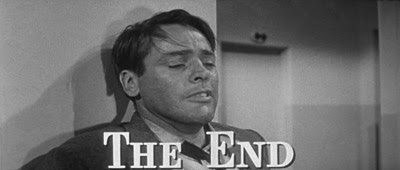
Labels: body snatchers, jazz, rock, vocal
posted by Tuwa @
23:55 | permalink |
1 comments
|
body snatchers mix, part 9
Buddy Tate and Claude Hopkins -- What Is This Thing Called Love? (March-October 1960)If this were a scene in one of the films it would be an extended take from Siegel's version, Miles and Becky in the bar, close dancing and pretending they're not falling in love again, the barman studiously not paying them any mind.
[Buddy and Claude @ emusic]
King Curtis -- What Is This Thing Called Love? (April 1960)
King Curtis was a record producer who started as a session player for R&B groups before moving on to a solo career. He recorded with John Lennon, Billy Preston, Aretha Franklin, and Duane Allman, as well as releasing a number of his own albums, before he was stabbed to death outside his New York apartment.
When I first heard this version of the song I wondered whether Curtis had cribbed from Cannonball Adderley or the other way around. The dates were one clue; the other was that on this track King Curtis has Nat Adderley on cornet.
I think I prefer this version for its concision, though the piano by Wynton Kelly is also quite nice (but, naturally, Victor Feldman on Cannonball's version acquits himself nicely).
[Soul Meeting ]
Cannonball Adderley -- What Is This Thing Called Love? (November 1960)
The rhythm is the same as the King Curtis version, but the tempo sped up, the song stretched out, the group treating the song like a pencilled map they aim to fill in.
[What Is This Thing Called Soul?]
George Shearing -- What Is This Thing Called Love? (June 1962)
George Searing and his group swimming against the tide of bop, turning in a sedate version with the bass riding a groove, the piano swapping between syncopated melody, vamps, and flights of fancy.
[Jazz Moments ]
Carmell Jones -- What Is This Thing Called Love? (1965)
Doubletime bass with trumpet (Carmell Jones) and tenor sax (Jimmy Heath) taking turns on the melody over nine minutes, seeing which one of them can blow hard and fast enough to reheat the cup of tea behind the microphone. It bubbles a few times; they give up, winded.
[Jay Hawk Talk]
Freddie Hubbard & Jimmy Heath -- What Is This Thing Called Love? (1965)
Eleven and a half minute version with sax and trumpet in competition again, Jimmy Heath trying to outbop himself. By the end of it, the tea has boiled and the ceramic cracked. I imagine the applause at the end is partly gratitude for turning in such an intense performance and partly relief for not killing themselves in the trying.
[Jam Gems: Live at the Left Bank]
Chris Connor -- Love Medley: What Is This Thing Called Love? / You Don't Know What Love Is (Aug 1986)
Chris Connor with a version which is energetic enough on its own but sounds positively tranquil in comparison to the last two versions.
[Classic]
Jessica Williams -- What Is This Thing Called Love? (Oct. 1986)
Jessica Williams on a whimsical, agile, and energetic piano rendition recorded live.
[Encounters, Vol. 2]
Mel Powell -- What Is This Thing Called Love? (October 21, 1987)
Mel Powell on his return to jazz after decades as a classical composer, recorded live on a cruise ship. It's a good track; Powell's in fine form; the bass gets a solo which maybe goes on a bit too long; but the group are obviously stretching themselves a bit and having a good time, and they have an appreciative audience.
[Return of Mel Powell]
...
Well, today didn't go as planned. Still, I think I've probably said all I have to say about the Body Snatchers works, at least without further reading. Next post will wrap it up, most likely with some brief summary of findings about sleep and dreams.
Labels: body snatchers, jazz, vocal
posted by Tuwa @
22:56 | permalink |
0 comments
|
body snatchers mix, part 7
.jpg "Carol screams (Ferrara, 1993)")
Carol screams (Ferrara, 1993)
(a.k.a. "You! Problematic director! Front and center!")
Les Paul -- What Is This Thing Called Love? (June 1950)
Les Paul with some overdubbing experimentation, second guitar like a dream where someone is shouting in a windstorm, sound snatched away, yet somehow you understand and it's all okay.
[The New Sound]
Dave Brubeck Octet -- What Is This Thing Called Love? (July 1950)
Brubeck's version starts somber, melancholy, and cautious, exploring a cage by lanternlight, then the lights come up and it's not a cave at all but a milquetoast ball at a military installation. The band strives to be polite, wanting very much not to meet the MP.
[The Dave Brubeck Octet]
Charlie Parker -- What Is This Thing Called Love? (1950)
Is it silly to say about a Charlie Parker song that you like the saxophone? Hm, then I won't. Instead I'll say I like the strings, and the brushed drums with the occasional kick, and the piano skipping down the street, and how Parker plays around all of them, and how the audience seems maybe unsure of what to expect but willing to go along with it.
[available on Charlie Parker with Strings]
Charlie Parker -- What Is This Thing Called Love? (March 25, 1952)
Parker and the band doing their damnedest to blow the roof off (Parker is a gunslinger, see; he uses the first half-dozen notes or so, then shoots holes in the melody until it's alive but barely recognizable. And that's how he leaves it, so its loved ones can identify the corpse in full realization that it was not as badass as it thought).
[digitized from The Verve Years (1952-1954), VE-2-2523, now available on Confirmation: The Best of the Verve Years]
Frank Sinatra -- What Is This Thing Called Love? (1953)
There are a lot of ways I could have imagined the song. This isn't one of them.
[Hello Young Lovers]
Frank Sinatra -- What Is This Thing Called Love? (April 1954)
Sinatra tries again, this time taking a much more melancholy approach to the song which probably suits it better.
[In the Wee Small Hours]
Charlie Mingus -- What Is This Thing Called Love? (Dec. 1954)
Some time in the mid 1990s, I read someone disparaging jazz by saying it was what happened when four different people played four different songs at the same time. I don't think I ever heard a jazz track that fit that definition until I sought out this one for this mix. The back of the LP tells me that what we have here is John LaPorta on alto sax playing the title track, Thad Jones on trumpet playing "Hot House," and Teo Macero on baritone sax playing "Woodyn You." Very strange, frequently dissonant, and 100% wonderful. Sorry for the few rubs on the LP though.
[Digitized from Everest Records FS235, which has since gone out of print; also available on Jazzical Moods.] [--thanks, Jason!]
(more Body Snatchers discussion: spoiler warnings still in effect)
Rereading "Genre and Closure in the Seven Versions of Invasion of the Body Snatchers: Finney ('54, '55, '78), Siegel ('56, '56), Kaufman ('78) and Ferrara ('93)" I'm struck by how similar my take on Ferrara's film is to Robert Shelton's, but I suspect that Shelton is the more perceptive reader. Shelton notes that the pacing in Ferrara's film slows "when Marti (played by Gabrielle Anwar) has no clothes on," which includes both her leisurely bath and the scene later when she's been taken to the hospital for some very un-Hippocratic treatment. I'd noticed the slowed pace the first time, missed it the second. In the hospital, pod tendrils snake into Marti's nose and mouth and the pod figure sits up, nude, back arched and mouth open as if in rapture, and then turns to Tim and strikes (and holds) a rather seductive pose, speaking to him in a soft tone. All of these are behaviors we have no reason to expect from a pod person. I'd be tempted to relate the pod's indifference to her public nudity to the alienness of the pod people, as in Kaufman's version, except that it's not, really; it's saddled with an imitation of human behavior which Marti's pod has no reason to indulge in. At this point in the film Tim is surrounded with enemies who will gladly and permanently subdue him, so the nudity seems to be there for reasons other than story-logic, which is already saddled with the stipulation that Marti survive and that (nearly) everyone else is expendable.
Shelton also points out the "idiot plot hole" of the General allowing Marti and Tim to leave: "Let them go," he says, "no one will believe them." As Shelton notes, "When the equivalent of this remark was made in Siegel's 1956 version, a solitary, unarmed, exhausted small town doctor was being 'let go'; in Ferrara's 1993 version, General Platt has just 'let go' an armed attack helicopter and pilot."
All of this suggests (to me at least) that Ferrara's film is what a feminist would call "problematic," yet I have to admit that it's also successful on somewhat unexpected terms: I haven't been able to stop thinking about it. Maybe that ties back to Rosenbaum's notion that a great film doesn't have to be a good film (or, stated another way, that the quality of a film is distinct from how much it causes the audience to think). I'm not sure if Ferrara's film is a great or even a good film but it's definitely been a thought-provoking one.
Labels: body snatchers, horror, jazz, movies, vocal
posted by Tuwa @
07:54 | permalink |
5 comments
|
body snatchers mix, part 6
.jpg "Andy and his painting (Ferrara, 1993)")
Andy and his painting (Ferrara, 1993)
When you play a piece of music there are so many different ways you could play it. You keep asking yourself what if. You try this and you say but what if and you try that. When you buy a CD you get one answer to the question. You never get the what if.
--Kenzo Yamamoto in The Last Samurai by Helen DeWitt.
I have to wake up in four hours and take a ten-hour flight. Please forgive the lack of description of the tunes.
The tunes are in chronological order, or as near to it as I could get them; if someone knows the recording dates on any of these and wouldn't mind sharing, I'd appreciate it.
These early versions aren't my favorites, though I do like them; my favorites will come later: Ella Fitzgerald, Hank Jones, Keely Smith and Nelson Riddle, Bill Evans, Buddy Tate and Claude Hopkins, Charlie Mingus, Charlie Parker, King Curtis.... Some of those versions want to blow the top of your head off and douse your brain in gasoline.
Wrapup post (or posts? I have over 30 more versions of the song, most of them good, most of them worth sharing) in January.
Big thanks to Reverend Frost and to Girish for making recommendations and helping me track some of these down.
Ray Vega -- Greenhouse
This one is here because greenhouses figured largely in the first two body snatchers films (and a swamp in Ferrara's, sorry) and because I'd already decided on "What Is This Thing Called Love?" for the end when I stumbled onto this track and read that it was based on the same changes. Synchronicity.
[Ray Vega]
Artie Shaw and The Meltones -- What Is This Thing Called Love? (1938/39)
[Artie and the Singers]
Jo Stafford -- What Is This Thing Called Love? (anywhere between 1939 and 1946)
[Too Marvellous For Words]
Anita O'Day -- What Is This Thing Called Love? (1940s)
[And Her Tears Flowed Like Wine ]
Lena Horne -- What Is This Thing Called Love? (1941)
[Stormy Weather: The Legendary Lena (1941-1958) ]
Nat King Cole -- What Is This Thing Called Love? (1943-1944)
[This Side Up ]
Billie Holiday -- What Is This Thing Called Love? (1945)
[Billie Holiday's Greatest Hits (Decca) ]
Django Reinhardt -- What Is This Thing Called Love? (1947)
[The Classic Early Recordings in Chronological Order or, you know, get the box set a la carte @ emusic]
(Spoiler warnings still in effect: plot details, including endings.)
Ferrara's Body Snatchers, in spite of removing the sensational "Invasion of the," does not return to the roots of Finney's story. Of all the versions, it's probably the least like the original serialized story, in spite of having an ending most like it.
The film centers on a teenage girl named Marti Malone, who, like most of the film's characters, has no direct match with any character in the previous stories. Marti is moving to an Army base in the southern U.S., where her father Steve has been sent as an agent of the EPA to monitor use of chemicals on site. Steve's job prompts discussion of chemicals and toxicity, showing a concern for the environment most likely borrowed (like the garbage trucks and those hair-raising alien screams) from Kaufman's film. Yet there are differences with all prior versions of the film, some of them quite striking. Finney's stories were in the first-person; Siegel's mimicked that with the (occasionally cheesy) voiceover. Kaufman's version did not have a voiceover; and Ferrara's version restores it, yet only as a bookending device: two by Marti, at beginning and end, and one at the end by Carol.
Near the beginning of the film, Marti and her family are shown driving across rural highway. When they stop at a gas station somewhere outside the base, looking like approximately the middle of nowhere, Marti goes to the restroom and is rushed by a large man in camouflage. He pushes her up against the door with his hand over her mouth, warning her about people who "get you when you sleep"; Marti manages to slip out the door and away from him, where she screems for her father. Inside the restroom, Steve and a gas station attendant find that there's no one there. It's an odd resolution to the scene, since there seems to be nowhere for the man to have hidden and so it seems to hint that Ferrara is both bending the rules and playing with kid gloves in regards to Marti. This choice, coupled with the choice to have Marti provide voiceover, immediately leads the audience to expect that Marti will most likely survive and therefore reduces the tension in the rest of the film.
Also, by having Marti provide voiceover, Ferrara hints at the possibility of a feminist take on the Body Snatchers story--but it's a version that he is not particularly interested in authoring, though Marti is much more proactive than either Becky or Elisabeth. Marti doesn't share the "wait and see" attitude of the characters in the other films, instead recognizing and dispatching one pod person nearly as soon as she suspected it wasn't human. Siegel's version, on the other hand, is marked by its time, seeming to think that women are mostly for screaming and for being carried. One scene in particular: Miles and Becky in Miles' office, with pod people waiting nearby for them to fall asleep. Miles begins to formulate an escape plan: he'll get the pod people to rush in and then inject them with something to incapacitate them. "It wouldn't work," he says, "I might get one or even two but I couldn't possibly get three of them." And Becky responds: "You're forgetting something, darling--me. It isn't three against one; it's three against two." Every time I see the film, I think that Becky is probably using 1950s-talk for "Goddammit, Miles, breasts don't cause incompetence."
Of all the versions of the story, Ferrara's is most explicitly about the nuclear family. In fact, the shift in focus from a potential couple to an existing family is so striking it causes some critics (like Robert Shelton in "Genre and Closure in the Seven Versions of Invasion of the Body Snatchers" to claim that "There are no children or adolescents at all in the Finney narratives or the Kaufman movie." There are; in Kaufman's version Elisabeth is first shown picking a flower as a group of schoolchildren walk past, being encouraged by their teacher to pick the "pretty flowers"; and later in the same film there is a busload of children unloading and going into a building, a young girl complaining that she isn't tired and doesn't want to go to sleep. Similarly, both versions of Finney's novel contain the prototype for Siegel's Jimmy Grimaldi, the son of the farmers who closed the vegetable stand (presumably to grow pods instead): "A nine-year-old boy came in with his grandmother, with whom he was now living, because he became hysterical at the sight of his mother who, he said, wasn't his mother at all." (Finney '55, p. 22; '78, p. 25)
How did this boy reach this conclusion? What did he see, if anything? Finney and Siegel both leave it to our imaginations; Ferrara shows us: at their new home, after the delivery of several boxes supposedly containing equipment for Steve Malone, Andy walks in on his mother, who is sleeping. As he watches, her body crumples and disintegrates, and the closet door opens. A woman looking just like his mother is standing there, completely nude and impassive. He runs, screaming, and his father catches him to ask what's going on. The pod-Carol descends the stairs and says that the boy had a nightmare. This scene is one of the more terrifying in the film, perfectly capturing what it's like to be a child: dismissed and patronized, worries ignored. Andy's situation is complicated by the fact that in Andy's first day at his new day care, the children were told to paint--their paintings are all strikingly similar; his is different. He's an outsider and knows it, and everyone else does too; and now he knows why.
And here, I think, is where the film falters: Marti is a typical U.S. teenager, at that age where she seems to think most of her family is insufferable, including her six-year-old brother and especially her stepmother. She's somewhat alienated, somewhat self-involved, yet most of her troubles seems rather superficial given the broader context of the story. Andy is a more sympathetic character, old enough to know that something is deeply wrong but too young to do anything about it. He is in danger and knows it; Marti is in danger and doesn't know it; the film has an implied sympathy with Marti's point of view; we know that Marti will most likely live; Marti meets a man she is attracted to, whom her father doesn't like; and Marti has pointless arguments with her family about independence.
The trajectory of the story seems clear early on yet, oddly enough, for me the film serves as a counterexample to Hitchcock's ticking-bomb theory: rather than delighting in suspense I checked off items on a list as they happened. It's probably my coolness towards both the plot and the characters that caused this emotional distance; and I know that some reviewers (including Roger Ebert) found the film very effective. For me the film seemed a strange beast, interesting in how it's different from the others, interesting in what it attempts and where and how it succeeds and fails, but not emotionally engaging. It seems a "faster" watch than the others, the plot developing more quickly and arriving at a sprint sooner (though it slows to a trot in the scene with Marti taking a bath--I'll leave it to the viewers to decide whether that's because Ferrara really enjoyed filming those scenes or because he was both paying homage to Hitchcock and trying to exploit that suppressed knowledge that you're most vulnerable in the bathroom).
In spite of Forest Whitaker's overacting and the general predictability of the story, the film is well-crafted and at least never dull, yet at the end of it all I'm left wondering if at heart the film is really a teenage revenge fantasy in horror-film clothes: after her family is destroyed, Marti and Tim fly away in a helicopter, blowing up the pod peoples' trucks and buildings along the way. In voiceover Marti talks about how revenge, hate, remorse, despair, pity, and fear are all human emotions. This retaliation, coupled with the military setting--military destroying humanity, one civilian and one soldier left striking back at the military--makes me wonder what the film means, or if it even means anything. Are we to make anything of the military setting? Is it merely there for, as Ebert points out, somewhere where pod people would seem to blend in?
And what does it mean when Marti and Tim land in Atlanta and Carol's warning to Steve plays back in slowed voiceover? "Where you gonna go?" Carol says. "Where you gonna run? Where you gonna hide? Nowhere. Because there's no one like you left." Is that to be taken as a haunting memory or an accurate omen? I don't know the answer to these questions.
Ferrara fades to black. In a way it's a spiritual brother to Siegel's ending.
Labels: body snatchers, horror, jazz, movies, vocal
posted by Tuwa @
00:14 | permalink |
2 comments
|
body snatchers mix, part 4
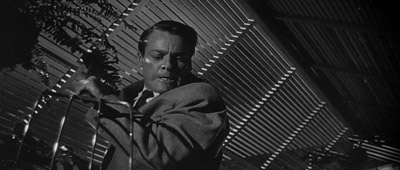
And the pods march on: next: Kaufman, Ferrara, closing thoughts. You're liking the music at least, I hope.
Howard Tate -- Hold Me Tight
Atypical reggae-inflected soul from Howard Tate.
[Howard Tate's Reaction ]
Otis Rush -- My Love Will Never Die (solo take with piano)
This is a slow, somber take, with Rush apparently still trying to figure out whether the song was meant to be a dirge. The occasional laughter in the background, and Rush's own laughter at the end, suggests that maybe it wasn't.
[Mr. Dixon's Workshop]
Otis Rush -- My Love Will Never Die
Otis Rush tries again, giving the song a lurching rhythm, trilling piano, guitar lines that are sinuous and somehow yearning, and banshee-like vocals leaving no doubt about the pain.
[Essential Collection: The Classic Cobra Recordings 1956-1958]
Magic Sam -- My Love Will Never Die
Magic Sam taking an approach very similar to Otis Rush's, ten years after. Sam and Rush were both on Cobra; West Side Soul is one of the classic blues records. (Interestingly enough, Sam used to play with fellow Chicagoan Syl Johnson in the 50s.)
[West Side Soul]
Dallas String Band -- So Tired
I think it might be easy to take this song ironically, but I love it: the washboard, the fretwork, the melody, the harmony, the progression. And the lyrics, at least what I can make out of them: "So tired of crying / so tired of sighing / so tired of being alone" ... "Though we are drifting far apart / My arms are empty but never my heart / So tired of yearning / For your returning / So tired of waiting for you."
[Texas Black Country Dance Music (1927-1935) @ emusic]
Kay Star -- So Tired
Another one you could take ironically, I guess, but I'm not hip enough to do it. I like the song; I hear something in the vocals that's anachronistic; I can't pinpoint it or explain it, but I like it. It's a very sweet song, uncomplicated and sincere.
[Kay Starr: the Best of The Standard Transcriptions @ emusic]
Junior Wells -- So Tired
Very murky sound on this one, no doubt on purpose--it's like the aural equivalent of squelching your way through thick dark muck that keeps trying to eat your shoes. Wonderful song, though, and the blues were meant to be at least a little discontent.
[1957-1966]
Eddie Bo -- I'm So Tired
Gritty early R&B, Bo rolling out piano riffs and howling about love given in vain.
[I Love to Rock 'N' Roll ]
(Ongoing spoiler warning: texts and films, including endings, discussed below.)
Siegel's 1956 filming of The Body Snatchers hews closely to the established text for most of the film: the story still deals with Miles, Becky, Jack, and Theodora (now called "Teddy"); and Miles' friend the pyschiatrist (now called "Danny" rather than "Mannie"). Miles was divorced more recently than in the book (five months rather than five years) and Becky more recently still (the weekend before the start of the story). As in the book, they had dated each other prior to marrying someone else, and, as in the book, they find themselves falling in love again after the divorces. Early in the film, after scattered reports of people feeling that their family members weren't themselves, Miles jokes that he'd hate to wake up and find that Becky wasn't Becky.
"I'm not the high school kid you used to romance," Becky says, "so how could you tell?"
"You really want to know?" he says. Becky does, so he kisses her.
The film has its differences, though, some of them interesting and others less so, and a few just as inconclusive as the differences among the Finney versions. In Siegel's film, Miles' self-doubts are greatly diminished and the concern over neighborhood upkeep almost entirely eliminated; the only mention of anything decrepit is near the beginning as Miles is driving into town from the train station: he nearly runs over Jimmy Grimaldi, the young son of farmers who have recently closed their vegetable stand.
The film follows Miles, Becky, Jack, and Teddy as they begin to suspect that the people claiming the impossible are in fact correct. Halfway through the film, Miles discovers four pods in his greenhouse, splitting open and beginning to look human. Miles urges Jack and Teddy to leave for help, and Becky tries to phone the FBI as Miles tries and fails to dispatch all the pods in the greenhouse. He lingers, pitchfork in hand, over the one turning into Becky, then decides he can't kill it and instead kills the one turning into him.
Outside town, desperate for somewhere to go for help, Miles drives to his receptionist's house, where he overhears some chilling dialogue:
"Baby asleep yet, Sally?"
"Not yet, but she will be soon, and there'll be no more tears."
Hiding in his office with Becky, Miles delivers the director's message:
"In my practice I've seen people who've allowed their humanity to drain away. Only it happened slowly instead of all at once. They didn't seem to mind."
"Just some people, Miles."
"All of us. A little bit. We harden our hearts, grow callous--only when we have to fight to stay human do we realize how precious it is to us, how dear--as you are to me."
 In the morning they see trucks arrive on the plaza and the tarps pulled back, the trucks full of pods. The townspeople collect pods and take them to their cars for distribution. When Jack arrives, their relief is quickly crushed: he's been changed into a pod person; and Danny was one all along. They explain the alien origins of the pods and explain what it's like to be a pod person:
Miles: "I love Becky. Tomorrow will I fell the same?"
Danny shakes his head. "There's no need for love."
"No emotion? Then you have no feelings? Only the instinct to survive. You can't love or be loved, am I right?"
"You say it as if it were terrible; believe me, it isn't. You've been in love before; it didn't last. It never does. Love. Desire. Ambition. Faith. Without them life's so simple, believe me."
And as if one betrayal were not enough, there's the climax of the film: Miles and Becky, exhausted, on the run from the entire town, just like in the book. Except they hide in a tunnel under some slats, rather than under some brush in the fields, and Miles leaves Becky to investigate some beautiful music which Becky says must mean that someone still knows what love is. When he returns he finds Becky in a different location; she's too tired to walk so Miles picks her up and begins to walk out of the tunnel. He trips and they fall into a mud puddle, where they kiss, and Siegel springs a surprise on a 1950s audience familiar with the source material: Becky looks up at Miles exceptionally coolly; Miles pulls away, face registering alarm and disgust. She's been changed. She tells him it's not painful, and he should quit resisting; then as he flees she shouts at the others that he's there.
They let him go to the highway, where he is taken for a drunk or a maniac; he finds the back of a semi loaded with pods and then, on the street, continues to shout his warnings into the camera: "They're coming! You're next!"
And there it would have ended, except that the film tested poorly and the studio forced a change. So Siegel shot a pair of tacky bookends: starting the film with a psychiatrist arriving at a hospital to find Miles panicked and unconvincing; and ending the film with the psychiatrist leaving the room and encountering a truck driver being pushed in on a gurney, with a broken arm and two broken legs. The psychiatrist is informed that the man ran a red light and crashed into a bus, tipping his truck over and spilling a cargo of large and unusual things that look like seed pods. So he goes to the phone, where he shouts at the operator to get him the FBI right away, and yes it's an emergency. And there the film ends.
It's a strange ending for a number of reasons. Generally it's accepted as an inferior ending to the one Siegel intended, which was to leave Miles looking like a stark raving lunatic on the freeway. The new ending might be considered a challenge to the auteur theory in that the studio forced Siegel to add it, against Siegel's wishes. Yet it's also somewhat appropriate in that the new ending hews more closely to the ending to the serial originally optioned: invoking the federal government to come solve local problems with national implications. And yet it's also a sly ending, a subtly suversive ending, on Siegel's part: the pyschiatrist believes Miles and calls for help. "Excellent," we think. "The day is saved." Except we see "The End" before we hear what happens next, and so it's easy to forget that Miles also tried to call for help, and that he could not get through because the pod people already controlled the phone system.
Besides, I'm not sure how many people the new ending relly convinced: I saw the film as a child and didn't see it for a decade afterwards; what I remembered of it was not the call to the FBI but Danny's betrayal and the unveiling of the truck loaded with pods.
In some ways Siegel's The Invasion of the Body Snatchers reminds me of Howard Hawk's The Thing: both deal with an alien invasion of murderous perambulatory plant matter; but The Thing has no patience for the federal government or the visitor, and The Invasion of the Body Snatchers takes a more patient, cautious, watchful stance. There's probably fertile soil there for someone willing to argue that the two films are the Rio Bravo and High Noon of science fiction.
It's common to put Finney's novel and Siegel's film into a Cold War context, and Glen M. Johnson does it as well as anyone. A bit from "'We'd Fight .... We Had to': The Body Snatchers as Novel and Film":
Finney complicates the simplistic them-vs-us forumula by making his invaders invisible--a force or consciousness that conquers by taking over the minds and personalities of ordinary people. So the "body" snatchers become apt symbols for ideological subversion, fear of which was a characterisitc form of anxiety in the American fifties.Johnson, like many authors discussing the story's Cold War origins, mentions brainwashing: "it is suggestive that The Body Snatchers is set in August 1953, immediately after the Korean armistice, when American newspapers were full of incredulous reports about the 'turncoats' who chose Communism over a return home."
At the time of the stories' publication, HUAC's investigation into Communist propaganda in Hollywood, followed by its blacklist of the Hollywood Ten in 1947, was not yet ten years past. Joe McCarthy had spent several years in Congress making rabid declamations against suspected communists as chair of the Subcommittee on Investigations, and only in late 1954, after several years of bellicose and frequently baseless accusations, had he netted a formal censure in the Senate. It's easy to imagine that the alien invasion in the body snatchers stories serves as a metaphor for Cold War anxieties--either as a fear of communism or as a fear of McCarthyism. If there's one thing central to U.S. belief it's rugged individualism, and both sides were no doubt feeling an overwhelming pressure to conform. So it's somewhat common that the series of betrayals in the story, executed by family and friends, reminds people (ironically or not) of J. Edgar Hoover's sensationalist warning in Masters of Deceit that "there are thousands of people in this country now working in secret to make it happen here." Furthermore, it's easy to view the sleep metaphor as freighted with political baggage, especially given the "sleep no more" propaganda common during the Cold War.
Yet as J. Hoberman notes in "Paranoia and the Pods,"
Sorting out the politics of the men who filmed Invasion of the Body Snatchers is not easy. Siegel has described himself as a liberal, although his ouevre is more suggestive of a libertarian belief in rugged individualism. Wanger, a producer with an interest in topically political material, was responsible for both the crypto-fascist Gabriel over the White House (1933) and the prematurely anti-fascist Blockade (1938) as well as for such New Dealish genre exercises as You Only Live Once, Stagecoach, and Foreign Correspondent.Hoberman goes on to note that Mainwaring, the film's screenwriter, had written the "relentlessly perfunctory" anti-communist film A Bullet for Joey and that Invasion of the Body Snatchers' script was rewritten by Richard Collins, "a former Communist Party functionary, co-author of the once notorious Song of Russia (1943), [and] an announced unfriendly witness first subpoenaed by the House Un-American Activities Committee in autumn 1947 among the original Hollywood Nineteen" who later turned witness for the FBI. So the film might be read as an anti-Communist fable, or as a satire of McCarthyism, or simply as a richly metaphorical work authored by a number of men with strikingly different philosophies.
Siegel, for his part, seems content to think of the film as about conformity in general: "It's the same as people who wlecome going into the army or prison. There's regimentation, a lack of having to make up your own mind, face decisions.... People are becoming vegetables. I don't know what the answer is, except an awareness of it. That's what makes a picture like Invasion of the Body Snatchers so important." (Parkes, "There Will Be No Survivors")
And Finney denies all of these interpretations, both here and elsewhere:
For years now, I've been amused by the fairly widely held notion that The Body Snatchers has anything to do with the cold war, McCarthyism, conformity... It does not. I was simply intrigued by the notion of a lot of people insisting that their friends and relatives were impostors.
--"Paranoia and the Pods," Sight and Sound May 1994, p.31
I have read explanations of the "meaning" of this story, which amuse me, because there is no meaning at all; it was just a story meant to entertain, and with no more meaning than that. The first movie version of the book followed the book with great faithfulness, except for the foolish ending; and I've always been amused by the contentions of people connected with the picture that they had a message of some sort in mind. If so, it's a lot more than I ever did, and since they followed my story very closely, it's hard to see how this message crept in. And when the message has been defined, it has always seemed a little simple-minded to me. The idea of writing a whole book in order to say that it's not really a good thing for us all to be alike, and that individuality is a good thing, makes me laugh.So the question is, then, whether the author is the final word on what a text means. I think the author often has a good idea of what he intended, except that even he might not realize all of the intentions and subtleties: I'm reminded of Ray Bradbury's comment in the afterword for Fahrenheit 451 that for decades he didn't notice that Faber was the name of a pencil company and that Montag was the name of a paper company.
--personal letter to Stephen King, December 24, 1979, as cited in Danse Macabre, 1983 Berkeley paperback, p. 306-307
And, too, it's obvious that the reader (or viewer) must understand, process, and interpret the parts of a story for it to have any meaning. Those interpretations are necessarily personal affairs, at times idiosyncratic or conflicted but always dependent on associations with existing knowledge. Is the story about communism? McCarthyism? The Red Scare? The case for each of those could be made, sure, and frequently is. Art is largely an interpretive matter and almost never yields as unequivocal results as math. And should it?
Labels: blues, body snatchers, country blues, horror, movies, RnB, vocal
posted by Tuwa @
21:14 | permalink |
5 comments
|
body snatchers mix, part 3
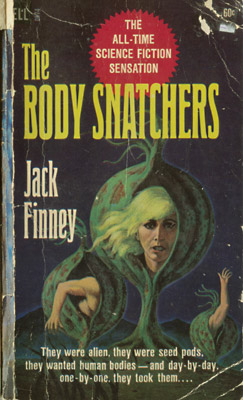
Some more songs tangentially related to the Body Snatchers stories, and more about the stories (with spoilers) below that:
Jimmy Bo Horne -- Get Happy
There's something here that reminds me of much of George McCrae's work, probably in the simple composition and the repetition, but also in the reliance on a sweet hook and an energetic horn section in a poppy R&B track with high-flying vocals. Another happy song, appropriately enough.
[The Legendary Henry Stone Presents: Jimmy Bo Horne @ emusic or @ amazon]
Shirley Bassey -- Hey Big Spender (Wild Oscar mix)
Bassey likes to make these big brassy music numbers that go well with Bond films (Goldfinger, Moonraker, Diamonds are Forever) and that get a deft parody in The Life of Brian ("He had arms ... and legs ... and hands ... and feet / This boy whose name was Brian"). The remix here decides that brassy isn't brassy enough, and so kicks it up a notch: adding breakneck percussion, muted guitar, vocal effects, and tempo changes.
[Shirley Bassey - The Greatest Hits]
J.J. Cale -- Call the Doctor
Countrified blues-rock, subdued delivery, plodding bass, sour horns, and electric guitar swelling into a stoned melancholy solo. The description sounds horrible but Cale pulls it off somehow.
[Naturally]
Eddie Floyd -- Bring It on Home To Me
Easy-going R&B, not pining, not pleading, not arguing a case so much as pointing out what a good time you could be having--hoping you'll come to your senses and come join in.
[Eddie Floyd - Chronicle: Greatest Hits]
Lou Rawls -- Bring It on Home
Nevermind the showboating at the beginning; give the song a minute (actually, 45 seconds). Let the bass come in and the funk get dropped; let Lou gather his evidence and practice his line of argument. It's a smooth-talking dapper performance, pitch-perfect and with just enough edge on it to let you know he's serious, but not so serious as to keep the jurors from clapping.
[Anthology]
Jack Finney has published at least three different versions of Body Snatchers: first as serialized in Collier's in November and December 1954, then as a book in 1955 (expanded and given a different climax) and then with further edits in 1978 to coincide with Philip Kaufman's second film version of the story.
The three have strong similarities, as could be expected. The text versions take place in Santa Mira, a small town outside San Francisco, and feature a doctor named Miles Bennell, a former flame named Becky Driscoll, a psychologist friend named Mannie Kaufman, a writer friend named Jack Belicec, and his wife Theodora. At the start of the story, Becky approaches Miles and tells him of her cousin Wilma who's become convinced that her Uncle Ira is not actually Uncle Ira; when they visit Wilma, she explains that her aunt hasn't noticed because she is also not her aunt. From there the details accrue suggesting that the humans are being besieged by aliens intent on replacing them, and the small group of humans decide to fight.
Along the way Becky and Miles, both divorced, find themselves increasingly attracted to each other. Becky has divorced recently and Miles five years earlier, yet Miles continues to be bothered by his divorce, taking it as a sign of some shameful defeat. There are scattered mentions throughout the novel, most of them wry, and others which seem either self-deluding or callous and sexist:
I'd seen Becky at least every other night all the past week, but not because there was any romance building up between us. It was just better than hanging around the pool hall, playing solitaire, or collecting stamps. She was a pleasant, comfortable way of spending some evenings, nothing more, and that suited me fine.Then there's this more telling passage as Miles is shaving:
--Body Snatchers, '55, p. 24
'You handsome bastard,' I said to my face. 'You can marry them, all right; you just can't stay married, that's your trouble. You are weak. Emotionally unstable. Basically insecure. A latent thumb-sucker. A cesspool of immaturity, unfit for adult responsibility." ... I cut it out, and finished shaving with the uncomfortable feeling that for all I knew it wasn't funny but true, that having failed with one woman, I was getting too involved with another, and that for my sake and hers, she should be anywhere but here under my roof.Both the paperback versions share Miles' self-doubt following his divorce, his penchant for prescribing sedatives, his passive wait-and-see attitude in the face of an obviously mounting crisis, and the curious marker of the body-snatched: an indifference to neighborhood upkeep. A visiting salesman complains that it's hard to get into and out of the town; coffee is hard to come by and tastes bad when a restaurant has it; and Miles notes that his Coca-Cola is warm. And outside the restaurant, on a littered street:
--Body Snatchers, '55, p.76
"Miles," she said in a cautious, lowered tone, "am I imagining it, or does this street look--dead?"Of the three versions, the Collier's version is probably the hardest to find: so far as I know it was never collected and published separately without changes, and it doesn't seem to be available in various academic databases, so finding it most likely requires access to the original magazines. I haven't read this version but I have the other two, and they're fairly similar. One of the more striking differences between the two novels happens early on when Miles mentions his car: "I drive a '52 Ford convertible, one of those fancy green ones, because I don't know of any law absolutely requiring a doctor to drive a small black coupé." (Finney '55, p. 13)
I shook my head. "No. In seven blocks we haven't passed a single house with as much as the trim being repainted; not a roof, porch, or even a cracked window being repaired; not a tree, shrub, or a blade of grass being planted, or even trimmed. Nothing's happening, Becky, nobody's doing anything. And they haven't for days, maybe weeks."
--Body Snatchers '55, p. 108
So early on Miles seems like a big spender, maybe a bit arrogant, maybe living a lavish lifestyle, with no time for Becky. In the 1978 version the passage is changed: "I drive a 1973 Mercedes two-seater, a nice fire-engine red job, bought used, to maintain the popular illusion that all doctors are rich." (Finney '78, p. 13)
Yet most of the differences between the two versions are subtle, perhaps inconsequential--instead of golf and swimming, Miles plays tennis, things like that. (In fact, the two versions seem so similar that the cynic in me suggests that the 1978 revisions were published simply to allow an extension on the copyright--copyright terms at the time were much more limited and the one on Body Snatchers had nearly run out.)
In the two novel versions Miles, Becky, Jack, and Theodora are increasingly persecuted, then flee town only to find that they don't know where to go or what to do. So they return to town, where they are split up. Becky and Miles hide in a field just outside town--the field where, it turns out, a professor had discovered what he thought was most likely an alien plant, and then a few days later retracted his story. It is here where the aliens are growing their pods for distribution, and Miles and Becky make a desperate last stand, setting fire to the fields and smashing pods. The aliens recognize their defeat and the pods detach from the plants, fly up off the ground, and leave the planet. Miles and Becky reunite with Jack and Theodora and discover that the aliens have a curiously short lifespan; most of them die off within a few years.
The serial version is apparently much different: Robert Shelton in "Genre and Closure in the Seven Versions of Invasion of the Body Snatchers" mentions that the 1955 Dell paperback "is based on, and twice the length of, the serial" and that "in the 1954 serial, a posse of FBI agents armed with 'riot guns' and 'small, light, almost dainty-looking machine guns'" arrives on site, attracted by Miles' fire, and helps fend off the alien invasion.
What does it mean that the endings are so different? What point was Finney trying to make, or deciding not to make? Catherine Jurca, in "Of Satire and Sofas," calls the novel "an allegory of postwar suburbanisation," yet the article is too brief to offer much supporting evidence and it's left to the reader to remember the United States' postwar population boom and the move from the cities to the suburbs.
Michael Parkes, in "There Will Be No Survivors," takes the novel as a metaphor for a different kind of encroaching conformity, and the pods as representing a different threat to identity: the introduction of television into American culture. Parkes notes that "between 1948 and 1955, television was installed in nearly two-thirds of the nation's homes and became the mythic and ideological unifier of the fragmented post-war family" and served "as a sign of suburban achievement," yet one that moved the family away from the hearth and conversation to the television and silent viewing. Parkes notes the effect of television on bars and cafes, as well, and its corollary to the cafe scene in the novel when Miles and Becky go to the Sky Terrace in the Siegel film to find few customers and no live music, but instead a jukebox: "the artistry and individuality of the original band has been 'snatched' and replaced by an inferior technological substitute." In this reading, Parkes considers the story's message somewhat ironic, calling it "an anti-media discourse which in itself is contradictory, as the film [and book] itself exists within the media."
This interpretation of the book as an anti-media, Luddite response to technological innovation is interesting; yet by far the most common reading of the story is as a metaphor for the political climate in the United States during the Cold War--whether as one about McCarthyism or as one about the Red Scare. More on that, and on Finney's and Siegel's reactions to it, next post.
Labels: about fiction, body snatchers, country blues, horror, RnB, vocal
posted by Tuwa @
21:41 | permalink |
1 comments
|
Minnie the Moocher / the Man from Harlem
Cab Calloway -- Minnie the MoocherCab Calloway -- The Man from Harlem
1930s jazz today from Cab Calloway. "Minnie the Moocher" is probably his best-known song, but it's always good for a smile; "The Man from Harlem" isn't as well known but it's more of the same. Funny that "The Man from Harlem" came out at the tail-end of U.S. Prohibition, before that one was finally conceded as a loss, giving the U.S. something else to set its sights on. Marijuana was still legal, which is probably why the drug dealing seems so, well, unhidden.
The linguist in me wonders why women are "frails" in Calloway's songs--the progressive in me says "that's sexist"; the sociologist says he would like to read about gender expectations of women in 1930s New York. And then the music fan says "quiet, now, I'm trying to hear the piano."
[Amazon.com]
posted by Tuwa @
13:41 | permalink |
0 comments
|
told him I ain't got five, so he will have to take two
Betty Roche -- Trouble TroubleA track today from Betty Roche, who played with Ellington in the 1940s and 50s. Roche is known for her phrasing, but on this track I'm especially fond of the trumpet, sax, and guitar. It's a smoking jazz tune about a man who's no end of trouble for Roche but she's staying with him anyway. It's a destructive relationship, a love that won't work out but won't be denied--he keeps leaving; she blames herself for speaking her mind; he calls from jail; she goes to bail him out. It's so bad she can't afford to pay the iceman or the landlord but she just won't dump him.
The track has some hiss and crackle on it--it was ripped from a 78--but the theme is timeless.
As far as I know, this track hasn't been released on CD. I found it on archive.org, which is not a bad source for old jazz and blues tracks that have lapsed into the public domain.
... I'm feeling a bit under the weather. I'll have another post Monday.
Labels: jazz, out of print, vocal
posted by Tuwa @
18:46 | permalink |
0 comments
|
Sugar Babe, I'm Leavin'
Blue Steele And His Orchestra -- Sugar Babe, I'm Leavin'Early jazz here, with horns oomphing along and one of those vocal melodies that seems wonderfully dated. It's a giddy little track about leaving a bad relationship: "don't you think I'm grieving 'cause you treated me wrong / you thought I'd be crying, not singing a song."
I don't remember where I found this track, but the mastering is far from, uh, masterful (check the drums in the back: they fell out almost entirely). There is a Blue Steele CD in print, but it got such an emphatically negative review at Amazon.com that I'll just mention that it exists and "caveat emptor." That might be where this one came from; I found the track on the internet some time last year and didn't listen to it before last week. I'd thought it was at archive.org, but it's not in their database.
[Amazon.com]: Texas & Tennessee Territory Bands: 1928-1931
And so ends the 'sweet' mix.
This delay in posting was brought to you by Hurricane Dennis. Was off visiting family in the panhandle and it became a poor time for it. By most accounts this one was a kitten for the Florida panhandle compared to Hurricane Ivan, though it still caused some destruction and claimed some lives.
posted by Tuwa @
19:50 | permalink |
0 comments
|
Sweet Marijuana (Brown)?
Julia Lee -- Lotus Blossom (Sweet Marijuana)Barney Bigard -- Sweet Marijuana Brown
Two vintage smoky jazz tunes today, a bit of pro and con like the faceoffs on a bad news show. Julia Lee wants you to know that marijuana can sooth her with its caress and help her in her distress; Barney Bigard warns that Sweet Marijuan Brown is frantic, directionless, and dangerous. I haven't known many people to get anything much like "frantic" from smoking out, and I can't help wondering if Bigard's getting his information from Reefer Madness. Lee at least is honest enough to admit she's indulging in fantasies when she talks about how she'll get her man back if she smokes enough.
... The U.S. Supreme Court decided yesterday that it's okay to seize private property for other private enterprise provided that the private enterprise (in this case, a strip mall) is for the "public good." Now, personally I consider strip malls for the public bad, just like SUVs and open sewers, but the Supreme Court seems to believe in trickle-down (was that ever anything more than a weak attempt at robber baron self-justification?)
It's a poor decision as I see it, but I wonder if it could be used for archivists and librarians to declare "eminent domain" on abandoned intellectual property. It's troublesome and counterproductive to have songs and films and books about which can't be re-used in some way originally intended by the Constitution (that is, in the progress of the arts and sciences--in commentary, in scholarship, in archiving) because the rights holders can't be found. At least in this case, you wouldn't be kicking a family out of its house; the work has been abandoned; there's no paper trail to contact the rightsholders (or compensate them!); and so the seizure would be victimless.
[Amazon.com] Barney Bigard -- 1944-1945 (Allmusic.com review)
[Amazon.com] Julia Lee -- Kansas City's First Lady of the Blues
posted by Tuwa @
14:07 | permalink |
0 comments
|
I Can't Believe That You're in Love with Me
May Wynn -- I Can't Believe That You're in Love with MeTrack today isn't so much a diamond in the rough as a ruby from a stack of emeralds: "I Can't Believe You're in Love with Me," a sultry jazz number from the Bogart film The Caine Mutiny. The movie is based on the Herman Wouk novel about a mutiny onboard a naval ship (a topic that might strike you as anything but sultry and jazzy--really, as competent as the movie is, the romance scenes still seem to belong to a different very competent movie from the rest of it).
The song's a jazz standard composed by Clarence Gaskill and covered by some heavyhitters (Louis Armstrong, Frank Sinatra, Django Reinhardt, Ella Fitzgerald); the performer here is a woman by the stage name "May Wynn," playing a singer who's taken the stage name "May Wynn."
I ripped the track from the VHS; as far as I can tell, the soundtrack was last released in 1954 on LP. So I hope you can pardon the bit of incidental music that bled over from the previous scene ... I just think there's something timeless & classy & compelling about the track, enough that I wanted to share it.
Labels: movies, out of print, soundtrack, vocal
posted by Tuwa @
13:46 | permalink |
0 comments
|
see you on the flipside
Three songs today, the last.Spooky Tooth: picture "I Am the Walrus" as a distraught bit of stoned blues rock. Audacious? Yes. But it's not a coy song in the first place. And that "expert texpert" part, holy shmoly that's good. (aside: I've long thought "Can't Buy Me Love" could work as an electric blues number. Might be wrong. I suck as a musician.)
Rotary Connection -- Life Could: psychedelic soul, with Minnie Riperton making use of all the octaves she can find.
Sayonara: Word. Bittersweet, cheesy and sincere, and somehow charming; and yes I genuinely like it.
The first two tracks are available on CD, but I just have the LPs.
[Spooky Tooth @ Amazon.com]:
[Aladdin/Dinner Music @ Amazon.com]:
...
I've been missing this Cannonball Adderley track, "Experience in E," off and on for nearly ten years, and heard it again today--they had the LP at the music library on campus and it turns out they let the public check out headphones (this was news to me). But no, you can't take the LP out of the building; you have to listen to it onsite. So I went and sat in the library listening to it. "Not bad," I was thinking, "not bad," then, a few minutes in, "wow"--the sax came in over that bass and my God it was just perfect; whatever part of me it is that intensely loves music was doing cartwheels and shouting to the heavens "yes! exactly! don't change a thing!"--silently; it was in a library--and then the excellent part was over and the song turned into a cacophonous mess: screeching horns and spastic drums and generally annoying shit for most of the rest of Side 1.
And I sat thinking "that was a two-minute pearl in a twenty-minute oyster." Wondering whether I'd rather have stuck with the memory. How much of this is typical? How often do you find something you remember fondly and it's as good as or better than you remember it? I'm curious what you (all) think.
...
Well, I'm done here. What have I learned?
1) I'm not as good a writer as I thought. Half the time there's some word or phrase I've left out that I shouldn't have.
2) My memory is not reliable; my understanding of any given thing isn't either.
3) My research skills aren't very good. And I'm intensely lazy, which leads to the misremembering/misunderstanding trouble above.
4) Which leads to alarming logical conclusions about my view of the world in general. ^_^
5) The political rants, while satisfying to write, are deeply dissatisfying to read.
There are tons of mp3 blogs around still, some of them really quite good; and more are springing up every day. Look through the sidebar on the Tofu Hut; you're certain to find something you like.
Tracks are staying up until the end of December, when Racknine cuts off the hosting. I'll be checking in on my favorite mp3 blogs (listed to the left), and if I find something great I won't hesitate to send it to whomever I think would be most interested in it (usually that's Sean at Said the Gramophone or John at The Tofu Hut).
Thank you, you've been very patient and very kind.
Labels: blues rock, psychedelic rock, vocal, world pop
posted by Tuwa @
03:00 | permalink |
0 comments
|
Nancy Wilson
Nancy Wilson -- Lonely, LonelyNancy Wilson -- The Real Me
Nancy Wilson is a vocalist who started recording in the 1950s, mostly in jazz; she's cut a record with Cannonball Adderley and appeared in concert with Nat King Cole and other big names in jazz, but she's also released pop and soul albums. She has a strong voice and a nice range, and she's well known in jazz circles for both her recordings and her work with NPR on Jazz Profiles.
I found her record Now I'm a Woman in a highly disorganized collection, for $1; it's out of print and about 80% top notch. Here are a couple of rare tracks from it--numbers 2 and 4 from side two.
"Lonely, Lonely" is a bit of soft jazz about loneliness (but you guessed that already); the vocals are quite nice but I wonder why they settled on a mix that swallows the second L. It's a good song but for my money, "The Real Me" is the star of the record.
"The Real Me" is a breakup song, but it's not the kind of sad messy breakup that has you sleeping in and then getting up to sit staring into your coffee--Wilson is exuberant about her sudden freedom; it's her chance to find herself. She knows it'll take some work to put her heart back together but she's eager to start; and she sounds fiery enough to take a trip around the world while she's working on it. I know I shouldn't play the "sounds like" game on this one because there are so many possible answers--vocalists who I'm guessing influenced Wilson, and who Wilson influenced. (And if I listened to her show more often I wouldn't have to guess at all.) But she does sound eerily like Dinah Washington in a few places. And that's not a bad thing.
The sleeve tells me these tracks were arranged and conducted by Bobby Martin, but doesn't list all the musicians, assuring me instead that "they were pros to a man ... the creme de creme of Hollywood." Right then. Well, the album seemed a decent place to document the lineup, for people interested in such things.
I've seen mention of a Blue Note compilation of female jazz vocalists that has "The Real Me" on it, but I've been unable to track it down (the page mentioning it was a forum, and the poster didn't know the CD title either. No, allmusic.com isn't helping).
free Amazon.com download (Christmas music)
and another free Amazon.com download (Christmas music)
Nancy Wilson's NPR show
Labels: jazz, out of print, vocal
posted by Tuwa @
02:34 | permalink |
0 comments
|
empty bed blues
Big thanks to Badger from Orbis Quintus and to Simon from Spoilt Victorian Child for looking at the CSS problem, and to SJ for figuring it out and posting a solution. Teh internets are much smarter (and cooler) than I. ^_^Bessie Smith -- Empty Bed Blues (parts 1 & 2)
Smoking jazz/blues tune today from Bessie Smith. I thought I had posted something from her already, but looking it over now I see that I haven't.
Bessie Smith worked with Ma Rainey in the early 1900s, followed it with a stretch in vaudeville, and then cut a number of albums in New York over the course of a decade. In that time she worked with a number of people including Coleman Hawkins and Louis Armstrong, and became known as the "Empress of the Blues." It's easy to see why here--she's got a set of pipes on her; her voice is strong and confident enough I can imagine her onstage rocking the house without a mic.
Smith was extraordinarily popular throughout the 1920s but then in the early 30s Columbia dropped her from the roster. The redhotjazz site linked below states that it was because Smith's style of singing was no longer popular and Columbia was suffering competition from radio and sound films, as well as financial troubles from The Great Depression. That's as good an explanation as any, and better than some I could think of.
Smith cut one more album--for Okeh in 1933--and continued to tour; then in 1937 her vehicle rear-ended a truck. Smith broke some of her ribs in the accident and died on the way to the hospital.
Bessie Smith is covered in the Allmusic Guide to the Blues but not the Allmusic Guide to Jazz--which is, I think, a somewhat arbitrary distinction: much of her work would fit in either. Her records for Columbia were re-released in the 1970s as five double LPs, but that's a bit much for most people so I've linked a 16-track introduction instead.
This is a bawdy track, in the same league as Smith's "Need a Little Sugar in My Bowl" (famously covered by Nina Simone). NSFW, rated R, etc., hilarious and audacious at the same time.
bio and RealAudio samples
[Amazon.com]
posted by Tuwa @
03:40 | permalink |
0 comments
|
I'm in the Mood for Love
Vera Lynn with the Casini Club Orchestra -- I'm in the Mood for LoveVera Lynn was a popular singer in the UK in the 1930s and 40s, and was voted "Forces' Sweetheart" in the UK for her constant touring in support of the troops.
This isn't one of the songs she's most known for--those would be "Auf Wiederseh'n Sweetheart," "White Cliffs of Dover," and "We'll Meet Again" (referenced in Pink Floyd's The Wall--"Remember how she said we'd meet again some sunny day? Vera ... what has become of you?")
Vera's singing here is easy and skillful but not something that forces itself on your attention; it's possible to have it on and concentrate on something else. But for me there's still something oddly compelling about the music--listening to this track is like getting a shortwave transmission from another planet. It's not just in the pop and hiss of a digitized LP; I think it's also in the cadences of the backing music, the easy melody of the vocals. The song paints a picture of a carefree world, whispers assurances, aims to soothe. And, though this song was recorded years before the start of World War II, it's representative enough that it's easy to see why she'd be voted Forces' Sweetheart.
allmusic.com biography
posted by Tuwa @
04:02 | permalink |
0 comments
|
 XML
XML


