body snatchers mix, part 5

Lightnin' Hopkins -- Feel So Bad
Acoustic country-blues with Hopkins' distinctive reedy voice and some banging piano backup.
[Blues Kingpins]
Waylon Jennings -- Crying
Jennings is not quite up to the melody; his reach isn't as agile as Orbison's, his touch not as deft. He's like a blackhat hacker whose social engineering fails and so he decides to brute force it. It's inelegant but it works.
[Country Giant @ emusic]
Rebekah Del Rio -- Llorando (Crying)
This one's from Mulholland Drive; supposedly it was a one-take recording, which (if true) is all the more amazing considering how well it turned out. This performance is like an angel, watching mute for six thousand years, then deciding it has something to say about sadness.
[Mulholland Drive: Original Motion Picture Score]
Lee Dorsey -- Tears, Tears and More Tears
Lee Dorsey just sounds so damn affable in his songs, like somebody's hip grandfather in sharp shoes and a fedora, incorrigible, bawdy, a metric ton of fun. He's known for working with Allen Toussaint and also the Meters; this one is a Toussaint production with the bass and muted guitars holding down the rhythm and pianos low in the mix accenting it. The horns are in tiptop shape and the vocals give them a run for their money.
[Yes We Can/Night People]
James & Bobby Purify -- You Don't Love Me
Uptempo soul number from James and Bobby Purify, most known for "I'm Your Puppet." This one's a rowdy track with knockout vocals.
[Shake a Tail Feather]
Bo Diddley -- You Don't Love Me (You Don't Care)
Bo Diddley can sing songs that don't contain the words "Bo Diddley," and they're often good, too. Love the harp on this one, especially the echo, and the pounding piano solo is good too. The song has an interesting structure: several verses, a solo, an outro.
[Bo's Blues ]
Oingo Boingo -- Imposter
This song is not afraid. Not afraid of you, or your mama, or your cyborg from the future with the chip in the head. It's from Only a Lad, an album with a gleefully creepy song about a pedophiles, but this isn't that one. This one's about music critics, who are painted less sympathetically than pedophiles. "You take the credit while others do all the work / You like to think you discovered them first / We all know you moved in after it was safe / That way you can never get hurt / You like to play God / You don't believe what you write / You're an imposter" and later, "Your head is firmly lodged way up your butt / Where it belongs."
[Only a Lad ]
(Discussion of Kaufman's film, with spoilers, follows.)
Philip Kaufman, in his remake of Invasion of the Body Snatchers, changed the setting from a small town outside San Francisco to San Francisco itself: at the start of the film, pods drift up off the surface of a barren planet, float through space, and descend on earth, the Golden Gate Bridge in the background. There they cover various plants with a gelatinous, translucent substance and begin putting out first roots and then flowers.
Elisabeth Driscoll finds one of the flowers, picks it, gets stared at by a teacher encouraging her young students to pick them, and goes home, where she tells her boyfriend Geoffrey that it might be a completely new species of plant that cross-pollinated from two others, something invasive and dangerous. Unlike in the first film and in the text versions, Elisabeth (the Becky character) is not divorced, but there are signs early on that their relationship is in trouble--the first thing Elisabeth says to Geoffrey is "Too much trouble to pick the mail up off the floor, Geoffrey?" She goes over to him and he pulls her into his lap; they kiss, and Geoffrey interrupts it to shout about the basketball game on the TV behind her.
Matthew Bennell, for his part, is not a doctor but a health inspector working for the Department of Health; he angers the wrong restaurant workers with a promise to have their permit revoked and then spends the rest of the film driving a car with a busted windshield. Elisabeth also works at the Department of Health, and though it's not clear if they've dated before, it is clear that they are attracted to each other. This attraction lends a certain tension to the early scenes in the film, when Elisabeth is still trying to make her relationship with Geoffrey work.
For someone who's seen the original film and noticed the teacher's interest in getting the children to take the flowers home it's probably no surprise that the next morning Geoffrey isn't acting like himself, that Elisabeth is curious and alarmed about it, and that Matthew has a psychologist friend with a number of fairly convincing explanations about why they might be imagining things. In this case the friend is David Kibner, played by Leonard Nimoy. It's an unusual casting choice, especially given the success of the original Star Trek series: Kaufman no doubt expected audiences to be unsurprised at his coolly logical demeanor and perhaps to wonder if it's too obvious that he would be a pod person.
Kaufman also makes a few recontextualizations: not just in changing the setting from suburban to urban but also in making explicit comparisons to disease, evolution, and pollution. All of the topics are covered in dialogue, generally more than once; so the subjects are not subtext but text itself. The change in Matthew's job is interesting, as it shifts him from private practice to civil servant, implying a certain amount of faith in the government yet maintaining the character's interest in contagion and infection. And while Jack is still an author (in this film a poet), he and his wife Nancy also own a mud bath. Nancy is explicitly concerned about environmental damage, at one point commenting that they don't know how the aliens invade humans--"We would never even notice it, not from the impurities we have. I mean we eat junk, we breathe junk--" And Elisabeth's interruption: "Look, I don't know where they're coming from. But I feel as though I've been poisoned today. We've got to take those flowers in and have them analyzed. This is the only thing we know; there is something here."
A number of critics and horror fans have commented that the new urban setting doesn't work (Stephen King, for instance, stating in Danse Macabre that Kaufman lost more than he gained in the change), but I suspect that's a matter of taste. Kaufman is not working on the same scale as Siegel or Finney: Finney's story is a somewhat harrowing but ultimately hopeful story. Siegel aimed for something darker--more loss, more betrayals, a grimmer ending--but had a more hopeful ending (or faux-hopeful ending, depending on your interpretation) forced onto the film. Kaufman states very calmly that there is no reason for hope and will be no survivors.
The aliens in this version sweep up and dispose of their human remains, and throughout the film we see garbage trucks compressing grey fluff in clouds of dust. The first vehicle seen in the film is a garbage truck; and the morning after Elisabeth takes home the flower, Geoffrey is already awake, sweeping something up when the alarm clock goes off. He ignores Elisabeth's questions and takes the trashcan downstairs to a waiting garbage truck. They're everywhere in the film, a constant reminder of both consumption and waste.
The film is also concerned with media, like the Siegel version and the various texts: at Matthew's house on top of a hill, Jack can't pick up any radio stations. Matthew tries several times to call for help, and while some of his later calls are intercepted, most of them go through because the people he's contacting have already been changed. They're careful to appear to help, at least until it no longer matters. When it's clear that the aliens are tired of waiting and are going to force the four of them to be changed, Matthew, Elisabeth, Jack, and Nancy flee Matthew's house, chased by a horde of pod people emitting a hair-raising, thoroughly alien, klaxxon-sounding alarm. The four humans run through dark city streets casting giant shadows, chased on foot and by motorcycle police, tracked by helicopter, and once they're cornered Jack decides to split up from them to find help. Nancy runs after him, leaving Matthew and Elisabeth to go in a different direction.
Eventually they hear some music coming from a ship, giving Matthew the idea to sail away. He goes to investigate, as in the previous film; and what he sees is a ship being loaded with pallets of pods. When he returns, Elisabeth has fallen asleep and won't wake up. He tells her comforting lies as her body disintegrates; and then her replacement sits up and tells him he should quit resisting. This scene is similar to the one near the end of the original film, except that in the original Siegel didn't dare show or imply that Becky was naked (most likely the Hayes code wouldn't allow it). As a result, in Siegel's film we're supposed to believe that the pod person came to life, took the clothes off the remains of the original, put them on itself, and then lay down to pretend to be tired for when Miles returned. No, in this one Elisabeth is naked and she doesn't care: not as she stands up, not as she follows Matthew to the greenhouse nearby, not as she walks through it with dozens of workers milling about, paying her no attention whatsoever. Some people take the nudity as gratuitous, but it strikes me as both logically consistent and purposeful, underscoring the complete alienness of the invaders. It's here in the greenhouse that Matthew makes his final stand, destroying some of the pods and causing a fire before fleeing again to hide.
Throughout the film, Matthew and Elisabeth have been the holdouts in government, trying to maintain their humanity against soul-crushing odds. At the very end we see Matthew at work, appearing dispassionate around the pod people, then in his office cutting out an article, as he did at the beginning of the film. And as the pod people begin to leave the Department of Health, Matthew does too: outside, to the plaza where those strange twisted unforgettable trees are growing, where he hears a voice behind him calling his name. It's Nancy. She steps forward, looking stressed and tearful and relieved to find him, and Matthew raises his arm and emits that klaxxon alarm. In a film explicitly concerned with the environment, starring two civil servants, this ending could be read as both a statement about the effectiveness and integrity of government and as a death knell for hippie idealism: the world is doomed; your government will make sure of it.
Labels: blues, body snatchers, country music, horror, movies, RnB, rock, soundtrack
posted by Tuwa @
10:59 | permalink |
4 comments
|

Pédaler en grand braquet
[camarades et amitié]
Matthieu Chedid -- Belleville Rendez-Vous (French Version)
Kraftwerk -- Tour de France (French Version)
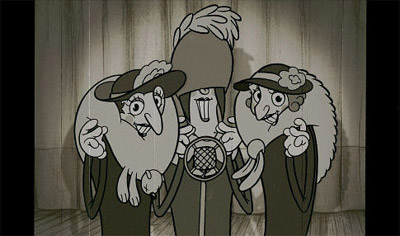
A young boy grows up to become a cyclist whom the French mafia want to kidnap to use as a power source. Yes. This is a common problem.
A few points about the French mafia:
1. They are better-dressed than the American mafia.
2. They are less interested in practicality than in the je ne sais quoi of an idea.
3. They tend to be broad and squarish and so thin they nearly disappear when they turn to the side. For this reason, they could be lurking anywhere.
Childhood events exercise a curious power over the mind (whether human or canine). Yes. They are called "formative years" for a reason.
A few points about The Triplets of Belleville:
1. It's quirky (you guessed that).
2. It's visually innovative.
3. It has sparse dialogue.
Benoit Charest writes, and Matthieu Chedid sings,* warm organic music with real instruments. Kraftwerk makes cold computerized music with circuits and knobs and switches.
A few points about Belleville Rendez-Vous (French Version):
1. acoustic guitar, muted strums.
2. classical guitar with the fingers breakdancing down the frets.
3. the voice. the voices. the harmony.
A few points about Tour de France (French Version):
1. drum machines, bike chain, grunts of a cyclist up a long hill.
2. the guitar, sounding like steel drums, with an unlikely melody.
3. the harp suggesting that might be the warmest Kraftwerk get.
[Triplets of Belleville]
[I think the French version is the same as the Francois K. remix on this disc but I'm not sure, as I only have the LP EP.]
...
If you don't read Girish's site you probably missed the notice, and even if you do read it, you might have forgotten about it, but I'm calling for a horror film blogathon on October 31st. (And today is a bit late to make the announcement, yes; suffice it to say that organizing movements is not one of my strong points.)
The blogathon is an idea Girish cooked up: bloggers write about one topic and all post on the same day; all you have to do to be a part of it is to post on the topic and say you're a part of it. In the past people have written on Showgirls, avant-garde film, Abel Ferrara's films, Hayao Miyazaki's films, Michelle Pfeiffer's films, and Code Unknown. If you decide to take part, please send me the URL once you've posted so I can link to it.
Elsewhere:
Soulheads, don't miss Darcy's post on The Ohio Players, Dan Phillips' post on Bobby Rush, and Soul Sides' post on Johnny Otis.
...
The House Next Door with a Jonathan Rosenbaum interview.
...
Fast Film, an animated movie mashup short. I've seen this before, though I can't remember where.
...
For the sidefills, can we have two great big enormous things please, of a type that might be venerated as gods by the inhabitants of Easter Island, capable of reaching volumes that would make Beelzebub soil his underpants, and driven by amplifiers that could provide the power for a Monster Truck Rally.
Iggy Pop's concert rider
...
Free Hugs: much better with the sound off. I like it with Ernie K-Doe's "Te Ta Te Ta Ta."
...
one-dimensional Tetris.
*Thanks to Vincent for correcting me on the attribution.
Labels: blogathon, electronica, soundtrack
posted by Tuwa @
15:03 | permalink |
4 comments
|
Paul Phillips & His Band -- Naked City
Paul Phillips and His Band -- TenderlyPaul Phillips and His Band -- In the Still of the Night
An argument:
1. The soundtrack to The Naked City is awesome.
2. There is an LP titled Naked City.
3. Some of the tracks on that LP are awesome.
:. The tracks are from the film The Naked City.
If this were in Introduction to Logic I'd have to question the conclusion. See, there might be other audiovisual entities named Naked City, for instance a TV show that was popular a decade after the film. There's also the premise that some tracks on the LP are not familiar to a viewer of the film. And one could introduce the premise that there are tracks on the LP which stop at "good," but by that point one would be making qualitative judgments and edging away from the purely mathematical/logical. Let's just say that the conclusion is not supported by the premises and try for another, avoiding any hint of linguistic hanky panky.
How about "There are millions of tracks from films, and these might be some of them"? No. Not a good conclusion--where it's not flippant it's vapid, the statement of a politician with few convictions beyond the necessity of his own re-election. And, besides, it doesn't follow necessarily from the premises.
Maybe we could escape the strictures of logic altogether, abandon the argument, present simply four premises, no conclusion?
"4. The full title of the LP is The Sound of Midnight: Naked City, by Paul Phillips and His Band, arranged and conducted by Joe Harnell, Kapp Records release MS-7517."
[LP out of print]
Labels: jazz, out of print, soundtrack
posted by Tuwa @
02:11 | permalink |
2 comments
|
Daniel Valdez & Edward James Olmos -- Marijuana Boogie
Daniel Valdez & Edward James Olmos -- Marijuana BoogieLast post's Asha/Kronos track was in context of a disapproving film, but I'm not so sure about this one--I haven't seen Zoot Suit, the film it's from. Side one of the soundtrack is mostly Chicano swing (half of it, including this one, composed by Lalo Guerrero), with one then-modern rock song, all of them with vocals; side two is entirely instrumentals, most of them swing standards.
This one is from side one and features Edward James Olmos doing his best Dr. John impression. Or maybe he's imitating Tommy Mooney, whom allmusic.com lists as the only other performer of the song--but I have no idea who that is, and allmusic.com doesn't seem to know much about him either.
(update: rosswords writes in to say that allmusic.com attributed the song wrong on that page--that Tommy Mooney sang "Bingo Boogie" on the CD, but that "Marijuana Boogie" is performed by Lalo Guerrero. Also: "Neither of those two songs are really boogie-woogie, which is a wild eight-to-the-bar piano music. In those days, you just added the word 'boogie' to a song and sales doubled." And, finally, the version here isn't properly boogie woogie either, but more a Tin Pan Alley/Dixieland/showtunes version.)
My Spanish is a bit rusty, but I'm not sure I ever knew what a zizivato or a calco is. I understand the rest, though, and quite like the piano. And I can forgive a song about marijuana for not working itself up to a flashy conclusion.
...
For fans of Cronenberg and "body horror" in general: Ascaris lumbricoides, complete with pictures and video. I've been having nightmares about this three nights running.
...
There are a lot of complaints you could make about the Barnes & Noble website, but this is a neat feature: searching by instrument. These CDs in the catalogue have theremin on them (or, in the case of Portishead, a convincing synthesizer); these have pipa. Gentlemen, start your mixtapes.
...
A record exec answers, in general, "Why isn't $Awesome_Thing_X on CD/DVD?" Which leads, naturally enough, back to the question of whose purposes copyright is serving when the artists can't keep their work in print even though their audience wants it. I wonder if the current system is doing as much as it should for furthering the "progress of the arts and sciences"--it seems that scientific and artistic progress would depend on keeping works in print so those ideas can circulate through society and be challenged or built on. And things aren't valuable only because they can be sold; I'm sure we all have things we could sell (CDs, food, family) that we decline to because we prefer their function to their theoretical market value.
...
box.net has recently changed its prices and instituted a bandwidth cap. It seems they want to compete with Google's upcoming GDrive, probably as part of a larger quest involving disenchanting maidens and tilting at windmills. At any rate, by Friday I'll probably be out of bandwidth for the month, which means that I'll need to decide whether to pony up for more bandwidth, post less, or find some other solution.
Labels: out of print, soundtrack
posted by Tuwa @
00:02 | permalink |
1 comments
|
together we'll nab it
Kermit and Fozzie -- Movin' Right AlongWhat could be better than two Muppets singing a song about friendship? I mean aside from singing it with witty lighthearted lyrics, to the accompaniment of a banjo and a string section?
[The Muppet Movie soundtrack], if you have $100 you didn't know what to spend on. Or pick the track up on this comp. Both of them also have "Can You Picture That?" so you're sure to have some fun.
...
Listening to this soundtrack again, I see that I missed my chance--Dr. Teeth belonged after Screamin' Jay Hawkins, and before something by Dr. John.
The Bran Flakes sampled this, with good results. The Gramophone posted that track in April '04, so I won't crank it up here again.
...
I keep forgetting to mention Girish's site--or, more specifically, his comments sections. Don't get me wrong; his posts are good--both the ones about movies and the ones about music--but there's something about the comments that is even more impressive. It's not just that the posts all get many more comments than nearly any post at any mp3blog (though they do); it's that the people posting clearly have actually thought about what other people have said and what might be meant by it. It's not uncommon to see a point, a rebuttal, a clarification, a question, a realization. That sort of interaction seems somewhat rare online, oddly enough, where interaction is as effortless as typing and as quick as an electron. In any case, Girish's site makes for some consistently enjoyable reading and I'm glad it's out there.
Labels: comedy, soundtrack
posted by Tuwa @
02:52 | permalink |
5 comments
|
The Alloy Orchestra: The Man with the Movie Camera
The Alloy Orchestra -- Man with the Movie Camera excerpt (Chapter 4)
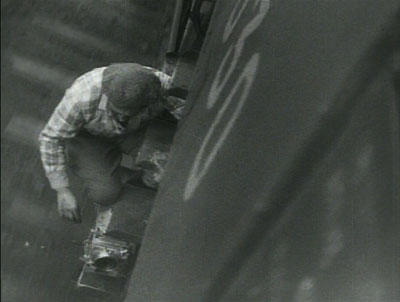
On one level The Man with the Movie Camera is an exploration of a day in the life of Soviet society, various workers preparing for and getting to work; on another level, the film is a celebration of film itself, grabbing you by the lapels and raving about the possibilities; it fires off impassioned tangents about the camera's all-seeing eye, about film's versatility and usefulness, about the joy of montage. So out go Dziga Vertov and Michael Kaufman to prove it, catching life unawares--sometimes filming it covertly, sneaking up on it, sometimes getting in its face to see what kind of reaction comes about--at pubs, at park benches, in the street, in the maternity ward, people going to work, people going to the theater, people at work making films to show in the theater. The film fits in well with Vertov's propaganda work of the time, though he scorned fiction as bourgeois luxury (I wonder what happened about that, if anything--Sergei Eisenstein and Battleship Potemkin were both enormously liked at the time). Fortunately the film is exhilarating work.
The film has aged so well at least in part because Vertov was doing things with it that still seem fresh and inspired seventy-six years later: freeze frames, reverse motion, split screen, insane angles, commentary and meta-commentary and commentary about the meta-commentary all mixed up in a heady brew. And the music--the music bumps along, exploding primary colors and syncopated whimsy, jaunty angular pounding piano like some occult precursor to Monk and Brubeck, cymbals, chimes, snares rattling like a train, like a circus on wheels, like a rollercoaster between towns.
 This track is from the 1996 re-release of the film, which had a new soundtrack recorded from Vertov's notes. I've heard an earlier version (the first, I think), which pales in comparison--I mean it pales in the way a ten-minute sketch pales in comparison to Güernica, or a wine cooler in comparison to a shot of whiskey. By which I mean, there's no comparison.
I've heard there's yet another version of the soundtrack but I haven't yet gotten past this one. Eventually I'll seek it out, but for now this one has my full respect and it's hard to imagine being any more satisfied.
The track does just end suddenly, yes--we're riding along in a car, watching the next car; we're in a car further back, watching the cameraman filming the other car; we're alongside a horse pulling a carriage--the horse stops. Freeze frame. It reverses a bit, slides out of frame. We're in the editing booth with the editor, looking through clips, pulling them out: appraising, selecting, cutting, splicing.
The film was silent but for the 1996 re-release some sound effects have been foleyed in, like the crowd noise at the start of this track and the arrival of the train.
As far as I know, the Alloy Orchestra's version of the soundtrack is not available on CD. I would love to be proven wrong.
Labels: jazz, movies, soundtrack
posted by Tuwa @
18:15 | permalink |
0 comments
|
Mikis Theodorakis
Mikis Theodorakis -- La Course De Manuel (Chase)
Mikis Theodorakis -- To Palikari Echi Kaimo (vocals: Maria Farandouli)
Mikis Theodorakis -- To Palikari Echi Kaimo (vocals: Mikis Theodorakis)
Walking home with a few sacks of groceries, you hear a snatch of music that grabs your attention. You turn to look, and find that the music is coming from a third-story loft, the window up halfway, propped with a board. After awhile you take a seat on the curb and set your groceries down beside you.
You sit fascinated, staring up at the window across the street, and then you notice that a group of wiry muscular heavily tattooed men have formed a half-circle behind you. They're closing in on the sides and they want to know what you're doing there. You point up at the window. The leader turns to look, and then the others follow suit. No one says anything for awhile.
Then, from your right: "I like the girl." You nod.
"I like the man more." This from your left. "It's like he has to try harder, but that makes it better." You nod to this too.
They sit down, one by one. A few songs later, you realize your ice cream sandwiches are probably melting. You open the box and pass them around. It's not enough. You look to see what else you have.
The next week you pass that same spot. The men are all there, hanging out on a stoop chit-chatting. The window across the street is closed. The men watch you approach. You tip your hat. They nod in response. From the back, someone asks if you have any ice cream sandwiches.
...
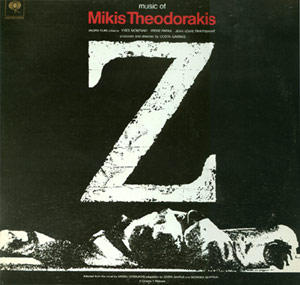
A bit of background: the last track offered here was one of two bonuses to the LP, which weren't included in the film. The film is a tightly-constructed political thriller about the assassination of a political figure and a government conspiracy to hide it (it sounds like it might be dull, ponderous, belabored--it's not; it's fascinating, fantastic, and should IMHO be well up on the IMDb top 250). At the beginning it's stated that any similarities between the characters and real people are deliberate. It's bold and brilliant work, on both the film and the music. Following the 1967 coup in Greece Theodorakis was jailed and then exiled for his political activities, but Costa-Gavras seems to have escaped that fate. Theodorakis is still alive and apparently going great guns, and no, thank you, I'd rather not debate his political views. :-)
wikipedia writeup on Mikis Theodorakis
Mikis Theodorakis' site
Z page at IMDb.com
[Amazon.com]: An out-of-print double-CD set of four soundtracks, if you have $100 USD you don't know what to spend on.
Labels: is fiction, movies, out of print, soundtrack
posted by Tuwa @
02:10 | permalink |
0 comments
|
Look Over Your Shoulder
Alan Price -- Look Over Your ShoulderTrack today is from Alan Price, keyboardist for The Animals, on his work for the soundtrack to the Lindsay Anderson/Malcolm MacDowell film O Lucky Man! Anderson and MacDowell have done some very odd and fascinating work together, starting with If...., a surreal, grim, blackly humorous film about some rebels at a British boarding school (<rot13: spoiler/commentary>Vapvqragnyyl, vg raqf jvgu n fubbgbhg juvpu jrag pbzcyrgryl haerznexrq va gur H.F. va gur zrqvn nsgre gur inevbhf fpubby fubbgvatf. V thrff gurl'er chaqvgf, abg fpubynef; gurl'er snzvyvne jvgu ivqrb tnzrf naq fb gubfr trg gur nggragvba engure guna nalguvat zber eryrinag be, Tbq sbeovq, frafvoyr. Nf Puevf Ebpx fnvq, jungrire unccrarq gb "ur'f shpxvat penml" sbe na rkcynangvba?</rot13: spoiler/commentary>)
O Lucky Man! picks up with Michael Travis some years later as his career takes a number of unexpected and amusing turns, putting him through all classes of British society. Like the first film, it's a social commentary and it tends towards the deeply satirical. Price's work fits the film like a glove and I think it's awesome that Price is filmed with his band, playing his piano, and the footage is cut in with the story so that the songs comment on the action like a Greek chorus. It's a bold move--risky--but I think it works.
"Poor People" puts social class as a zero-sum game, explaining that poor people stay poor because they don't have spunk enough to take everything they can, gleefully; "Justice" explains that you need a lot of wealth to get any; "My Home Town" is a ragtimey tune with some wonderful lyrics. Those are all good tracks, but I think "Look Over Your Shoulder" is the one for today, because the rhythm and melody are memorable, hummable, and (as Sean at Said the Gramophone said) pastoral. Very nice for a mid-summer.
When there's a bluebird singing by your windowpane
And the sun shines bright all day through
Don't forget, boy, look over your shoulder
Because there's always someone coming after you-hoooo, la la la la....
Right-o. Bangup work.
I just want to reiterate at this point that I do very much like every track I've posted here on the shanty. That said, some of my writeups left a lot to be desired, especially the ones that sound glib or spend their time talking about things with nothing whatsoever to do with the music. I'm making it up as I go along, true, but I'll try to do better. If nothing else, I hope you dig the music.
Daily Question: John at The Tofu Hut was
a) kidnapped by aliens for a young extra-terrestrial's science project,
b) kidnapped by the CIA/DHS/NSA for posting unpatriotic photos,
c) kidnapped by the RIAA and forced to listen to the Beauty and the Beast soundtrack on repeat for nearly two weeks, effectively breaking his psyche and forcing him forevermore to post only music that sucks, or
d) not kidnapped at all; in fact he decided to take a trip to Isla Mujeres, where he is now, in a hammock with a straw hat over his face, sipping a margarita and singing "Malagueña". Badly.
[Amazon.com]
Labels: pop, soundtrack
posted by Tuwa @
13:23 | permalink |
0 comments
|
I Can't Believe That You're in Love with Me
May Wynn -- I Can't Believe That You're in Love with MeTrack today isn't so much a diamond in the rough as a ruby from a stack of emeralds: "I Can't Believe You're in Love with Me," a sultry jazz number from the Bogart film The Caine Mutiny. The movie is based on the Herman Wouk novel about a mutiny onboard a naval ship (a topic that might strike you as anything but sultry and jazzy--really, as competent as the movie is, the romance scenes still seem to belong to a different very competent movie from the rest of it).
The song's a jazz standard composed by Clarence Gaskill and covered by some heavyhitters (Louis Armstrong, Frank Sinatra, Django Reinhardt, Ella Fitzgerald); the performer here is a woman by the stage name "May Wynn," playing a singer who's taken the stage name "May Wynn."
I ripped the track from the VHS; as far as I can tell, the soundtrack was last released in 1954 on LP. So I hope you can pardon the bit of incidental music that bled over from the previous scene ... I just think there's something timeless & classy & compelling about the track, enough that I wanted to share it.
Labels: movies, out of print, soundtrack, vocal
posted by Tuwa @
13:46 | permalink |
0 comments
|
happymaking post
Chico Marx -- 2nd movement of the Beer Barrel PolkaMarx Brothers today, only because I watched At the Circus and A Night in Casablanca recently, and this track made me smile. It's from A Night in Casablanca, but the soundtrack isn't in print and I didn't see any tracks from it on the boxed set.
The Marx Brothers films are kind of uneven IMO but the musical numbers are always a treat.
Beer Barrel Polka lyrics (that would be for the, uh, first movement.)
Warners vs. the Marxes about the film title. Groucho shuts them out.
IMDb claims that Roeper claims that story is a legend, but I can't find anything about it from Roeper himself. And the IMDb also claims that someone said "Play It Again, Sam" in this film, but I think they've confused the Marx Brothers with Woody Allen.
Snopes.com on the story: untrue.
Labels: comedy, jazz, movies, soundtrack
posted by Tuwa @
23:41 | permalink |
0 comments
|
thoughts of you get in my eyes
George Clinton and Parliament Funkadelic -- Erotic CityHere's a track off the PCU soundtrack. One of the reviews for the film says "not Animal House, not even close," which is true enough. But I'll take my gems where I can find them. As most of you probably know, this is a cover song originally by the purple one who shall not be named.
I love it when Parliament's in session.
edit: bloglines won't syndicate this post for some reason, so I guess this one is a bonus for people that come to the site.
[Amazon.com]
Labels: funk, out of print, soundtrack
posted by Tuwa @
14:28 | permalink |
0 comments
|
from somewhere on the Long Tail
Teddy Randazzo -- Shall We Gather at the Boat DockJoseph Mullendore -- Requiem for a Sideman
Thought I'd drop a couple tracks today from a CD compilation that a friend turned me on to; the compilation is one of out-of-print LPs digitized by Basic Hip Digital Oddio. The compilations are organized by theme, and both of the ones that I've heard have some real gems on them. These tracks are both from the Soundtracks Of The Sixties Volume 1 and are, as you might expect, orchestral jazz; the CDs had them at 320kbps, really great sound, but I've dropped them down to 128 here so they're quicker to download.
Historically about 95% of everything published goes out of print and stays out of print. With the evidence of online music sales--that everything sells for the right price, and typically does so every month, many times--maybe that will change. Here's hoping: there are some fantastic pieces that haven't ever been rereleased. Wired's article on The Long Tail article argues (convincingly, I think) that even the misses can be hits in a digital store. And I think digitizing and offering an entire label's catalogue, once you get past the initial outlay, could be hugely profitable, especially on these big labels, where they have just acres and acres of vinyl. (So much to explore, you'd never run out--you'd just need some network to poke around, making connections clear--either a database of who worked with whom, or "if you like x have you heard y?"... And maybe a "random" function like you get sometimes in real vinyl collections.... It could be a music geek's paradise).
On that note, I'm still (periodically) looking for this one version of a Cannonball Adderly track I heard nearly 10 years ago. It would be much easier to have it available for download than to have to try to track the record down in hopes of digitizing it. I'd gladly pay the 99¢.
Get hip
Labels: jazz, out of print, soundtrack
posted by Tuwa @
01:41 | permalink |
0 comments
|
I think I see the light
Cat Stevens -- I Think I See the LightTrack today from that notorious singer/songwriter/humanitarian Yusuf Islam, whose peace activism so alarmed the United States they had him deported. (To be fair, the U.S. claimed he contributed money to charities which contributed to Hamas, which isn't the sunshiniest group around; but, to be logical, W. and Osama have a similar relationship; and Bush's pop and Noriega did as well, so why is the administration pretending outrage?)
This song is from Harold and Maude, in the scene where Harold is in bed blowing bubbles. Quite the change from his previous hobbies--all macabre failed attempts to get his mother's attention.
...
non-partisan political message follows:
Everyone in the U.S., please be aware that you can vote early, and please do vote. And, if you're in California, please know that you have the right to vote on a paper ballot. Spread the word.
I am very skeptical of e-voting machines: you get a paper record even for buying a Coca-Cola at the gas station, so why should your voice in your own government be any different? Is it less important?
Representative democracy hinges on accountability and transparency, and with no paper record, there's no possibility of a recount. So please do vote and please do request a paper ballot. If you've got one of these confounded e-voting machines in your area, you should take it up with your elections supervisor: the purpose of HAVA was to get away from things like hanging chads; that can be accomplished as easily with an optical scan machine (they work as expected and leave a paper record that can be recounted if need be. So they are, IMO, a thoroughly superior solution--the voice of the people being important and all). There have already been numerous reports of e-voting ballots being "lost," of people pressing the box for one candidate and a check-mark appearing for the other, of the machines crashing.... Please, please, regardless of whom you're voting for, vote on paper.
Official Site
[Amazon.com]
Labels: politics, rock, soundtrack
posted by Tuwa @
13:18 | permalink |
0 comments
|
Edwards and Mancini
Henry Mancini -- Walkin' BassHenry Mancini -- Blue Steel
Two from the Mancini vaults. These were bonus tracks on the 1999 re-release of the Peter Gunn soundtrack. I'm not sure why they weren't released in the first place, as I think they're great.
These won't do much for you if you don't like orchestral jazz, but I love them--the walking bass on, uh, "Walkin' Bass," the flute, the baritone sax--and "Blue Steel" is as fine a bit of orchestral jazz as I've heard, even if the start of that baritone sax solo does borrow a bit from "Don't Sit Under the Apple Tree (with Anyone Else But Me)." (Brubeck borrows--or "samples"--from Glen Miller from time to time also, as well as from Thelonious Monk and countless others. It's very very common in jazz. But never mind about recent brain-damaged Supreme Court decisions).
The liner notes tell a story about Mancini being fired from the studio where he'd worked, and going afterwards to get a haircut. In the next chair was Blake Edwards; they started to talk and Edwards asked Mancini to write for him. And there you have it. If you're an unsuccessful musician, maybe you need to get a haircut more often--you too can write "Peter Gunn" and the Pink Panther theme.
An aside here. Actors used to work under what was called the studio system, which is that, say, Cary Grant was signed on to a certain studio and could not work with any other until the (sometimes decades-long) contract ran out. Actors and directors started making enough noise about it, saying it was an illegal monopoly, that eventually the U.S. filed suit against the studios under anti-trust laws; the case went to the U.S. Supreme Court, which sided with the actors. (Obviously the Supreme Court used to be a bit more serious about illegal monopolies--look at the difference between the scope and reach of the "trust-busted" railroad companies in the early twentieth century, and the scope and reach of Microsoft, which got a slap on the wrist.)
So. About the studio system. There were some brilliant and amazing films produced under the studio system, and any restriction will have its costs and its benefits. Now an actor can work with any director he wants, and a director can work for any studio he wants. Often an actor or director will have the rights to something and shop it around until finding a studio interested in financing it--it's the film they're interested in, not the studio. ... So would things be better or worse in music if the "label system" were abolished and a band could shop any album around until finding a label that liked it?
The Studio System
[Amazon.com]
Labels: jazz, soundtrack
posted by Tuwa @
16:23 | permalink |
0 comments
|
Leone and Morricone
Ennio Morricone -- The Man with the HarmonicaI watched The Good, the Bad, and the Ugly last night and, aside from not thinking that the Good was particularly good or that the Ugly was particularly ugly, I thought it was a good film. I liked it much more than when I last saw it, about ten years ago, but I still don't think it was better than Once Upon a Time in the West--in my opinion that entire scene around the bridge is bunk, though the rest is very good. I didn't have any crisis of belief watching Once Upon a Time in the West.
Throughout the film, there's this man with a harmonica--played by Charles Bronson--who's one of several men after this merciless killer who's after a woman who, in my first guess, will be killed before she has enough time to figure out what's going on. But things don't work out exactly as expected. I kept wondering why Bronson's chracter had the harmonica and why he was after the killer (played, oddly enough, by Henry Fonda--quite the difference from that unshakeable noble juror in 12 Angry Men). This track is part of the theme that plays throughout, culminating at the climax, when all you can do is sit back and say "holy shit." It's wicked, in the truest sense of the word; it's almost too much to believe but the music pushes it through. It wails, it screams, it moans: "it's all true, every bloody last bit of it."
The track starts with the harmonica, lone and haunting, then adds in seesawing strings and a distorted electrical guitar, and a brief orchestral section. It sounds like the opening number for the four horsemen of the apocalypse in concert; it's as brilliant and memorable a piece of film scoring as I've heard.
[Amazon.com] Get the re-release, with previously unreleased tracks.
Labels: movies, rock, soundtrack
posted by Tuwa @
16:07 | permalink |
0 comments
|
I ain't skerred ... ok, maybe a little
David Byrne -- FearDavid Byrne -- Main Title Theme (Last Emperor)
Over the last year David Byrne music has turned up on a number of mp3blogs I wouldn't expect to be interested in him. In hopes of keeping the Blogger Cred Police from kicking my door in, here's some trippy funk from the out of print In Spite of Wishing and Wanting. The disc is a soundtrack to a dance routine, and if you can't listen to this track and see why then you just might be The Squarest Person Alive.
And then here's something hip and cool and achingly beautiful from The Last Emperor soundtrack. Byrne and Ryuichi Sakamoto each composed half of the music; the soundtrack won both an Oscar and a Grammy. The film deals with the last emperor of pre-Communist China and the hardships he faces once communism is established; it won a number of Oscars, BAFTAs, and other awards but didn't make it onto the IMDb top 250.... Well, the IMDb list has been more consitently entertaining that most film lists I've seen (here's looking at you AFI, Maltin, Time Out, National Registry).
Discography. And Samples!
[Amazon.com]: The Last Emperor
Labels: movies, out of print, rock, soundtrack, world pop
posted by Tuwa @
01:24 | permalink |
0 comments
|
That Loving Feeling
Isaac Hayes -- That Loving FeelingIsaac Hayes taught himself piano and sax and worked for awhile as part of Stax's house band, guesting with Otis Redding and Johnnie Taylor, among others. His released his first solo album in 1967; Hot Buttered Soul got a lot of attention in '69 and sold well, and in 1971 Hayes won the Oscar for best song for the theme from Shaft (he was nominated for the score but didn't win). And then, just a few years later, he broke with Stax in a dispute over royalties. From there things took a turn for the worse. He went off to form his own label, Hot Buttered Soul, undoubtedly with high hopes (like The Beatles with Apple, Led Zeppelin with Swan Song), but released only two albums on it before declaring bankruptcy.
From then until the late 80s he released the occasional album and had some bit parts in various films (nothing like his lead in Truck Turner, though, just something to keep food on the table). And then he had his big break with South Park, and things have been looking up since. I read an article a couple of years ago about how his debt collectors were after him again--they knew before South Park that he didn't have the money and wasn't worth the bother.
Here's something that is worth the bother--"That Loving Feeling" off Chocolate Chip, his first album on the Hot Buttered Soul label. This is vintage Hayes: horns, piano, spare guitar, and that deep voice claiming what he's feeling is "more than sexual attraction." He talks it up anyway, just to be safe--this is exactly the kind of approach that Hayes is famous for and that Chef lampoons on South Park. But damn is it slick.
[amazon.com]
Labels: RnB, soundtrack
posted by Tuwa @
03:08 | permalink |
0 comments
|
When Good Songs Happen to Bad Soundtracks
Supple -- Stayin' AliveThis song is from the film Hurricane Streets, an independent film that won a couple of awards at Sundance in 1997. I thought the film was overearnest and strained, and the bit towards the end struck me as fake and manipulative, but I guess I'm in the minority on that one. Anyway I bought the soundtrack because a couple of the tracks piqued my interest, but having it on CD hasn't changed anything: there are a few good songs, a lot of mediocre songs, and one that's damned annoying.
And then there's this: Supple covering the Bee Gees. This isn't the effete high-pitched version you're used to: the band scraps the guitar in favor of a cello; the percussion is low-key; the singing is earthy and suave. It's how Bono might sing if he were tough like Bogart and smooth like Cary Grant. But, you know, with a better singing voice.
The song is affable enough, fun, oddly compelling. Yet it's not on Supple's studio release; it's stuck in Bad Soundtrack purgatory, waiting for some beneficent studio head to come along and pray it out.
[Amazon.com ] Used copies from 1¢. Don't miss the reviews. They make funny.
Labels: rock, soundtrack
posted by Tuwa @
01:42 | permalink |
0 comments
|
Cold Cold Ground
Tom Waits -- Cold Cold GroundI first heard this song in the film Leolo, a surreal and troubling exploration of adolescence and thwarted love. While most of the film quickly faded away, the song stayed with me: haunting yet melodic, compelling and cryptic. It reminds me of what Faulkner might write if he had been a lyricist: enigmatic images, oblique hints at the plot, animosity and menace entwined with poverty and despair. Yet, as with Faulkner, there's a ray of hope--Dilsey's church and David Hidalgo's accordion.
Caveat: this track is off Franks Wild Years which, like Faulkner, like whiskey, may take some getting used to. Tom's an odd character, with odd music. I hate some of his work, love some of the rest, and always give him another chance.
Amazon.com
Free Tom Waits download
another free download
and another
Labels: movies, rock, soundtrack
posted by Tuwa @
01:26 | permalink |
1 comments
|
 XML
XML


