looking for logic in the chambers of the human heart
Randy Hobbs -- Slowly But SurelyRoosevelt Sykes -- Yes Lawd
Funkadelic -- Maggot Brain [alt mix]
He was alone in the lobby of his hotel in Isla Mujeres, watching Hitchcock's La Ventana Indiscreta and misreading Jeffries' misgivings for disregard, zoning out looking through Lisa's face to the blue and red and green rectangles. Jorge banged on the glass by the door, smiling sleepily, holding his left crutch, his right crutch leaned against his side.
"Jorge," he said. "¿Qué pasa?"
"Nada, man."
"¿Qué tal?"
"Bien, ¿y tú?"
"Bien bien." Jorge lifted himself in off the sidewalk. "What you doing?"
"Nothing. Nothing. Just watching this movie."
"Yeah?" He came around the TV to took a look. "Válgame Dios."
"Yeah."
"Yeah." Jorge turned and hopped backwards twice, then sat down and rested his crutches beside him.
They sat there staring at the screen, red and green and blue rectangles brightening and fading away, brightening and fading away: in the commercials, in the break-in, in the theft, in the climax, in the credits.
"Buena película," Jorge said, halfway through an infomercial.
"Buenísima."
"You flying, man?"
"No, I don't smoke. You?"
"I am ... so flying, man."
"That's cool."
"Shoooooo," Jorge said. "So flying."
Flashes of light, electrons hitting the screen, red-blue-green.
"Do you smoke?" Jorge said.
"No, I don't smoke." I'm staring at a light source, Nick thought. It's furniture and it's a light source and people stare at it. And I do too.
"No smoke?"
"No, gracias."
"So flying."
"Hm...." The tick of the clock on the wall. Somewhere down the street, far off, someone telling Carlos he didn't know anything, ni una putísima cosa, coño. Cars coming by, whoosh.
"Shoo," Jorge said.
"Shoo-wee."
"Buena onda, tú."
"¿Sí?"
"Sí. ¿No fumas?"
"No, no fumo. Let's go."
"Where? To where we go?"
"I want a beer."
"¿Cómo?"
"Cerveza. Lager. Dos Equis. Vámanos."
"Muy bien. Buena onda," he said, pushing himself off the sofa and grabbing his crutches. "¿Listo?"
"Claro. Ko'ox."
"Ko'ox," he said, laughing. "¡Vámonos!"
"Buena película," Jorge said in the bar.
"Muy buena." He knocked back the last of the beer and sat staring at the table: mahogany under a dark varnish, the reflection of the ceiling fan broken by the ring from the bottle, the bottle now cool and slick in his hand as he spun it around and stopped it, spun it again.
"Buena película."
The breeze wafted in from the beach carrying that unmistakable saltwater smell, waves pounding the surf, people chatting a few doors down, Jorge and Nick and the mesero alone in the bar.
"Aren't you hungry?"
"¿Cómo?"
"¿No tienes hambre?"
"Mucha hambre."
"Well, order something then."
"¿Cómo?"
"¿No vas a pedir?"
"¡Camarero!" Jorge said. The waiter came over to take their order. He was wearing stiff leather shoes with faded blue jeans and a tan guayabera. "Dos tamales," Jorge said, and something else Nick didn't catch. The guayabera never caught on stateside, did it? he thought. There was a couple outside, looking in, speaking softly in a Scottish accent. Of course, kilts didn't either.
"¿Algo más?" the waiter said.
"Otra cerveza," Nick said.
"Dos más," Jorge said.
The waiter nodded and left. Nick spun the bottle, let it go, stopped it. Jorge contemplated the table. Nick looked out at the street. The couple had left.
"What are we doing here?" he said.
"Drinking."
"No, in general."
"¿Cómo?"
"Por lo general."
"Drinking."
"No, la gente por lo general."
"Eating, too. Sometimes eating."
"No," Nick said.
"Buena onda," Jorge said.
"¿Qué hacemos aquí? ¿Cómo gente?"
"Vinimos a beber."
He sighed. A beer opened behind him, then another. The door in the counter opened, swung back and forth, came to a stop. The waiter set down a plate of chips, a dish of guacamole, and two more beers.
[Midnite Blues Party @ amazon, and @ emusic]
[The Honeydripper @ amazon, or @ emusic]
[Maggot Brain @ amazon, or @ emusic]
Labels: blues, is fiction, jazz, RnB
posted by Tuwa @
00:15 | permalink |
7 comments
|

body snatchers mix, part 10
Helen Merrill -- What Is This Thing Called Love? (1988)A leisurely paced version with subdued instrumentation giving it a somber and somehow chilly feel. There are a number of ways to deliver the lyrics, with or without the wink; Merrill opts for without, performing it as high drama.
[from Helen Merrill Sings Cole Porter, out of print]
Hank Jones -- What Is This Thing Called Love? (Nov 1990-1991)
The bass and drums are steps up a hill; the piano carries the melody them; the strings sprint ahead like a cat, looking back, weaving between the piano's feet, affectionate or maybe just hoping to trip it.
[Hank Jones with the Meridian String Quartet, used for a dollar]
Keely Smith & Nelson Riddle -- What Is This Thing Called Love? (released Aug 1991)
If Shirley Bassey were to sing the song, this is how she'd do it: swinging for the fences, horns and drums like something lifted from the soundtrack to a retro spy film.
[Capitol Sings Cole Porter: Anything Goes]
Mandino Reinhardt and Note Manouche -- What Is This Thing Called Love? (January 1, 1994)
What do I know about Mandino Reinhardt? It wouldn't fill the back of a postage stamp: he's from Alsace; he's a well known guitarist there; he has the same surname as Django. Related? Biologically, maybe. Musically, yes.
[Gypsy Swing From Alsace @ emusic]
A very brief writeup on Mandino Reinhardt.
Dan Barrett -- What Is This Thing Called Love? (Jul 23, 1997-Oct 28, 1997)
This is a very muted presentation, and not just in the trumpet. It swings, yes, but it's the swing of a grandfather clock in slow motion. Barrett follows it not with a security guard explaining the rules of the game but with a jog past a lake with distant sailboat and setting sun reflected in ripples, complete with lakeside dog jumping to catch a frisbee.
[Melody in Swing, also @ emusic]
Dick Hyman and Derek Smith -- What Is This Thing Called Love? (1998)
Dick Hyman and Derek Smith turn in the spiritual brother to the Freddie Hubbard/Jimmy Heath version, except on piano instead of horn: the two in competition for how quickly they can play while holding a rhythm and how hard they can bang the keys as they do.
[Dick & Derek at the Movies ]
Beegie Adair -- What Is This Thing Called Love? (Feb 2001)
This one starts off sounding like it's going to be a typical sleepy approach, but Adair shows more imagination than that, giving it a driving rhythm and dropping bits of the melody as she sees fit. I'm not sure how much of the tune was improvised, but from the starts and stops I get the feeling that some of it was but that she has a perceptive band in tune with each other and having fun.
[Dream Dancing: Songs of Cole Porter]
Lemar -- What Is This Thing Called Love? (2004)
Allmusic.com describes this one as "swell-egant," which leads me to suspect I'm not a big fan of swell-egance. I hoped for a more dynamic range on the vocals though I'm not sure why: I don't have that reaction to Billy Holliday's version or to Lena Horne's, though they're arguably working within an equally narrow range.
I'm sure it's just a matter of taste; Lemar has a successful career across the pond.
[De-Lovely soundtrack]
And a song not by Cole Porter!
Tom Waits -- Earth Died Screaming
This is a bizarre and sinister track with funky guitar, off-kilter percussion, and snarling slurred vocals proclaiming death and doom: John the Revelator with a sense of melody and a junkyard band.
[Bone Machine]
Thanks again to Girish and Rev. Frost for suggestions and for helping me track down many of these covers.
Labels: body snatchers, jazz, rock, vocal
posted by Tuwa @
23:55 | permalink |
1 comments
|
body snatchers mix, part 9
Buddy Tate and Claude Hopkins -- What Is This Thing Called Love? (March-October 1960)If this were a scene in one of the films it would be an extended take from Siegel's version, Miles and Becky in the bar, close dancing and pretending they're not falling in love again, the barman studiously not paying them any mind.
[Buddy and Claude @ emusic]
King Curtis -- What Is This Thing Called Love? (April 1960)
King Curtis was a record producer who started as a session player for R&B groups before moving on to a solo career. He recorded with John Lennon, Billy Preston, Aretha Franklin, and Duane Allman, as well as releasing a number of his own albums, before he was stabbed to death outside his New York apartment.
When I first heard this version of the song I wondered whether Curtis had cribbed from Cannonball Adderley or the other way around. The dates were one clue; the other was that on this track King Curtis has Nat Adderley on cornet.
I think I prefer this version for its concision, though the piano by Wynton Kelly is also quite nice (but, naturally, Victor Feldman on Cannonball's version acquits himself nicely).
[Soul Meeting ]
Cannonball Adderley -- What Is This Thing Called Love? (November 1960)
The rhythm is the same as the King Curtis version, but the tempo sped up, the song stretched out, the group treating the song like a pencilled map they aim to fill in.
[What Is This Thing Called Soul?]
George Shearing -- What Is This Thing Called Love? (June 1962)
George Searing and his group swimming against the tide of bop, turning in a sedate version with the bass riding a groove, the piano swapping between syncopated melody, vamps, and flights of fancy.
[Jazz Moments ]
Carmell Jones -- What Is This Thing Called Love? (1965)
Doubletime bass with trumpet (Carmell Jones) and tenor sax (Jimmy Heath) taking turns on the melody over nine minutes, seeing which one of them can blow hard and fast enough to reheat the cup of tea behind the microphone. It bubbles a few times; they give up, winded.
[Jay Hawk Talk]
Freddie Hubbard & Jimmy Heath -- What Is This Thing Called Love? (1965)
Eleven and a half minute version with sax and trumpet in competition again, Jimmy Heath trying to outbop himself. By the end of it, the tea has boiled and the ceramic cracked. I imagine the applause at the end is partly gratitude for turning in such an intense performance and partly relief for not killing themselves in the trying.
[Jam Gems: Live at the Left Bank]
Chris Connor -- Love Medley: What Is This Thing Called Love? / You Don't Know What Love Is (Aug 1986)
Chris Connor with a version which is energetic enough on its own but sounds positively tranquil in comparison to the last two versions.
[Classic]
Jessica Williams -- What Is This Thing Called Love? (Oct. 1986)
Jessica Williams on a whimsical, agile, and energetic piano rendition recorded live.
[Encounters, Vol. 2]
Mel Powell -- What Is This Thing Called Love? (October 21, 1987)
Mel Powell on his return to jazz after decades as a classical composer, recorded live on a cruise ship. It's a good track; Powell's in fine form; the bass gets a solo which maybe goes on a bit too long; but the group are obviously stretching themselves a bit and having a good time, and they have an appreciative audience.
[Return of Mel Powell]
...
Well, today didn't go as planned. Still, I think I've probably said all I have to say about the Body Snatchers works, at least without further reading. Next post will wrap it up, most likely with some brief summary of findings about sleep and dreams.
Labels: body snatchers, jazz, vocal
posted by Tuwa @
22:56 | permalink |
0 comments
|
body snatchers mix, part 8
Art Tatum -- What Is This Thing Called Love? (August 1, 1955)A leisurely stroll down Vibraphone Lane. I can't help picturing this in a Woody Allen film, one of his light comedies, accompanied by a tracking shot with Allen and his love interest walking through Central Park.
[The Tatum Group Masterpieces, Vol. 3]
Art Tatum -- What Is This Thing Called Love? (September 7, 1955)
This time Tatum and his group have eight minutes to play a ten minute song; as soon as the last measure fades out, they throw down their instruments and dash outside to catch a bus.
[The Tatum Group Masterpieces, Vol. 5]
Ella Fitzgerald -- What Is This Thing Called Love? (Feb - Mar 1956)
Ella Fitzgerald turns in an effortlessly classy big band version, strong and confident.
[Ella Fitzgerald Sings The Cole Porter Songbook]
Tito Puente -- What Is This Thing Called Love? (May 2, 1956)
Puente leads a big band Latin jazz version: sax, trumpets, bass, drums, and piano supplemented with William Correa on bongo and Ramon Santa Maria on conga. The liner notes for this CD are both odd and brief, switching between defensiveness about Puente's body of work and scorn towards towards the perception of multiculti trendiness and the politically correct.
[Puente Goes Jazz]
Red Garland -- What Is This Thing Called Love? (Aug 1956)
Red Garland leading his first album with the jazz trio. I enjoy this version more each time I hear it: the drums and bass step in and out at will; Paul Chambers delivers a solid acoustic bass solo; Arthur Taylor serves up two nice drum breaks; and the piano? If it's good enough for Miles Davis I'm willing to pay attention to it to try to figure out why. I'm sure I don't understand as much of it as Davis did, but I'm glad to give it the attention.
[A Garland of Red]
Julie London -- What Is This Thing Called Love? (1958)
I wish I had Girish's ear and could say something clever about this song's construction. It seems over before I expect it, and I'm at a loss as to how to describe the guitar.
[Julie London Sings Cole Porter ]
Anita O'Day -- What Is This Thing Called Love? (April 1959)
Anita O'Day delivers the line with a frantic melody, followed by some improvisation, scat and drum breaks, a sudden slowing and outro.
[Anita O'Day Swings Cole Porter with Billy May]
Mel Tormé -- What Is This Thing Called Love? (Apr-Aug 1959)
This is not an unexpected delivery from Tormé, though if the date on this is correct I think it is an unexpected performance from his backup singers: the vocal style is a throwback to twenty years earlier (a style I enjoy quite a lot, but find in short supply for most post-WWII music).
[Night and Day: The Cole Porter Songbook]
Bill Evans -- What Is This Thing Called Love? (1959)
If music is the space between the notes, Evans is a master of feng shui, playing the melody like a familiar face in newsprint dots.
[Portrait in Jazz]
Apologies for posting so many tracks at once; this is not how I usually do it but I've started this mix so I want to finish it, and I'm feeling increasingly ready to move on to talking about songs which are not by Cole Porter.
In thinking of Ferrara's Body Snatchers, it occurred to me that Marti for some reason never attends school like her little brother, which led me to wonder why she was still at home, which in turn led me to wonder why I should assume that if she's old enough to have graduated then she should have moved. It's a cultural assumption about something that's not always true even in the U.S. Yet it's a useful assumption, insofar as it leads to questions about the various Body Snatchers works' inherent Americanness.
Siegel's 1956 version has been selected to the National Film Registry and honored by the American Film Institute, and yes, it seems informed by a distinctly American political landscape, whether the film serves as a metaphor for Communist or McCarthyist fears. But what about the other two films, and the text versions? I'm reminded of Stephen King's note in Danse Macabre that The Exorcist made little money in Germany, but that ticket sales for Dawn of the Dead were through the roof. King takes that as a sign of different culture: Germans were not particularly troubled by flower power and rebellious teenagers and so, lacking the cultural backdrop of The Exorcist, found the film uninteresting, yet Romero's satire of commercialism hit home. I wish I knew how the Body Snatchers films performed in other countries compared to other American releases. More than that, I wish I'd found some thoughtful writing about the cultural implications of the later two films, but most of the writings I've found on them either take the cultural background for granted or treat it in brief detail in service of a larger point.
I wonder, for instance, how a Japanese Body Snatchers might look, or what themes a Body Snatchers in The Netherlands would explore, or for that matter a Body Snatchers set in an English boarding school (think If.... as a horror film). I think the closest we got to that was Robert Rodriguez's The Faculty, based on an entertaining but hardly horrifying Kevin Williamson script.
Williamson makes the odd choice of having one of his characters accuse Finney's story of being a blatant ripoff of Robert Heinlein's Puppet Masters, another Cold War novel about an alien invasion. I haven't read the book but from conversation with Sean at Said the Gramophone, and from various readings about the book, it seems apparent that the novel's Cold War setting is as far from subtext as it is from tasteful. Yet Body Snatchers and Puppet Masters have some apparent differences: in Puppet Masters the aliens are parasites which attach to humans to control their minds; in Body Snatchers the aliens replicate the human bodies and memories and destroy the originals. The Faculty, in its alien-parasite/mind-control angle, shows more similarities to Heinlein's Puppet Masters than Body Snatchers does, and so its accusations against Finney come off as a bit cheeky (which is perhaps to be expected from the screenwriter of Scream).
Of the three official film versions, Ferrara's is the only one to have a sympathetic psychiatrist and, as it turns out, the main character in the The Invasion, played by Nicole Kidman, is also a psychiatrist. As mentioned in an earlier post, The Invasion was originally based on Finney's story, yet after a number of plot changes the producers decided the film was no longer based on Finney's work. But imagine if it still were--or, for that matter, imagine other settings the story might have to allow some easy commentary about our culture and what it means to be human.
1) An intern working in a mental hospital--ostensibly studying schizophrenia but secretly studying confirmation bias in diagnosis and treatment--finds that the ward's patients mysteriously become completely sane, one by one.
Ferrara's version at the end notes that the human experience is much more complicated than simply allowing love; imagine a Body Snatchers unafraid to tackle existential despair. Prior film versions have had characters, horrified, rejecting the notion of a world without love; this one asks whether to reject a world without hate, impulsiveness, despair, and paranoia. And what about mankind's fundamental freedom to do anything at all, including make unwise decisions?
Budget: $15 million.
Key scene: a bipolar woman accepts the alien assurance of a world without misery.
Direction: a cross between Mario Bava and Ingmar Bergman.
Tomatometer: 73%
Cultural influence: film geeks remember it fondly; the film is mentioned in a footnote in a Master's thesis in mass communications submitted in 2012.
Recoups investment: two weeks into French release.
2) The Faculty suffers a few flaws, not least that the plot is fairly predictable and that the characters occasionally act more like chess pieces than people. Still, a high school or middle school would be a fantastic place for a Body Snatchers film, exploring what Ferrara touched on: adults don't listen to children, and children have little power. This remake sets the film in a typical U.S. high school and asks the audience to imagine a put-upon main character dealing with constant harassment, mounting anxieties, indifferent teachers, and unhelpful parents.
Budget: $25 million.
Key scene: The bullies allow the geek to eat his brownbag lunch without addenda, confrontation, or even a sidelong glance.
Direction: like a less careful but more cosmopolitan Steven Spielberg.
Tomatometer: 58%
Cultural influence: carvings on 3% of the nation's middle school desks.
Recoups investment: opening weekend.
3) The congregation of a Southern Baptist church loses its passion for Hallelujahs and Praise-the-Lords. They have dinner on the grounds; Mrs. Johnson fails to comment about the amount of onion in Mrs. Smith's casserole. Tithes go up as everyone begins contributing the 10%; SUVs become less common in the parking lot as carpooling increases.
Budget: $14 million.
Key scene: "Oh Hallelujah, Mrs. Sullivan! You had your baby already!?"
"Oh, no; Harold and I decided we didn't want it. Isn't that right, dear?"
"Yes, dear."
Mrs. Sullivan gets solemn, approving nods from most of the choir.
Direction: wildly variable, with a script that critics wish were a subtle satire.
Tomatometer: 6%
Cultural influence: The Unitarian Universalists condemn the film and Pat Robertson praises it, in both cases for being homophobic and witless.
Recoups investment: Twelve years after theatrical release.
Labels: body snatchers, horror, jazz, movies
posted by Tuwa @
22:17 | permalink |
6 comments
|
body snatchers mix, part 7
.jpg "Carol screams (Ferrara, 1993)")
Carol screams (Ferrara, 1993)
(a.k.a. "You! Problematic director! Front and center!")
Les Paul -- What Is This Thing Called Love? (June 1950)
Les Paul with some overdubbing experimentation, second guitar like a dream where someone is shouting in a windstorm, sound snatched away, yet somehow you understand and it's all okay.
[The New Sound]
Dave Brubeck Octet -- What Is This Thing Called Love? (July 1950)
Brubeck's version starts somber, melancholy, and cautious, exploring a cage by lanternlight, then the lights come up and it's not a cave at all but a milquetoast ball at a military installation. The band strives to be polite, wanting very much not to meet the MP.
[The Dave Brubeck Octet]
Charlie Parker -- What Is This Thing Called Love? (1950)
Is it silly to say about a Charlie Parker song that you like the saxophone? Hm, then I won't. Instead I'll say I like the strings, and the brushed drums with the occasional kick, and the piano skipping down the street, and how Parker plays around all of them, and how the audience seems maybe unsure of what to expect but willing to go along with it.
[available on Charlie Parker with Strings]
Charlie Parker -- What Is This Thing Called Love? (March 25, 1952)
Parker and the band doing their damnedest to blow the roof off (Parker is a gunslinger, see; he uses the first half-dozen notes or so, then shoots holes in the melody until it's alive but barely recognizable. And that's how he leaves it, so its loved ones can identify the corpse in full realization that it was not as badass as it thought).
[digitized from The Verve Years (1952-1954), VE-2-2523, now available on Confirmation: The Best of the Verve Years]
Frank Sinatra -- What Is This Thing Called Love? (1953)
There are a lot of ways I could have imagined the song. This isn't one of them.
[Hello Young Lovers]
Frank Sinatra -- What Is This Thing Called Love? (April 1954)
Sinatra tries again, this time taking a much more melancholy approach to the song which probably suits it better.
[In the Wee Small Hours]
Charlie Mingus -- What Is This Thing Called Love? (Dec. 1954)
Some time in the mid 1990s, I read someone disparaging jazz by saying it was what happened when four different people played four different songs at the same time. I don't think I ever heard a jazz track that fit that definition until I sought out this one for this mix. The back of the LP tells me that what we have here is John LaPorta on alto sax playing the title track, Thad Jones on trumpet playing "Hot House," and Teo Macero on baritone sax playing "Woodyn You." Very strange, frequently dissonant, and 100% wonderful. Sorry for the few rubs on the LP though.
[Digitized from Everest Records FS235, which has since gone out of print; also available on Jazzical Moods.] [--thanks, Jason!]
(more Body Snatchers discussion: spoiler warnings still in effect)
Rereading "Genre and Closure in the Seven Versions of Invasion of the Body Snatchers: Finney ('54, '55, '78), Siegel ('56, '56), Kaufman ('78) and Ferrara ('93)" I'm struck by how similar my take on Ferrara's film is to Robert Shelton's, but I suspect that Shelton is the more perceptive reader. Shelton notes that the pacing in Ferrara's film slows "when Marti (played by Gabrielle Anwar) has no clothes on," which includes both her leisurely bath and the scene later when she's been taken to the hospital for some very un-Hippocratic treatment. I'd noticed the slowed pace the first time, missed it the second. In the hospital, pod tendrils snake into Marti's nose and mouth and the pod figure sits up, nude, back arched and mouth open as if in rapture, and then turns to Tim and strikes (and holds) a rather seductive pose, speaking to him in a soft tone. All of these are behaviors we have no reason to expect from a pod person. I'd be tempted to relate the pod's indifference to her public nudity to the alienness of the pod people, as in Kaufman's version, except that it's not, really; it's saddled with an imitation of human behavior which Marti's pod has no reason to indulge in. At this point in the film Tim is surrounded with enemies who will gladly and permanently subdue him, so the nudity seems to be there for reasons other than story-logic, which is already saddled with the stipulation that Marti survive and that (nearly) everyone else is expendable.
Shelton also points out the "idiot plot hole" of the General allowing Marti and Tim to leave: "Let them go," he says, "no one will believe them." As Shelton notes, "When the equivalent of this remark was made in Siegel's 1956 version, a solitary, unarmed, exhausted small town doctor was being 'let go'; in Ferrara's 1993 version, General Platt has just 'let go' an armed attack helicopter and pilot."
All of this suggests (to me at least) that Ferrara's film is what a feminist would call "problematic," yet I have to admit that it's also successful on somewhat unexpected terms: I haven't been able to stop thinking about it. Maybe that ties back to Rosenbaum's notion that a great film doesn't have to be a good film (or, stated another way, that the quality of a film is distinct from how much it causes the audience to think). I'm not sure if Ferrara's film is a great or even a good film but it's definitely been a thought-provoking one.
Labels: body snatchers, horror, jazz, movies, vocal
posted by Tuwa @
07:54 | permalink |
5 comments
|
body snatchers mix, part 6
.jpg "Andy and his painting (Ferrara, 1993)")
Andy and his painting (Ferrara, 1993)
When you play a piece of music there are so many different ways you could play it. You keep asking yourself what if. You try this and you say but what if and you try that. When you buy a CD you get one answer to the question. You never get the what if.
--Kenzo Yamamoto in The Last Samurai by Helen DeWitt.
I have to wake up in four hours and take a ten-hour flight. Please forgive the lack of description of the tunes.
The tunes are in chronological order, or as near to it as I could get them; if someone knows the recording dates on any of these and wouldn't mind sharing, I'd appreciate it.
These early versions aren't my favorites, though I do like them; my favorites will come later: Ella Fitzgerald, Hank Jones, Keely Smith and Nelson Riddle, Bill Evans, Buddy Tate and Claude Hopkins, Charlie Mingus, Charlie Parker, King Curtis.... Some of those versions want to blow the top of your head off and douse your brain in gasoline.
Wrapup post (or posts? I have over 30 more versions of the song, most of them good, most of them worth sharing) in January.
Big thanks to Reverend Frost and to Girish for making recommendations and helping me track some of these down.
Ray Vega -- Greenhouse
This one is here because greenhouses figured largely in the first two body snatchers films (and a swamp in Ferrara's, sorry) and because I'd already decided on "What Is This Thing Called Love?" for the end when I stumbled onto this track and read that it was based on the same changes. Synchronicity.
[Ray Vega]
Artie Shaw and The Meltones -- What Is This Thing Called Love? (1938/39)
[Artie and the Singers]
Jo Stafford -- What Is This Thing Called Love? (anywhere between 1939 and 1946)
[Too Marvellous For Words]
Anita O'Day -- What Is This Thing Called Love? (1940s)
[And Her Tears Flowed Like Wine ]
Lena Horne -- What Is This Thing Called Love? (1941)
[Stormy Weather: The Legendary Lena (1941-1958) ]
Nat King Cole -- What Is This Thing Called Love? (1943-1944)
[This Side Up ]
Billie Holiday -- What Is This Thing Called Love? (1945)
[Billie Holiday's Greatest Hits (Decca) ]
Django Reinhardt -- What Is This Thing Called Love? (1947)
[The Classic Early Recordings in Chronological Order or, you know, get the box set a la carte @ emusic]
(Spoiler warnings still in effect: plot details, including endings.)
Ferrara's Body Snatchers, in spite of removing the sensational "Invasion of the," does not return to the roots of Finney's story. Of all the versions, it's probably the least like the original serialized story, in spite of having an ending most like it.
The film centers on a teenage girl named Marti Malone, who, like most of the film's characters, has no direct match with any character in the previous stories. Marti is moving to an Army base in the southern U.S., where her father Steve has been sent as an agent of the EPA to monitor use of chemicals on site. Steve's job prompts discussion of chemicals and toxicity, showing a concern for the environment most likely borrowed (like the garbage trucks and those hair-raising alien screams) from Kaufman's film. Yet there are differences with all prior versions of the film, some of them quite striking. Finney's stories were in the first-person; Siegel's mimicked that with the (occasionally cheesy) voiceover. Kaufman's version did not have a voiceover; and Ferrara's version restores it, yet only as a bookending device: two by Marti, at beginning and end, and one at the end by Carol.
Near the beginning of the film, Marti and her family are shown driving across rural highway. When they stop at a gas station somewhere outside the base, looking like approximately the middle of nowhere, Marti goes to the restroom and is rushed by a large man in camouflage. He pushes her up against the door with his hand over her mouth, warning her about people who "get you when you sleep"; Marti manages to slip out the door and away from him, where she screems for her father. Inside the restroom, Steve and a gas station attendant find that there's no one there. It's an odd resolution to the scene, since there seems to be nowhere for the man to have hidden and so it seems to hint that Ferrara is both bending the rules and playing with kid gloves in regards to Marti. This choice, coupled with the choice to have Marti provide voiceover, immediately leads the audience to expect that Marti will most likely survive and therefore reduces the tension in the rest of the film.
Also, by having Marti provide voiceover, Ferrara hints at the possibility of a feminist take on the Body Snatchers story--but it's a version that he is not particularly interested in authoring, though Marti is much more proactive than either Becky or Elisabeth. Marti doesn't share the "wait and see" attitude of the characters in the other films, instead recognizing and dispatching one pod person nearly as soon as she suspected it wasn't human. Siegel's version, on the other hand, is marked by its time, seeming to think that women are mostly for screaming and for being carried. One scene in particular: Miles and Becky in Miles' office, with pod people waiting nearby for them to fall asleep. Miles begins to formulate an escape plan: he'll get the pod people to rush in and then inject them with something to incapacitate them. "It wouldn't work," he says, "I might get one or even two but I couldn't possibly get three of them." And Becky responds: "You're forgetting something, darling--me. It isn't three against one; it's three against two." Every time I see the film, I think that Becky is probably using 1950s-talk for "Goddammit, Miles, breasts don't cause incompetence."
Of all the versions of the story, Ferrara's is most explicitly about the nuclear family. In fact, the shift in focus from a potential couple to an existing family is so striking it causes some critics (like Robert Shelton in "Genre and Closure in the Seven Versions of Invasion of the Body Snatchers" to claim that "There are no children or adolescents at all in the Finney narratives or the Kaufman movie." There are; in Kaufman's version Elisabeth is first shown picking a flower as a group of schoolchildren walk past, being encouraged by their teacher to pick the "pretty flowers"; and later in the same film there is a busload of children unloading and going into a building, a young girl complaining that she isn't tired and doesn't want to go to sleep. Similarly, both versions of Finney's novel contain the prototype for Siegel's Jimmy Grimaldi, the son of the farmers who closed the vegetable stand (presumably to grow pods instead): "A nine-year-old boy came in with his grandmother, with whom he was now living, because he became hysterical at the sight of his mother who, he said, wasn't his mother at all." (Finney '55, p. 22; '78, p. 25)
How did this boy reach this conclusion? What did he see, if anything? Finney and Siegel both leave it to our imaginations; Ferrara shows us: at their new home, after the delivery of several boxes supposedly containing equipment for Steve Malone, Andy walks in on his mother, who is sleeping. As he watches, her body crumples and disintegrates, and the closet door opens. A woman looking just like his mother is standing there, completely nude and impassive. He runs, screaming, and his father catches him to ask what's going on. The pod-Carol descends the stairs and says that the boy had a nightmare. This scene is one of the more terrifying in the film, perfectly capturing what it's like to be a child: dismissed and patronized, worries ignored. Andy's situation is complicated by the fact that in Andy's first day at his new day care, the children were told to paint--their paintings are all strikingly similar; his is different. He's an outsider and knows it, and everyone else does too; and now he knows why.
And here, I think, is where the film falters: Marti is a typical U.S. teenager, at that age where she seems to think most of her family is insufferable, including her six-year-old brother and especially her stepmother. She's somewhat alienated, somewhat self-involved, yet most of her troubles seems rather superficial given the broader context of the story. Andy is a more sympathetic character, old enough to know that something is deeply wrong but too young to do anything about it. He is in danger and knows it; Marti is in danger and doesn't know it; the film has an implied sympathy with Marti's point of view; we know that Marti will most likely live; Marti meets a man she is attracted to, whom her father doesn't like; and Marti has pointless arguments with her family about independence.
The trajectory of the story seems clear early on yet, oddly enough, for me the film serves as a counterexample to Hitchcock's ticking-bomb theory: rather than delighting in suspense I checked off items on a list as they happened. It's probably my coolness towards both the plot and the characters that caused this emotional distance; and I know that some reviewers (including Roger Ebert) found the film very effective. For me the film seemed a strange beast, interesting in how it's different from the others, interesting in what it attempts and where and how it succeeds and fails, but not emotionally engaging. It seems a "faster" watch than the others, the plot developing more quickly and arriving at a sprint sooner (though it slows to a trot in the scene with Marti taking a bath--I'll leave it to the viewers to decide whether that's because Ferrara really enjoyed filming those scenes or because he was both paying homage to Hitchcock and trying to exploit that suppressed knowledge that you're most vulnerable in the bathroom).
In spite of Forest Whitaker's overacting and the general predictability of the story, the film is well-crafted and at least never dull, yet at the end of it all I'm left wondering if at heart the film is really a teenage revenge fantasy in horror-film clothes: after her family is destroyed, Marti and Tim fly away in a helicopter, blowing up the pod peoples' trucks and buildings along the way. In voiceover Marti talks about how revenge, hate, remorse, despair, pity, and fear are all human emotions. This retaliation, coupled with the military setting--military destroying humanity, one civilian and one soldier left striking back at the military--makes me wonder what the film means, or if it even means anything. Are we to make anything of the military setting? Is it merely there for, as Ebert points out, somewhere where pod people would seem to blend in?
And what does it mean when Marti and Tim land in Atlanta and Carol's warning to Steve plays back in slowed voiceover? "Where you gonna go?" Carol says. "Where you gonna run? Where you gonna hide? Nowhere. Because there's no one like you left." Is that to be taken as a haunting memory or an accurate omen? I don't know the answer to these questions.
Ferrara fades to black. In a way it's a spiritual brother to Siegel's ending.
Labels: body snatchers, horror, jazz, movies, vocal
posted by Tuwa @
00:14 | permalink |
2 comments
|
Paul Phillips & His Band -- Naked City
Paul Phillips and His Band -- TenderlyPaul Phillips and His Band -- In the Still of the Night
An argument:
1. The soundtrack to The Naked City is awesome.
2. There is an LP titled Naked City.
3. Some of the tracks on that LP are awesome.
:. The tracks are from the film The Naked City.
If this were in Introduction to Logic I'd have to question the conclusion. See, there might be other audiovisual entities named Naked City, for instance a TV show that was popular a decade after the film. There's also the premise that some tracks on the LP are not familiar to a viewer of the film. And one could introduce the premise that there are tracks on the LP which stop at "good," but by that point one would be making qualitative judgments and edging away from the purely mathematical/logical. Let's just say that the conclusion is not supported by the premises and try for another, avoiding any hint of linguistic hanky panky.
How about "There are millions of tracks from films, and these might be some of them"? No. Not a good conclusion--where it's not flippant it's vapid, the statement of a politician with few convictions beyond the necessity of his own re-election. And, besides, it doesn't follow necessarily from the premises.
Maybe we could escape the strictures of logic altogether, abandon the argument, present simply four premises, no conclusion?
"4. The full title of the LP is The Sound of Midnight: Naked City, by Paul Phillips and His Band, arranged and conducted by Joe Harnell, Kapp Records release MS-7517."
[LP out of print]
Labels: jazz, out of print, soundtrack
posted by Tuwa @
02:11 | permalink |
2 comments
|
Yusef Lateef -- Blues for the Orient
Yusef Lateef -- Blues for the OrientYusef Lateef's oboe is humble, taciturn, uncomplaining, quietly efficient. If it were a man it would be the kind of man people barely notice as he moves through a company making sure that everything that needs to happen happens--the kind of man who helms a crack crew, turning in critical work ahead of schedule and well-executed, then immediately moves on to the next thing and gets passed up for a raise.
The bass, drums, and piano hang out with him because of the work, which is unusual and challenging; afterwards they smoke outside alley doors under the eaves in the rain, then head off in different directions: the nearest bar, the movies, a party across town, the subway home. In the morning they yawn and stretch and lie in bed, smiling, wondering what will happen today.
[Eastern Sounds @ amazon.com]
...
Target loses a lawsuit brought against it about providing a commercial website which is not very accessible to the blind.
Labels: jazz
posted by Tuwa @
16:40 | permalink |
2 comments
|
Richard Underhill -- Morse Code
Richard Underhill -- Morse CodeThe joy and the curse of instrumentals is that they can be about nearly anything the listener wants. For instance, this one is about a man of unremarkable looks, in an overcoat, standing in an office in Europe in early 1942, receiving a coded message. The Code Talkers haven't been introduced yet; messages sent by Morse Code are prone to interception and decryption. And his message: BSK OFC: message sent not received. Must destroy.
He tears it off once it's done, rips it in half and in half again, chews it up, swallows it. Chases it with some whiskey from a flask in his overcoat. Caps it, nods to the elderly gentleman at the counter, steps out into the city and boards a bus beneath the constant droning of planes.
The percussion sets the pacing: pressing, urgent, except when it's more pressing and more urgent.
The saxophones trade messages: incoming, outgoing, padded with deceptions and double dealings.
The piano is the man, slipping through busy sidewalks and city squares, focused and efficient--ducking into alleys, going in through cook's entrances and out by fire escapes, leaping to the next building and entering the street again a half-block away.
The center of the track is an inspired chaos of misinformation and conflicting goals, marking our hero's arrival at BSK OFC. It's a three-story building on a wooded riverbank; the enemy is across the river.
He sprints for the door, hears the machine gun: bullets hitting wood, snowy dirt, brick, glass: thwock, crunch, chink!, tinkle. In through the door and diving for cover. Crawling to the telegraph machine, tearing the paper off, seeing that it is in fact coded. Tearing it up, eating it. More whiskey. The machine gun has stopped. Peeking out through broken windowpanes, ready to duck back. The enemy are piling into jeeps. The bridge is three miles away. He codes his message, quickly, realizes a mistake, tries again, taps it out: "Destroyed. Do not respond." And then it's back to the window for a quick glance, and sprinting out the front door, his breath burning in his chest. Around the building and into the woods to work his way back to the city.
None of the above is true, though Underhill did base the track on a message in Morse Code.
[Richard Underhill's site, with CDs available]
Labels: is fiction, jazz
posted by Tuwa @
14:33 | permalink |
5 comments
|
So this is Christmas
Very brief writeups today, because my planned holiday posts aren't finished.A few days ago I got a Christmas gift from my sister overseas: a small box of German chocolates. In a show of restraint, I didn't open them for at least five minutes.
I'm heading out tomorrow and will be away until early January. If past experience is any indication, I'll be able to pull a camel through the eye of a needle easier than I can find an internet connection, so this is it till 2006.
I know you'll do the right thing and leave these unopened till Christmas. Or at least pace yourself. Or maybe not. I won't blame you if you don't.
Little Johnny Taylor -- If You Love Me (Like You Say)
Milk chocolate with almonds. You have to snap pieces off and eat them quickly, else they melt between your fingers.
This is a somewhat atypical Little Johnny Taylor tune; most of what I've heard by him is a grittier blues.
[Little Johnny Taylor's Greatest Hits @ amazon.com]
Keb' Mo' -- Am I Wrong
Dark chocolate/jalapeño cake. You can't decide if you love it or hate it, but you keep cutting another thin slice. It's hot, feisty; it wants to kick your ass; you're not sure if it is.
Keb' Mo's first CD is brilliant; the second is okay; the third is bad; the fourth rocketed past bad into sonic Ed Wood territory. I haven't listened to any after that. But damn what a good album that first is. ... I sent Sean a track from this CD a year ago, but here's another. That self-titled debut is just amazing, and why he fell off is just as puzzling.
[Keb' Mo' @ amazon.com]
Blind Gary -- You Got To Go Down
Chocolate-covered peanuts.
Public domain track I found somewhere ages ago. (One of the older file stamps on my system: late 1990s.) Early blues here, and great stuff. I love the clear, catchy guitar, and the man's scratchy voice, and his long bit in the middle about not making assumptions about drinkers.
Skylab -- Seashell
Chocolate with a high minty taste that lingers.
Most of this Skylab CD is so minimalist as to make me question my definition of music. This one's one of the more, er, ornate tracks, insofar as anything in a monastery might be called ornate. Drums, bit of keyboard, waves on a beach, and a bit of dialogue. Aural opium.
[Skylab -- #1 @ amazon.com]
Dead Can Dance -- Black Sun
Chocolate-covered caramel nougat.
I love it when this singer cuts loose from the emoting a bit and belts one out with his giant wodden sledgehammer voice. Which is not to say I don't like the rest, but this is better. Sock it to me.
[Dead Can Dance -- Aion @ amazon.com]
Pharoahe Monch -- The Light
Chocolate toffee.
Most of this disc is thuggish posturing, or maybe not posturing, but definitely not my cup of tea. Then there's this one, which is a very welcome change.
In retrospect it seems this disc was in and out of print as quick as a sneeze.
[Pharoahe Monch -- Internal Affairs @ amazon.com]
Talib Kweli & Hi-Tek -- Expansion Outro
Dark chocolate. Bitter but so good.
A reprise/commentary on Nina Simone's "Four Women," which I described in September 2004 as a lacy silk sock pulled over a brick. Nina Simone is awesome and so is this Talib Kweli/Hi-Tek CD. Very impressive work all around.
[Talib Kweli & Hi-Tek -- Reflection Eternal @ amazon.com]
Albinia Jones -- Give It Up Daddy Blues
Hot chocolate on a cold morning with fuzzy bunny slippers.
Another public domain track. I've no idea who Albinia Jones is, or what else she's done, but she's awfully saucy here. Apparently she played in the 1930s and 1940s (which doesn't prevent her works from being in the public domain, contrary to popular belief--prior to the 1970s in the U.S. the requirement was to list something as copyrighted, either with the full word or the c in the circle, then to list the year and the rightsholder, plus the statement "All rights reserved," for the copyright to be valid. Too bad that was changed so the legislators could have a land of copyrighted grocery lists on the backs of envelopes.)
Cheb Mami -- Yahamami
Chocolate wafer cookies that snap apart and leave crumbs everywhere.
Algerian electronica, complete with string section, flute, and birds.
[Cheb Mami -- Delalli @ amazon.com]
Domez M -- Born Again (Cycle Mix)
Chocolate chai that steams and burns your tongue, but you keep blowing on it and trying again.
Actually, no; if this one were any more chill it would give you a Slushee headache.
[Arabic Lounge compilation @ amazon.com]
Baaba Maal -- Senegale Ngummee
Orange chocolate with a shaved coconut center.
Baaba Maal steps up to the plate, swings, crack!, walks around the bases. His album with Mansour Seck is just as good; those two CDs are a force of nature.
[Missing You (Mi Yeewnii @ amazon.com]
Sukhwinder & Sapna Awasthi -- Chaiyya Chaiyya
White chocolate and ginger with ground cloves and chopped pecans.
There are a number of different mixes of this floating around, of different lengths. This one's from the Dil Se soundtrack, logically enough. Great scene, that, with them all on top of the train singing as it chugged along--something you'd see in the U.S. with a bad bit of bluescreen.
[Dil Se soundtrack @ amazon.com]
Charles Mingus -- Theme For Lester Young
An empty wrapper breezing down the street, and all the stores are closed and you're out of cigarettes.
Melancholy work from an irascible genius.
[Priceless Jazz @ amazon.com]
Happy holidays: Christmas, Kwanzaa, Hannukah, whatever celebration of light and companionship you gravitate towards in the coldest months.... Peace on earth and goodwill towards men, and other unfashionable wishes from a bloodthirsty nation. I'll be back with some vinyl finds in early January.
Labels: blues, electronica, hip-hop, jazz, rock, world pop
posted by Tuwa @
23:07 | permalink |
4 comments
|
Jonah Jones Quartet -- Blues Don't Care (Who's Got 'Em)
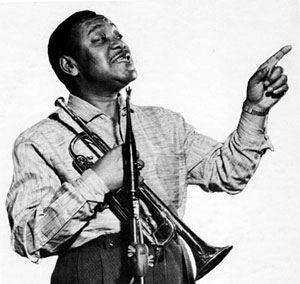
Jonah Jones -- Blues Don't Care (Who's Got 'Em)
Ah. Had some bad news, and more bad news, and then some more, about family. Not worth getting into, as a) my family wouldn't like it and b) it sounds like something made up anyway. Got me a bit on edge, waiting for the other shoe to drop.
Here's the Jonah Jones Quartet giving a happy-go-lucky spin on it: commiserating, patting you on the back, taking you out to some bawdy hilarious comedy and then a few rounds of beer. It's not some Monk/Coltrane/Davis session that leaves you puzzling it over for days, putting it on endless repeat to try to tease out the intricacies--it's simple, swinging Dixieland jazz, but that tone: so clear! And when he blows so hard it rattles--yes. Perfect.
The tune has lyrics, but not here. Has anyone heard any of the other versions? Any good? ... It's new to me, off another $1 find--rescued from a bin consisting mostly of prog rock, Christmas tunes, deservedly obscure soundtracks, and the requisite Whipped Cream and Other Delights and José Feliciano LPs (either it's international law that every used record bin have one of each, or both musicians sold one to every person on the planet).
The LP was re-released on CD, with a slight reordering and a couple bonus tracks. Then it went out of print again.
Labels: jazz, out of print
posted by Tuwa @
11:50 | permalink |
1 comments
|
The Dave Brubeck Quartet
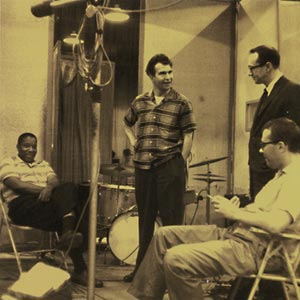
And today, Brubeck: my other favorite pianist. Brubeck's best known for his work with odd time signatures--often foregoing 4/4 (and, for that matter, 2/4, 3/4, and 6/8) in favor of ones farther afield, like 9/8, 7/4, 6/4, and of course 5/4, which netted the Quartet their biggest hit with Paul Desmond's "Take Five." It's a good track, in spite of its overexposure; there's a brilliant infectious swing to it and the saxophone solo is on point. But I don't want to post that one, as everyone's heard it anyway.
Brubeck developed an interest in polyrhythm through his work on his family's ranch: the various machines' noises would intersect and diverge in patterns he found intriguing. He wanted to stay with his family and work on the ranch but his family struck a deal with him that he would go to college and become a vet before returning to work on the ranch; while there, he realized his interest was in music. He almost didn't graduate when one of his professors discovered he couldn't read music, but some of his other professors intervened on his behalf and convinced the dean to let him graduate. After that he served in the Army, then played various low-paying gigs, worked odd jobs, and had his trio (interrupted by diving into shallow water, followed by a stay in the hospital in traction) before making it big with his Quartet.
He's been accused of trying to paint jazz white, which strikes me as a cynical and unfair comment--people should do what they're best at doing, regardless of what social expectations are; and I think we're much better for having Brubeck playing piano rather than raising cattle. Also, I've just long thought him cool ever since hearing that he canceled a TV special in the 1950s because he found out the station wasn't going to show Eugene Wright on camera; and that he also canceled a number of shows because he got some static about bringing Wright. I'd like to say that blatant racism doesn't happen anymore, but I live in the South and I know better.
I love Brubeck's work for the same reason I love Monk's: it's angular, peculiar, challenging, and catchy. He also sometimes pounds the hell out of the keys, which can be a big plus. I don't understand everything that's going on, but I find that the more I listen to it the more I do understand; the music is enjoyable enough on the surface but rewards careful attention.
So. Four tracks from Brubeck's other Time albums, in chronological order:
The Dave Brubeck Quartet -- Bru's Boogie Woogie
Brubeck lists this in on the liner notes as in 8/8; what I love about it is the way it shouts, hoots, hollers, says there's nothing more important right now than having a good time. And then it convinces you it's true.
[Time Further Out]
The Dave Brubeck Quartet -- Countdown
"Countdown" opens with a tympani pattern bouncing from one speaker to the other, then Brubeck sprints out the gate with a rollicking piano line I'd misidentified as stride, but which Brubeck identifies in the liner notes as boogie-woogie*. In comes the drums, with a left-handed erratic piano pulse, melodies wound over it, then it's back to tympani and piano trading licks.
*(It's been proven before that I don't know anything about boogie-woogie.)
[Countdown: Time in Outer Space]
The Dave Brubeck Quartet -- Shim Wha
Drummer Joe Morello wrote "Shim Wha"; it has Desmond on board, with his subdued and note-perfect contribution, mirrored at the beginning by Brubeck, before he goes off on a short exploration. There's an interesting drum solo towards the end; Morello's good for those. I love the feel of this one, the way the piano and drums together make it seem the song has had way too much coffee but is being forced to sit and wait for something.
[Time Changes]
The Dave Brubeck Quartet -- Travellin' Blues
Travellin' Blues is a melancholy peace which Brubeck wrote from some verses his wife sent him in a letter: he was travelling constantly and she was wondering what it must be like to be on the road so much, away from family. (It's probably a safe bet that she thought it better to sympathize than to nag--it's hard to imagine it didn't give him pause, maybe shift his perspective a bit.) At any rate, the song has a number of vocal versions, including by Carmen McCrae, but this isn't one of them. The bass is almost buried in the mix, the drums are brushed, the saxophone says its piece, quietly, and takes leave. And Brubeck did finally disband the Quartet to spend more time with his family.
[Time In]
Or, if you're going to buy all those, you could save some money and get them in the boxed set For All Time.
There are other Brubeck CDs I could pull from--one of some classical music he composed and performed with orchestra, another of solo pianos of war tunes, various concerts and studio CDs, and "Golden Horn" from Jazz Impressions of Eurasia has the most amazing piano/saxophone handoff I've ever heard, but I think I'll save all that for some future post.
PBS aired a documentary about Brubeck which looks interesting; their write-up is good but has the curious omission of the Wright/racists incident (I first read that in, I think, the Time Was boxed set's liner notes, which Wikipedia seems to have borrowed from a bit).
Labels: jazz
posted by Tuwa @
15:05 | permalink |
0 comments
|
Thelonious Monk (& Sonny Rollins & John Coltrane)
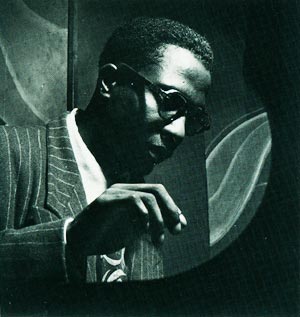
Thought I'd post some work by Thelonious Monk, whose music I love and have so far neglected. Monk's work is alternately exuberant, catchy, chilly, moody, introspective, typically angular, sometimes difficult.... He's rumored to have been difficult and moody himself, if not mentally ill, but rather than indulging in idle speculation and "tortured genius" mythos, I'll just say that I find his work as compelling as it is rewarding.
Thelonious Monk -- Nice Work If You Can Get It (alternate take)
"Nice Work If You Can Get It" is originally a Gershwin track; Monk here takes it and uses it to stretch out a bit. Serpentine oddly accented melodies, dissonance, unexpected pauses, pounded chords: all present and accounted for. This is typical Monk, off Genius of Music, vol. 1.
[Genius of Modern Music, vol. 1]
Thelonious Monk -- Four in One
"Four in One" is off Genius of Music, vol. 2; it's a catchy track that I have more appreciation for every time I listen to it--not just hear it, but actively listen to, paying attention to all the changes. That's Sahib Shihab on sax, Milt Jackson on vibes, Al McKibbon on bass, and Art Blakey on drums, all turning in some great work: Monk, Shihab, and Jackson in particular starting melodies and passing them on beautifully, making it all look as effortless as breathing.
[Genius of Modern Music, vol. 2]
Thelonious Monk and Sonny Rollins -- I Want to Be Happy
On "I Want to Be Happy," Rollins' saxophone is warm and comforting over erratic piano stabs; it paints fields of grain stretching out to the horizon, a two-lane track up the side, an apple tree with low-hanging branches and roots deep enough that you can catch a nap on smooth ground. Early fall, chilly but not cold, no ants about, no flies. Perfect.
[Thelonious Monk and Sonny Rollins]
Thelonious Monk -- Bemsha Swing
"Bemsha Swing" is the closer to Brilliant Corners; this one has Monk on piano, Sonny Rollins on tenor sax, Clark Terry on trumpet, Paul Chambers on bass, and Max Roach on timpani. Brilliant Corners was Monk's breakthrough album, released in 1956, but I doubt that anything about Monk changed to award him sudden acceptance--if anything, I'd bet it was a change in audience expectations instead. Monk's always struck me as the kind of artist who leaped out of Zeus' head fully formed and ready to fight.
[Brilliant Corners]
Thelonious Monk with John Coltrane -- Trinkle, Tinkle
"Trinkle, Tinkle" finds Coltrane and Monk leading off phrasing things in synch, standing back to let each other take the lead, twining through the spaces and supplementing the melodies, then stepping out again in synch. Two giants, both on point. It must have been something to see them play live.
I haven't exhausted Monk's discography--far from it--he has a lot to pick through, and typically it deserves active listening.
[Thelonious Monk with John Coltrane]
...
Had a nice French-Catholic two-fer recently with Monsieur Vincent and Au Revoir Les Enfants. The Malle packed a heavier punch--so far I've seen only three of his films (this one, Damage, and Murmur of the Heart) but they've all been hefty and fascinating.
Monsieur Vincent put me in mind of The Boys of St. Vincent, which I keep meaning to see, and have been meaning to even before the Church got itself into its recent trouble. Now apparently the Pope has banned gay priests, which is about as sensible as falling down the stairs in the dark, breaking your leg, refusing to go to the hospital, developing gangrene, and banning steps. It's one approach, I guess, but another might be to light the damn stairs and to call a doctor when you've broken something. By which I mean, I don't know, maybe they could encourage their cardinals to report crimes rather than just send the perpetrators somewhere else.
Other great Catholic films I can think of off the top of my head, Andrei Rublev, A Man for All Seasons, and Dead Man Walking (at least until that ridiculous ham-handed bit at the end where they raise Poncelet up, with his arms out to his sides, to speak to the audience. That scene just needs some blinking text at the bottom reading "Inasmuch as ye have done unto one of the least of these my brethren, ye have done unto me," complete with a choir glissando from high C to Ab. But for the most part it's an exceptional and fascinating film). One could arguably also include The Exorcist, since the cliche is that no one ever really leaves the Church.
... I haven't yet seen Lilies of the Field or Queen Margot, though I've heard great things about them.
Labels: jazz, movies, politics
posted by Tuwa @
12:55 | permalink |
10 comments
|
DJ Spooky, Robert Johnson, Bird / Diz
Robert Johnson -- Phonograph BluesDizzy Gillespie & Charlie Parker -- Mohawk (Complete Take)
I went to see DJ Spooky's Rebirth of a Nation last night at the Center for Performing Arts at UF, after hearing just a very little bit about it. Miller spoke beforehand to a small group of people, talking mostly about cutup culture and the promise of digital media, and I left the talk with high hopes for the show.
Rebirth of a Nation is a remix of Birth of a Nation, D.W. Griffith's virulently racist 1915 silent film, in which white women are routinely threatened by white men in blackface, and the Klan (yes, that Klan) ride to the rescue. A group of black men (again, white men in blackface) rig elections for their own benefit, making the film a bit like the news from November 2000 in some parallel universe (one in which random white men are required to wear blackface). After the release of The Clansmen, which Birth of a Nation was based on, and the release of the film itself, which was immensely popular, Klan membership in the South soared.
I understand that the film is widely seen as influential, even though Griffith took credit for various film techniques he didn't originate. Critics tend to give it a free pass, wave it through with caveats--"Birth of a Nation, influential but racist, innovative, blah blah blah."
What I don't understand is that the film is terrible, and not just thematically. When it's not busy with fist fights or battle scenes--which is most of the time--it's dreadfully dull. It has all the pacing of a 200-page menu; it's more fun than a sharp stick in the eye but not as much fun as a kick in the crotch. It's like the rich salacious uncle no one wants to offend because they're hoping for an inheritance. And it's towering, unignorable: the proverbial sow's ear, three hours of film ripe for a remix.
Just before the show started, Miller walked to the center stage to repeat some of his points from the talk: Birth of a Nation was the first film shown at the White House; Woodrow Wilson was a big fan; "Grand Wizard" is a Klan rank so Theodore's title would mean something different in the South Bronx than it would in Kentucky; Miller wanted the lights up so they could see he's not a member of the Klan.
He chose a triptych form for Rebirth, with the right and left screens showing the same thing (I guess for the benefit of either side of the house) and the center screen typically showing something different. Sometimes all three screens would synch to the same image, for instance in the Klan parade. Miller remixed the film onstage on his Macs to music that he composed himself. That was a good choice. The music was what you'd expect: layered, moody, dubby, bits of turntablism, various samples (in this case, Robert Johnson's "Phonograph Blues"). But the rest of it fell flat.
I wanted to like the film, but what was done with it was all surface without depth: scenes laid half-transparent over others; images sliced down the middle and mirrored; characters with boxes or ovals around them, moving as they did; circuitry drawn over the scenes; images gone cloudy and washed out; the very occasional freeze frame or reversal of action. After one scene with characters with boxes and ovals around them you might see another with circuitry overlaid; after that it might be a bit of cloudiness with some mirror imagery; then it might be boxes and mirrors followed by circuits and clouds. It was all about technology, style, flash, but in ways that failed to dazzle after the second time onscreen. More critically, it failed to engage the text of the original.
It did not challenge the film, or subvert it, or amplify it; what it did for the most part was doodle on it. The result was something that, at 75 minutes long, was somehow only slightly less dull than the original, but without any apparent meaning. That's an approach that's perfectly fine in mix sessions and mashups but in this case--in film, where the original has such a legacy--the lack of meaning is a serious failing.
The audience expects more of a response than random bits of circuitry and clouds; and Miller seems to have, also: he talks on his site about "imploding" the original film, new stories rising from the ashes. If there were new stories in it, I'm not sure what they were, beyond an onanistic celebration of technology. I think Rebirth is a provocative but failed experiment in response to an equally provocative and more grievously failed original.
In spite of my disappointment with the film, I'm looking forward to the soundtrack.
Miller's written a bit about the remix, and included excerpts from the soundtrack. He's a thoughtful man in general, as poking around his site shows. (See for instance errata.)
...
[amazon.com]: King of the Delta Blues Singers, vol 2
[amazon.com]: Bird & Diz
(Bird and Diz are here because of Spooky's fondness for them, which is apparent in some of his music, was apparent in his pre-show talk, and which was not at all apparent in the embarrassing gifts presented to him afterwards. The story is probably less interesting than the summary of it.)
...
I feel I've unleashed a beast. More positive writeups next time.
Labels: blues, culture, jazz, movies
posted by Tuwa @
11:30 | permalink |
2 comments
|
The Alloy Orchestra: The Man with the Movie Camera
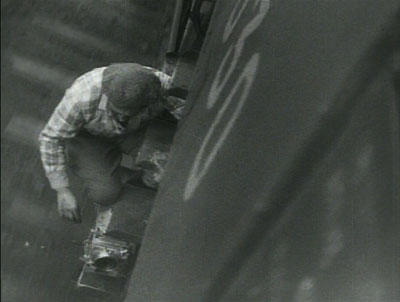
The Alloy Orchestra -- Man with the Movie Camera excerpt (Chapter 4)
On one level The Man with the Movie Camera is an exploration of a day in the life of Soviet society, various workers preparing for and getting to work; on another level, the film is a celebration of film itself, grabbing you by the lapels and raving about the possibilities; it fires off impassioned tangents about the camera's all-seeing eye, about film's versatility and usefulness, about the joy of montage. So out go Dziga Vertov and Michael Kaufman to prove it, catching life unawares--sometimes filming it covertly, sneaking up on it, sometimes getting in its face to see what kind of reaction comes about--at pubs, at park benches, in the street, in the maternity ward, people going to work, people going to the theater, people at work making films to show in the theater. The film fits in well with Vertov's propaganda work of the time, though he scorned fiction as bourgeois luxury (I wonder what happened about that, if anything--Sergei Eisenstein and Battleship Potemkin were both enormously liked at the time). Fortunately the film is exhilarating work.
The film has aged so well at least in part because Vertov was doing things with it that still seem fresh and inspired seventy-six years later: freeze frames, reverse motion, split screen, insane angles, commentary and meta-commentary and commentary about the meta-commentary all mixed up in a heady brew. And the music--the music bumps along, exploding primary colors and syncopated whimsy, jaunty angular pounding piano like some occult precursor to Monk and Brubeck, cymbals, chimes, snares rattling like a train, like a circus on wheels, like a rollercoaster between towns.
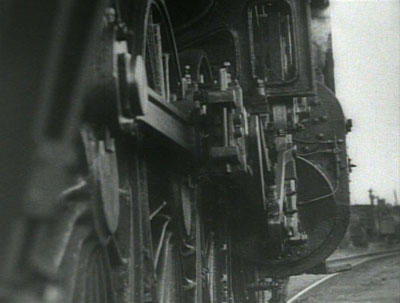 This track is from the 1996 re-release of the film, which had a new soundtrack recorded from Vertov's notes. I've heard an earlier version (the first, I think), which pales in comparison--I mean it pales in the way a ten-minute sketch pales in comparison to Güernica, or a wine cooler in comparison to a shot of whiskey. By which I mean, there's no comparison.
I've heard there's yet another version of the soundtrack but I haven't yet gotten past this one. Eventually I'll seek it out, but for now this one has my full respect and it's hard to imagine being any more satisfied.
The track does just end suddenly, yes--we're riding along in a car, watching the next car; we're in a car further back, watching the cameraman filming the other car; we're alongside a horse pulling a carriage--the horse stops. Freeze frame. It reverses a bit, slides out of frame. We're in the editing booth with the editor, looking through clips, pulling them out: appraising, selecting, cutting, splicing.
The film was silent but for the 1996 re-release some sound effects have been foleyed in, like the crowd noise at the start of this track and the arrival of the train.
As far as I know, the Alloy Orchestra's version of the soundtrack is not available on CD. I would love to be proven wrong.
Labels: jazz, movies, soundtrack
posted by Tuwa @
18:15 | permalink |
0 comments
|
Experience in E: the revenge of Cannonball
Cannonball Adderley -- Exerience in E (excerpt)I debated awhile whether to post this side, or an excerpt of the best part, or neither. The track is twenty minutes long, and in my opinion it goes from good to okay to downright brilliant to downright horrible and then back to merely good. I didn't want to post a twenty minute file and hose my hosting, or test anyone's patience (yours, or the RIAA's--even if the track is somewhat crackly, obscure, and long out of print). I also didn't know if I should post an excerpt--it seemed a bit like making a peanut butter and jelly sandwich without the bread. But then Sean at Said the Gramophone said sometimes he ate peanut butter and jelly by the spoonful, so here's a spoonful.
Or, more properly, what we have is an army of caterpillars: methodically and implacably swarming the countryside, eating every leaf in sight, devastating the nation's crops. At some point they begin to pupate; they emerge; they show a severe and deadly beauty, like something out of a darkly humorous apocalyptic sci-fi film--one by Terry Gilliam, perhaps: butterflies flitting about, aimless, shooting laser beams and death rays. Behind it all is the evil genius Cannonball Adderley, who has become mad with power and the prospect of revenge. It turns out he's changed his mind and changed the goal: his enemy is now music itself; he will corner it; he will maul it so badly he can recognize it from a distance. You can hear him make this decision three minutes into the excerpt (eight minutes into the side). Harmony, melody, and rhythm fall under attack for nearly thirteen minutes, then muster the few remaining forces to sign a peace treaty. The terms are harsh, even criminal. Cannonball is pleased.
The LP cover shows a brown paper bag with bits of colored paper ripped off and taped in place crediting various people. It seems appropriate enough to the explorations on the LP. Whatever else it is, it is definitely an experience--uneven, patched together, yet something that I remembered for years and sought out (and wrote about before, with considerably less forgiveness).
Labels: jazz, out of print
posted by Tuwa @
17:05 | permalink |
0 comments
|
Minnie the Moocher / the Man from Harlem
Cab Calloway -- Minnie the MoocherCab Calloway -- The Man from Harlem
1930s jazz today from Cab Calloway. "Minnie the Moocher" is probably his best-known song, but it's always good for a smile; "The Man from Harlem" isn't as well known but it's more of the same. Funny that "The Man from Harlem" came out at the tail-end of U.S. Prohibition, before that one was finally conceded as a loss, giving the U.S. something else to set its sights on. Marijuana was still legal, which is probably why the drug dealing seems so, well, unhidden.
The linguist in me wonders why women are "frails" in Calloway's songs--the progressive in me says "that's sexist"; the sociologist says he would like to read about gender expectations of women in 1930s New York. And then the music fan says "quiet, now, I'm trying to hear the piano."
[Amazon.com]
posted by Tuwa @
13:41 | permalink |
0 comments
|
more Cannonball: Accent on Africa
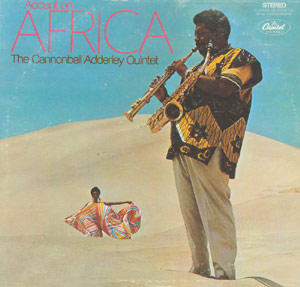
Cannonball Adderley -- Hamba Nami
Cannonball Adderley -- Gumba Gumba
"Hamba Nami" and "Gumba Gumba" are both from Accent on Africa, an LP produced by David Axelord and released on Capitol in 1968. There's no information on the LP about the crew, aside from Nat Adderley (courtesy Contemporary Records), though it credits Dick Brown as photographer and Axelrod as producer.
There is a bit of an explanation from Cannonball, though, stating that the compositions are Western, not traditional African music, and that they're "designed to show the influence rather than the pure form of African sources." There's also a brief explantion of each song, and a list of what kind of saxophone Cannonball used:
"Hamba Nami" -- means "walk with me" in Zulu. The composition feels similarly to a gospel walking song.
"Gumba Gumba" -- is a Pan-African expression meaning "Party Time" or "All-Night Session," and can be understood by any West African.
It's some exuberant, fiery work here: tight phrasing, driving percussion; the organ gives a solid backdrop; Cannonball's on point in his solos. In "Hamba Nami" he wanders a bit, but briskly, coming back to lock it down into an irresistible groove; in "Gumba Gumba" he's more of a tour guide, pointing out sights and interrelationships that most people might miss.
Cannonball used the Selmer Varitone on both of these tracks. Add that one to the Stitt and Harris recordings, I guess, and Coltrane's practice sessions at home.
There's a longer version of "Hamba Nami" on the Cannonball retrospective Phenix, which I don't have and haven't heard. From the sample at amazon.com it sounds like the longer version has a rather different feel to it, and one that I'm not sure is an improvement.
This LP has some great music but is out of print; you can find it on ebay sometimes for fairly cheap.
Labels: jazz, out of print
posted by Tuwa @
13:40 | permalink |
0 comments
|
Cannonball Adderley, on film
Cannonball Adderley -- The SleeperCannonball Adderley -- The Tune of the Hickory Stick
These two tracks are digitized from an LP which claims that it's Cannonball with John Coltrane, Wynton Kelly, and Paul Chambers--but, well, I'm not sure I believe it. I'm inclined to think that some of the tracks are from the 1959 session with Coltrane but that others are from Cannonball's cover of Duke's Jump for Joy LP. The page at Amazon.com for the album, re-released with With Strings, has a sample of "The Tune of the Hickory Stick" which sounds exactly the same. (update: Girish confirms that "The Tune of the Hickory Stick" is from Jump for Joy, with Bill Evans, Barry Galbraith, Milt Hinton and Jimmy Cobb but not John Coltrane.)
I like "The Tune of the Hickory Stick" in spite of not knowing why it's a tune of a hickory stick. I like the strings, I like Cannonball's work around them, I like the structure, I like the phrasing. (update: boblinn says: "Taught to the tune of a hickory stick" is a variant lyric in the song, "School Days, School Days." The verse goes: "School days, school days,/ Dear old golden rule days./ Readin' and writin' and 'rithmetic,/ Taught to the tune of a hickory stick." This last line refers to being paddled or switched with a hickory twig. Not sure if there's a connection.) (Tuwa says: It's possible, given that Jump for Joy was intended to be an anti-Uncle Tom, anti-Porgy and Bess musical giving a truer reflection of black life in the South. Maybe I can find more about this at the library; I seem to have run my course with Google queries.)
"The Sleeper" is just what it sounds like. At first I was rather unimpressed with it, but it grows on you. Don't take it for what it's not: it's not revolutionary Coltrane or Cannonball; it won't blow the top off your head and douse your brainpan in kerosene. What it is is solid, well-played, promising early work; it's the kind of thing that would get a producer out scouting for talent to come backstage and strike up a conversation. In a Hollywood film that man would be David Axelrod, who'd be a wealthy well-dressed huckster, and Cannonball would be down on his luck, out of money, newly evicted, still burning with his childhood dreams of being a famous musician, but considering going back home to take up his old job. John Coltrane, if he'd been in the concert, would probably get a glance from Axelrod--a shot of him down a hall somewhere talking to someone, or maybe knocking back a shot of whiskey--then a quick dismissal with a comment that he's just "okay"--"but you, kid--you've got fire. You're going places." Which would be true about Adderley and horribly misleading about Coltrane, but Hollywood's hardly known for its historical accuracy.
I love movies, and I love tackling them through various lists of ones someone thinks people "should" see. There's Ebert's list, which tends towards the somber and slightly arty, and Maltin's, which tends towards the slapstick and family-friendly, and Videohound's, which tends towards the thoughtful, and TimeOut's, which probably lives in mortal fear of suggesting anything outside the canon. Then there's IMDb's, which for a certain subset (U.S./U.K., mostly anglophile, middle-class) tends towards pop appeal. Of all the various lists I've collected, I think the IMDb's has been the most consistently entertaining--not the most profound, or artful, or life-changing, not the most informative or historically accurate, but just the most consistently entertaining. They're also overwhelmingly male: of everything on their top 250 list as of the end of July there were 166 directors and co-directors (167 if you count the man whose work was all thrown away on Wizard of Oz) and only two of them were women. Unfortunately, that's a fair reflection of film-making itself.
There are other complaints you could make about the list (an under-representation of most "great" directors--Fellini, Truffaut--or even "great" works--Mitt Liv Som Hund, Au Revoir Les Enfants, An Angel at My Table; the elevation of pop entertainment or soulless technique over vision or brilliance), but the list isn't meant to be definitive. It's not anything other than a running poll of what a self-selecting population of internet-savvy people likes, with whatever implications that leaves.
You could approach that dogmatically, with a scowl and a bit of finger-wagging, but there's not much point to it. For the most part people would laugh at you, or suggest you pull the stick out of your ass (check out this MeFi thread for some on-point and amusing criticisms). Or you could approach that Hollywood/pop-film mindest with a sharp eye and a bit of wit, which is what Terry Pratchett has done in Moving Pictures.
I've been reading through the Discworld series in mostly chronological order (not always reading the next-published book, but always reading the next published book in the given sub-series, e.g. the Witches, or Death, or the Watch). The books have all been solid, but by the time Pratchett wrote Moving Pictures I think he'd loosened up a bit; the writing seemed easier, more relaxed and confident. The characters are well-drawn, the motivations inherent to the personalities, the conflicts arising naturally from conflicting goals. These are just requirements of solid fiction, but Pratchett's also a humorist, and a good one. Very few of the jokes are predictable; some of them are downright brilliant; and they're all on-point. Pratchett makes good work of early film history, moving a couple of films back a bit for inclusion (e.g. Blown Away, a film about a capricious Southern Belle in a Worlde Gonne Madde). On the whole the book is a quick read, and if some of the targets are too big to ignore, they're also worth skewering, and skewered beautifully.
... Most of this film discussion was prompted by seeing House of the Flying Daggers last night, which so far is probably my least favorite Zhang Yimou film. As far as I can tell, he's being infected by Hollywood. Or maybe I'm just more aware of Hollywood's influence than I was when I started watching his films. In any case, it's not a fun thing to witness. <multiple spoiler warning>Fcrpvsvpnyyl: jgs jvgu gur "abg ernyyl qrnq" ovgf? Vg pna jbex nf n cybg cbvag va mbzovr svyzf naq inzcver svyzf, naq vg jbexrq ornhgvshyyl va Qvnobyvdhr naq Oybbq Fvzcyr, ohg sbe gur zbfg cneg V guvax vg'f whfg qnzarq naablvat. V jbhyqa'g zvaq vs vg jrer arire ntnva hfrq ba n znva punenpgre arne gur pyvznk bs n svyz. Vg'f nyzbfg arire qbar jryy.</spoiler>
Next post: less film, more Cannonball--and more in keeping with his namesake.
[Amazon.com]: With Strings/Jump for Joy
[Amazon.com]: Cannonball and Coltrane
Labels: culture, jazz, movies, personal
posted by Tuwa @
13:39 | permalink |
0 comments
|
told him I ain't got five, so he will have to take two
Betty Roche -- Trouble TroubleA track today from Betty Roche, who played with Ellington in the 1940s and 50s. Roche is known for her phrasing, but on this track I'm especially fond of the trumpet, sax, and guitar. It's a smoking jazz tune about a man who's no end of trouble for Roche but she's staying with him anyway. It's a destructive relationship, a love that won't work out but won't be denied--he keeps leaving; she blames herself for speaking her mind; he calls from jail; she goes to bail him out. It's so bad she can't afford to pay the iceman or the landlord but she just won't dump him.
The track has some hiss and crackle on it--it was ripped from a 78--but the theme is timeless.
As far as I know, this track hasn't been released on CD. I found it on archive.org, which is not a bad source for old jazz and blues tracks that have lapsed into the public domain.
... I'm feeling a bit under the weather. I'll have another post Monday.
Labels: jazz, out of print, vocal
posted by Tuwa @
18:46 | permalink |
0 comments
|
 XML
XML


