looking for logic in the chambers of the human heart
Randy Hobbs -- Slowly But SurelyRoosevelt Sykes -- Yes Lawd
Funkadelic -- Maggot Brain [alt mix]
He was alone in the lobby of his hotel in Isla Mujeres, watching Hitchcock's La Ventana Indiscreta and misreading Jeffries' misgivings for disregard, zoning out looking through Lisa's face to the blue and red and green rectangles. Jorge banged on the glass by the door, smiling sleepily, holding his left crutch, his right crutch leaned against his side.
"Jorge," he said. "¿Qué pasa?"
"Nada, man."
"¿Qué tal?"
"Bien, ¿y tú?"
"Bien bien." Jorge lifted himself in off the sidewalk. "What you doing?"
"Nothing. Nothing. Just watching this movie."
"Yeah?" He came around the TV to took a look. "Válgame Dios."
"Yeah."
"Yeah." Jorge turned and hopped backwards twice, then sat down and rested his crutches beside him.
They sat there staring at the screen, red and green and blue rectangles brightening and fading away, brightening and fading away: in the commercials, in the break-in, in the theft, in the climax, in the credits.
"Buena película," Jorge said, halfway through an infomercial.
"Buenísima."
"You flying, man?"
"No, I don't smoke. You?"
"I am ... so flying, man."
"That's cool."
"Shoooooo," Jorge said. "So flying."
Flashes of light, electrons hitting the screen, red-blue-green.
"Do you smoke?" Jorge said.
"No, I don't smoke." I'm staring at a light source, Nick thought. It's furniture and it's a light source and people stare at it. And I do too.
"No smoke?"
"No, gracias."
"So flying."
"Hm...." The tick of the clock on the wall. Somewhere down the street, far off, someone telling Carlos he didn't know anything, ni una putísima cosa, coño. Cars coming by, whoosh.
"Shoo," Jorge said.
"Shoo-wee."
"Buena onda, tú."
"¿Sí?"
"Sí. ¿No fumas?"
"No, no fumo. Let's go."
"Where? To where we go?"
"I want a beer."
"¿Cómo?"
"Cerveza. Lager. Dos Equis. Vámanos."
"Muy bien. Buena onda," he said, pushing himself off the sofa and grabbing his crutches. "¿Listo?"
"Claro. Ko'ox."
"Ko'ox," he said, laughing. "¡Vámonos!"
"Buena película," Jorge said in the bar.
"Muy buena." He knocked back the last of the beer and sat staring at the table: mahogany under a dark varnish, the reflection of the ceiling fan broken by the ring from the bottle, the bottle now cool and slick in his hand as he spun it around and stopped it, spun it again.
"Buena película."
The breeze wafted in from the beach carrying that unmistakable saltwater smell, waves pounding the surf, people chatting a few doors down, Jorge and Nick and the mesero alone in the bar.
"Aren't you hungry?"
"¿Cómo?"
"¿No tienes hambre?"
"Mucha hambre."
"Well, order something then."
"¿Cómo?"
"¿No vas a pedir?"
"¡Camarero!" Jorge said. The waiter came over to take their order. He was wearing stiff leather shoes with faded blue jeans and a tan guayabera. "Dos tamales," Jorge said, and something else Nick didn't catch. The guayabera never caught on stateside, did it? he thought. There was a couple outside, looking in, speaking softly in a Scottish accent. Of course, kilts didn't either.
"¿Algo más?" the waiter said.
"Otra cerveza," Nick said.
"Dos más," Jorge said.
The waiter nodded and left. Nick spun the bottle, let it go, stopped it. Jorge contemplated the table. Nick looked out at the street. The couple had left.
"What are we doing here?" he said.
"Drinking."
"No, in general."
"¿Cómo?"
"Por lo general."
"Drinking."
"No, la gente por lo general."
"Eating, too. Sometimes eating."
"No," Nick said.
"Buena onda," Jorge said.
"¿Qué hacemos aquí? ¿Cómo gente?"
"Vinimos a beber."
He sighed. A beer opened behind him, then another. The door in the counter opened, swung back and forth, came to a stop. The waiter set down a plate of chips, a dish of guacamole, and two more beers.
[Midnite Blues Party @ amazon, and @ emusic]
[The Honeydripper @ amazon, or @ emusic]
[Maggot Brain @ amazon, or @ emusic]
Labels: blues, is fiction, jazz, RnB
posted by Tuwa @
00:15 | permalink |
7 comments
|

Otis Spann -- The Hard Way
Otis Spann -- The Hard WayThe blues are a distinctively American creation; and among them this song has a distinctively American sensibility, the narrator proud of his individualism even while recognizing that with some help he could have gone much further.
You know I came up the hard way
I just about raised myself
I been in and out of trouble
but I never begged no one for help
And what kills me: one word in a couplet:
After a few years passed
I soon learned how to sign my name
It's a Jim Crow song to be sure, released after Brown v. Board of Education but well before the government, in its "all deliberate speed," managed to integrate most schools (and even so, today the process of steering and school vouchers seeks to reestablish de facto segregation where de jure isn't possible).
Spann was pianist for Muddy Waters before Pinetop Perkins took over. I imagine the hiring process went something like this:
"There's the piano."
"Yeah."
And then Spann sat down at it and proceeded to show it who's boss, a blur of hands slamming ivories, hammers on strings, keyboard solid but the legs beginning to groan, threatening to crack. And they toured with one more carpenter than usual, just in case.
[Otis Spann Is the Blues]
Labels: blues
posted by Tuwa @
16:57 | permalink |
1 comments
|
body snatchers mix, part 5

Lightnin' Hopkins -- Feel So Bad
Acoustic country-blues with Hopkins' distinctive reedy voice and some banging piano backup.
[Blues Kingpins]
Waylon Jennings -- Crying
Jennings is not quite up to the melody; his reach isn't as agile as Orbison's, his touch not as deft. He's like a blackhat hacker whose social engineering fails and so he decides to brute force it. It's inelegant but it works.
[Country Giant @ emusic]
Rebekah Del Rio -- Llorando (Crying)
This one's from Mulholland Drive; supposedly it was a one-take recording, which (if true) is all the more amazing considering how well it turned out. This performance is like an angel, watching mute for six thousand years, then deciding it has something to say about sadness.
[Mulholland Drive: Original Motion Picture Score]
Lee Dorsey -- Tears, Tears and More Tears
Lee Dorsey just sounds so damn affable in his songs, like somebody's hip grandfather in sharp shoes and a fedora, incorrigible, bawdy, a metric ton of fun. He's known for working with Allen Toussaint and also the Meters; this one is a Toussaint production with the bass and muted guitars holding down the rhythm and pianos low in the mix accenting it. The horns are in tiptop shape and the vocals give them a run for their money.
[Yes We Can/Night People]
James & Bobby Purify -- You Don't Love Me
Uptempo soul number from James and Bobby Purify, most known for "I'm Your Puppet." This one's a rowdy track with knockout vocals.
[Shake a Tail Feather]
Bo Diddley -- You Don't Love Me (You Don't Care)
Bo Diddley can sing songs that don't contain the words "Bo Diddley," and they're often good, too. Love the harp on this one, especially the echo, and the pounding piano solo is good too. The song has an interesting structure: several verses, a solo, an outro.
[Bo's Blues ]
Oingo Boingo -- Imposter
This song is not afraid. Not afraid of you, or your mama, or your cyborg from the future with the chip in the head. It's from Only a Lad, an album with a gleefully creepy song about a pedophiles, but this isn't that one. This one's about music critics, who are painted less sympathetically than pedophiles. "You take the credit while others do all the work / You like to think you discovered them first / We all know you moved in after it was safe / That way you can never get hurt / You like to play God / You don't believe what you write / You're an imposter" and later, "Your head is firmly lodged way up your butt / Where it belongs."
[Only a Lad ]
(Discussion of Kaufman's film, with spoilers, follows.)
Philip Kaufman, in his remake of Invasion of the Body Snatchers, changed the setting from a small town outside San Francisco to San Francisco itself: at the start of the film, pods drift up off the surface of a barren planet, float through space, and descend on earth, the Golden Gate Bridge in the background. There they cover various plants with a gelatinous, translucent substance and begin putting out first roots and then flowers.
Elisabeth Driscoll finds one of the flowers, picks it, gets stared at by a teacher encouraging her young students to pick them, and goes home, where she tells her boyfriend Geoffrey that it might be a completely new species of plant that cross-pollinated from two others, something invasive and dangerous. Unlike in the first film and in the text versions, Elisabeth (the Becky character) is not divorced, but there are signs early on that their relationship is in trouble--the first thing Elisabeth says to Geoffrey is "Too much trouble to pick the mail up off the floor, Geoffrey?" She goes over to him and he pulls her into his lap; they kiss, and Geoffrey interrupts it to shout about the basketball game on the TV behind her.
Matthew Bennell, for his part, is not a doctor but a health inspector working for the Department of Health; he angers the wrong restaurant workers with a promise to have their permit revoked and then spends the rest of the film driving a car with a busted windshield. Elisabeth also works at the Department of Health, and though it's not clear if they've dated before, it is clear that they are attracted to each other. This attraction lends a certain tension to the early scenes in the film, when Elisabeth is still trying to make her relationship with Geoffrey work.
For someone who's seen the original film and noticed the teacher's interest in getting the children to take the flowers home it's probably no surprise that the next morning Geoffrey isn't acting like himself, that Elisabeth is curious and alarmed about it, and that Matthew has a psychologist friend with a number of fairly convincing explanations about why they might be imagining things. In this case the friend is David Kibner, played by Leonard Nimoy. It's an unusual casting choice, especially given the success of the original Star Trek series: Kaufman no doubt expected audiences to be unsurprised at his coolly logical demeanor and perhaps to wonder if it's too obvious that he would be a pod person.
Kaufman also makes a few recontextualizations: not just in changing the setting from suburban to urban but also in making explicit comparisons to disease, evolution, and pollution. All of the topics are covered in dialogue, generally more than once; so the subjects are not subtext but text itself. The change in Matthew's job is interesting, as it shifts him from private practice to civil servant, implying a certain amount of faith in the government yet maintaining the character's interest in contagion and infection. And while Jack is still an author (in this film a poet), he and his wife Nancy also own a mud bath. Nancy is explicitly concerned about environmental damage, at one point commenting that they don't know how the aliens invade humans--"We would never even notice it, not from the impurities we have. I mean we eat junk, we breathe junk--" And Elisabeth's interruption: "Look, I don't know where they're coming from. But I feel as though I've been poisoned today. We've got to take those flowers in and have them analyzed. This is the only thing we know; there is something here."
A number of critics and horror fans have commented that the new urban setting doesn't work (Stephen King, for instance, stating in Danse Macabre that Kaufman lost more than he gained in the change), but I suspect that's a matter of taste. Kaufman is not working on the same scale as Siegel or Finney: Finney's story is a somewhat harrowing but ultimately hopeful story. Siegel aimed for something darker--more loss, more betrayals, a grimmer ending--but had a more hopeful ending (or faux-hopeful ending, depending on your interpretation) forced onto the film. Kaufman states very calmly that there is no reason for hope and will be no survivors.
The aliens in this version sweep up and dispose of their human remains, and throughout the film we see garbage trucks compressing grey fluff in clouds of dust. The first vehicle seen in the film is a garbage truck; and the morning after Elisabeth takes home the flower, Geoffrey is already awake, sweeping something up when the alarm clock goes off. He ignores Elisabeth's questions and takes the trashcan downstairs to a waiting garbage truck. They're everywhere in the film, a constant reminder of both consumption and waste.
The film is also concerned with media, like the Siegel version and the various texts: at Matthew's house on top of a hill, Jack can't pick up any radio stations. Matthew tries several times to call for help, and while some of his later calls are intercepted, most of them go through because the people he's contacting have already been changed. They're careful to appear to help, at least until it no longer matters. When it's clear that the aliens are tired of waiting and are going to force the four of them to be changed, Matthew, Elisabeth, Jack, and Nancy flee Matthew's house, chased by a horde of pod people emitting a hair-raising, thoroughly alien, klaxxon-sounding alarm. The four humans run through dark city streets casting giant shadows, chased on foot and by motorcycle police, tracked by helicopter, and once they're cornered Jack decides to split up from them to find help. Nancy runs after him, leaving Matthew and Elisabeth to go in a different direction.
Eventually they hear some music coming from a ship, giving Matthew the idea to sail away. He goes to investigate, as in the previous film; and what he sees is a ship being loaded with pallets of pods. When he returns, Elisabeth has fallen asleep and won't wake up. He tells her comforting lies as her body disintegrates; and then her replacement sits up and tells him he should quit resisting. This scene is similar to the one near the end of the original film, except that in the original Siegel didn't dare show or imply that Becky was naked (most likely the Hayes code wouldn't allow it). As a result, in Siegel's film we're supposed to believe that the pod person came to life, took the clothes off the remains of the original, put them on itself, and then lay down to pretend to be tired for when Miles returned. No, in this one Elisabeth is naked and she doesn't care: not as she stands up, not as she follows Matthew to the greenhouse nearby, not as she walks through it with dozens of workers milling about, paying her no attention whatsoever. Some people take the nudity as gratuitous, but it strikes me as both logically consistent and purposeful, underscoring the complete alienness of the invaders. It's here in the greenhouse that Matthew makes his final stand, destroying some of the pods and causing a fire before fleeing again to hide.
Throughout the film, Matthew and Elisabeth have been the holdouts in government, trying to maintain their humanity against soul-crushing odds. At the very end we see Matthew at work, appearing dispassionate around the pod people, then in his office cutting out an article, as he did at the beginning of the film. And as the pod people begin to leave the Department of Health, Matthew does too: outside, to the plaza where those strange twisted unforgettable trees are growing, where he hears a voice behind him calling his name. It's Nancy. She steps forward, looking stressed and tearful and relieved to find him, and Matthew raises his arm and emits that klaxxon alarm. In a film explicitly concerned with the environment, starring two civil servants, this ending could be read as both a statement about the effectiveness and integrity of government and as a death knell for hippie idealism: the world is doomed; your government will make sure of it.
Labels: blues, body snatchers, country music, horror, movies, RnB, rock, soundtrack
posted by Tuwa @
10:59 | permalink |
4 comments
|
body snatchers mix, part 4
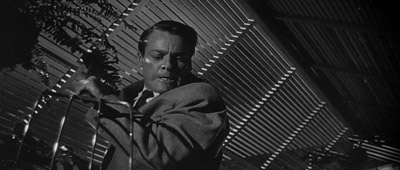
And the pods march on: next: Kaufman, Ferrara, closing thoughts. You're liking the music at least, I hope.
Howard Tate -- Hold Me Tight
Atypical reggae-inflected soul from Howard Tate.
[Howard Tate's Reaction ]
Otis Rush -- My Love Will Never Die (solo take with piano)
This is a slow, somber take, with Rush apparently still trying to figure out whether the song was meant to be a dirge. The occasional laughter in the background, and Rush's own laughter at the end, suggests that maybe it wasn't.
[Mr. Dixon's Workshop]
Otis Rush -- My Love Will Never Die
Otis Rush tries again, giving the song a lurching rhythm, trilling piano, guitar lines that are sinuous and somehow yearning, and banshee-like vocals leaving no doubt about the pain.
[Essential Collection: The Classic Cobra Recordings 1956-1958]
Magic Sam -- My Love Will Never Die
Magic Sam taking an approach very similar to Otis Rush's, ten years after. Sam and Rush were both on Cobra; West Side Soul is one of the classic blues records. (Interestingly enough, Sam used to play with fellow Chicagoan Syl Johnson in the 50s.)
[West Side Soul]
Dallas String Band -- So Tired
I think it might be easy to take this song ironically, but I love it: the washboard, the fretwork, the melody, the harmony, the progression. And the lyrics, at least what I can make out of them: "So tired of crying / so tired of sighing / so tired of being alone" ... "Though we are drifting far apart / My arms are empty but never my heart / So tired of yearning / For your returning / So tired of waiting for you."
[Texas Black Country Dance Music (1927-1935) @ emusic]
Kay Star -- So Tired
Another one you could take ironically, I guess, but I'm not hip enough to do it. I like the song; I hear something in the vocals that's anachronistic; I can't pinpoint it or explain it, but I like it. It's a very sweet song, uncomplicated and sincere.
[Kay Starr: the Best of The Standard Transcriptions @ emusic]
Junior Wells -- So Tired
Very murky sound on this one, no doubt on purpose--it's like the aural equivalent of squelching your way through thick dark muck that keeps trying to eat your shoes. Wonderful song, though, and the blues were meant to be at least a little discontent.
[1957-1966]
Eddie Bo -- I'm So Tired
Gritty early R&B, Bo rolling out piano riffs and howling about love given in vain.
[I Love to Rock 'N' Roll ]
(Ongoing spoiler warning: texts and films, including endings, discussed below.)
Siegel's 1956 filming of The Body Snatchers hews closely to the established text for most of the film: the story still deals with Miles, Becky, Jack, and Theodora (now called "Teddy"); and Miles' friend the pyschiatrist (now called "Danny" rather than "Mannie"). Miles was divorced more recently than in the book (five months rather than five years) and Becky more recently still (the weekend before the start of the story). As in the book, they had dated each other prior to marrying someone else, and, as in the book, they find themselves falling in love again after the divorces. Early in the film, after scattered reports of people feeling that their family members weren't themselves, Miles jokes that he'd hate to wake up and find that Becky wasn't Becky.
"I'm not the high school kid you used to romance," Becky says, "so how could you tell?"
"You really want to know?" he says. Becky does, so he kisses her.
The film has its differences, though, some of them interesting and others less so, and a few just as inconclusive as the differences among the Finney versions. In Siegel's film, Miles' self-doubts are greatly diminished and the concern over neighborhood upkeep almost entirely eliminated; the only mention of anything decrepit is near the beginning as Miles is driving into town from the train station: he nearly runs over Jimmy Grimaldi, the young son of farmers who have recently closed their vegetable stand.
The film follows Miles, Becky, Jack, and Teddy as they begin to suspect that the people claiming the impossible are in fact correct. Halfway through the film, Miles discovers four pods in his greenhouse, splitting open and beginning to look human. Miles urges Jack and Teddy to leave for help, and Becky tries to phone the FBI as Miles tries and fails to dispatch all the pods in the greenhouse. He lingers, pitchfork in hand, over the one turning into Becky, then decides he can't kill it and instead kills the one turning into him.
Outside town, desperate for somewhere to go for help, Miles drives to his receptionist's house, where he overhears some chilling dialogue:
"Baby asleep yet, Sally?"
"Not yet, but she will be soon, and there'll be no more tears."
Hiding in his office with Becky, Miles delivers the director's message:
"In my practice I've seen people who've allowed their humanity to drain away. Only it happened slowly instead of all at once. They didn't seem to mind."
"Just some people, Miles."
"All of us. A little bit. We harden our hearts, grow callous--only when we have to fight to stay human do we realize how precious it is to us, how dear--as you are to me."
 In the morning they see trucks arrive on the plaza and the tarps pulled back, the trucks full of pods. The townspeople collect pods and take them to their cars for distribution. When Jack arrives, their relief is quickly crushed: he's been changed into a pod person; and Danny was one all along. They explain the alien origins of the pods and explain what it's like to be a pod person:
Miles: "I love Becky. Tomorrow will I fell the same?"
Danny shakes his head. "There's no need for love."
"No emotion? Then you have no feelings? Only the instinct to survive. You can't love or be loved, am I right?"
"You say it as if it were terrible; believe me, it isn't. You've been in love before; it didn't last. It never does. Love. Desire. Ambition. Faith. Without them life's so simple, believe me."
And as if one betrayal were not enough, there's the climax of the film: Miles and Becky, exhausted, on the run from the entire town, just like in the book. Except they hide in a tunnel under some slats, rather than under some brush in the fields, and Miles leaves Becky to investigate some beautiful music which Becky says must mean that someone still knows what love is. When he returns he finds Becky in a different location; she's too tired to walk so Miles picks her up and begins to walk out of the tunnel. He trips and they fall into a mud puddle, where they kiss, and Siegel springs a surprise on a 1950s audience familiar with the source material: Becky looks up at Miles exceptionally coolly; Miles pulls away, face registering alarm and disgust. She's been changed. She tells him it's not painful, and he should quit resisting; then as he flees she shouts at the others that he's there.
They let him go to the highway, where he is taken for a drunk or a maniac; he finds the back of a semi loaded with pods and then, on the street, continues to shout his warnings into the camera: "They're coming! You're next!"
And there it would have ended, except that the film tested poorly and the studio forced a change. So Siegel shot a pair of tacky bookends: starting the film with a psychiatrist arriving at a hospital to find Miles panicked and unconvincing; and ending the film with the psychiatrist leaving the room and encountering a truck driver being pushed in on a gurney, with a broken arm and two broken legs. The psychiatrist is informed that the man ran a red light and crashed into a bus, tipping his truck over and spilling a cargo of large and unusual things that look like seed pods. So he goes to the phone, where he shouts at the operator to get him the FBI right away, and yes it's an emergency. And there the film ends.
It's a strange ending for a number of reasons. Generally it's accepted as an inferior ending to the one Siegel intended, which was to leave Miles looking like a stark raving lunatic on the freeway. The new ending might be considered a challenge to the auteur theory in that the studio forced Siegel to add it, against Siegel's wishes. Yet it's also somewhat appropriate in that the new ending hews more closely to the ending to the serial originally optioned: invoking the federal government to come solve local problems with national implications. And yet it's also a sly ending, a subtly suversive ending, on Siegel's part: the pyschiatrist believes Miles and calls for help. "Excellent," we think. "The day is saved." Except we see "The End" before we hear what happens next, and so it's easy to forget that Miles also tried to call for help, and that he could not get through because the pod people already controlled the phone system.
Besides, I'm not sure how many people the new ending relly convinced: I saw the film as a child and didn't see it for a decade afterwards; what I remembered of it was not the call to the FBI but Danny's betrayal and the unveiling of the truck loaded with pods.
In some ways Siegel's The Invasion of the Body Snatchers reminds me of Howard Hawk's The Thing: both deal with an alien invasion of murderous perambulatory plant matter; but The Thing has no patience for the federal government or the visitor, and The Invasion of the Body Snatchers takes a more patient, cautious, watchful stance. There's probably fertile soil there for someone willing to argue that the two films are the Rio Bravo and High Noon of science fiction.
It's common to put Finney's novel and Siegel's film into a Cold War context, and Glen M. Johnson does it as well as anyone. A bit from "'We'd Fight .... We Had to': The Body Snatchers as Novel and Film":
Finney complicates the simplistic them-vs-us forumula by making his invaders invisible--a force or consciousness that conquers by taking over the minds and personalities of ordinary people. So the "body" snatchers become apt symbols for ideological subversion, fear of which was a characterisitc form of anxiety in the American fifties.Johnson, like many authors discussing the story's Cold War origins, mentions brainwashing: "it is suggestive that The Body Snatchers is set in August 1953, immediately after the Korean armistice, when American newspapers were full of incredulous reports about the 'turncoats' who chose Communism over a return home."
At the time of the stories' publication, HUAC's investigation into Communist propaganda in Hollywood, followed by its blacklist of the Hollywood Ten in 1947, was not yet ten years past. Joe McCarthy had spent several years in Congress making rabid declamations against suspected communists as chair of the Subcommittee on Investigations, and only in late 1954, after several years of bellicose and frequently baseless accusations, had he netted a formal censure in the Senate. It's easy to imagine that the alien invasion in the body snatchers stories serves as a metaphor for Cold War anxieties--either as a fear of communism or as a fear of McCarthyism. If there's one thing central to U.S. belief it's rugged individualism, and both sides were no doubt feeling an overwhelming pressure to conform. So it's somewhat common that the series of betrayals in the story, executed by family and friends, reminds people (ironically or not) of J. Edgar Hoover's sensationalist warning in Masters of Deceit that "there are thousands of people in this country now working in secret to make it happen here." Furthermore, it's easy to view the sleep metaphor as freighted with political baggage, especially given the "sleep no more" propaganda common during the Cold War.
Yet as J. Hoberman notes in "Paranoia and the Pods,"
Sorting out the politics of the men who filmed Invasion of the Body Snatchers is not easy. Siegel has described himself as a liberal, although his ouevre is more suggestive of a libertarian belief in rugged individualism. Wanger, a producer with an interest in topically political material, was responsible for both the crypto-fascist Gabriel over the White House (1933) and the prematurely anti-fascist Blockade (1938) as well as for such New Dealish genre exercises as You Only Live Once, Stagecoach, and Foreign Correspondent.Hoberman goes on to note that Mainwaring, the film's screenwriter, had written the "relentlessly perfunctory" anti-communist film A Bullet for Joey and that Invasion of the Body Snatchers' script was rewritten by Richard Collins, "a former Communist Party functionary, co-author of the once notorious Song of Russia (1943), [and] an announced unfriendly witness first subpoenaed by the House Un-American Activities Committee in autumn 1947 among the original Hollywood Nineteen" who later turned witness for the FBI. So the film might be read as an anti-Communist fable, or as a satire of McCarthyism, or simply as a richly metaphorical work authored by a number of men with strikingly different philosophies.
Siegel, for his part, seems content to think of the film as about conformity in general: "It's the same as people who wlecome going into the army or prison. There's regimentation, a lack of having to make up your own mind, face decisions.... People are becoming vegetables. I don't know what the answer is, except an awareness of it. That's what makes a picture like Invasion of the Body Snatchers so important." (Parkes, "There Will Be No Survivors")
And Finney denies all of these interpretations, both here and elsewhere:
For years now, I've been amused by the fairly widely held notion that The Body Snatchers has anything to do with the cold war, McCarthyism, conformity... It does not. I was simply intrigued by the notion of a lot of people insisting that their friends and relatives were impostors.
--"Paranoia and the Pods," Sight and Sound May 1994, p.31
I have read explanations of the "meaning" of this story, which amuse me, because there is no meaning at all; it was just a story meant to entertain, and with no more meaning than that. The first movie version of the book followed the book with great faithfulness, except for the foolish ending; and I've always been amused by the contentions of people connected with the picture that they had a message of some sort in mind. If so, it's a lot more than I ever did, and since they followed my story very closely, it's hard to see how this message crept in. And when the message has been defined, it has always seemed a little simple-minded to me. The idea of writing a whole book in order to say that it's not really a good thing for us all to be alike, and that individuality is a good thing, makes me laugh.So the question is, then, whether the author is the final word on what a text means. I think the author often has a good idea of what he intended, except that even he might not realize all of the intentions and subtleties: I'm reminded of Ray Bradbury's comment in the afterword for Fahrenheit 451 that for decades he didn't notice that Faber was the name of a pencil company and that Montag was the name of a paper company.
--personal letter to Stephen King, December 24, 1979, as cited in Danse Macabre, 1983 Berkeley paperback, p. 306-307
And, too, it's obvious that the reader (or viewer) must understand, process, and interpret the parts of a story for it to have any meaning. Those interpretations are necessarily personal affairs, at times idiosyncratic or conflicted but always dependent on associations with existing knowledge. Is the story about communism? McCarthyism? The Red Scare? The case for each of those could be made, sure, and frequently is. Art is largely an interpretive matter and almost never yields as unequivocal results as math. And should it?
Labels: blues, body snatchers, country blues, horror, movies, RnB, vocal
posted by Tuwa @
21:14 | permalink |
5 comments
|
body snatchers mix, part 2
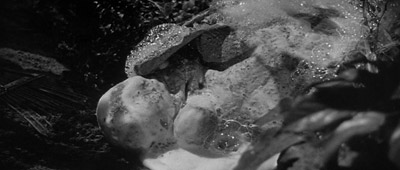
I guess I should have explained a bit more about the mix last time: most of the songs are tangentially related to the Body Snatchers stories at best, and the mix isn't limited to what could fit on a CD (mostly because I'm not one to make tough decisions). Along the way we'll see some songs with a passing resemblance and others that are different from how we remembered them.
Betty Everett and Jerry Butler -- Love Is Strange
I've written about Betty Everett twice before. This one is one of the better tracks off Together--sweet lyrics and a sweet duo, but what sells it for me is when each of them take it solo towards the end. And then I'm completely sold, yes.
(As for the rest of the LP ... no. It's mostly middling, with tracks that tend to stop at competent without making it to genuinely affecting, and I'm not surprised it's gone out of print. I can't speak for the CD linked below, though--haven't heard it and it's awfully pricey for me to pick up.)
[They're Delicious Together]
Little Milton -- If You Love Me
If guitars were animals, PETA would stage a protest about this song.
[Anthology 1953-1961 ]
Little Johnny Taylor -- If You Love Me (Like You Say)
Keeping with the Chicago blues, the horns, the electric guitars, and the general theme--this one has a smoother melody on the vocals, less grit on the delivery, more syncopation on the horns, and an organ buried in the mix.
[Greatest Hits]
Muddy Waters -- I Feel So Good
Blues piano with a harmonica and a drumset rocking the joint, letting the public know that feeling good can be contagious.
[At Newport]
Ann Peebles -- Slipped, Tripped, and Fell in Love
Three great things about this song: the bass, the organ, the background vocals. The first one runs throughout; the next two stop in for tea and leave right after. You'd consider it rude, except now you're friends and you just hope they can stay longer next time.
[The Best of Ann Peebles: The Hi Records Years]
Dreaming permits each and every one of us to be quietly and safely insane every night of our lives.
--William Dement of the Stanford University Sleep Research Centre, Newsweek, November 30 1959
A bare-bones plot description of the Body Snatchers stories (all of them): residents of a community come to suspect that certain loved ones are not themselves, but are perfect physical replicas without any genuine emotional responses. They discover that people are in fact being destroyed and replaced by impostors hatched from alien pods, one by one, as each one of them sleeps. A small group of people decide to fight the aliens, and at least two of them are in love.
From there the details differ--in the characters, locations, resolution, and treatment of themes, with implications about each story's beliefs. But fundamentally the story is about love and vulnerability and the loss of individuality. It's about being human and getting tired and needing to sleep. We're no more vulnerable than when we sleep, as Wes Craven knows, but Finney didn't create a sardonic villain to dispense gory deaths; instead he poses the more psychological question: who will we be when we wake up?
It seems a silly question, easy to laugh off, yet sleeping itself is somewhat troublesome. "We all go a little mad sometimes," sure. We might go a bit unhinged on hearing some devastating news, but that's not all, is it? It's a truism that no one wants to hear about anyone else's dreams, and probably even psychiatrists are faking it, but what are these things? Our brain tells us the earth is a swamp and that people drive Yugos over fallen mossy trees past dully interested brontosauri, and then we get up in the morning and yawn and stretch and go make tea or cofee. Our brain sorts out the desk and dusts the bookshelves and dumps the dreams in the trash. We go around with this tacit agreement that dreams are mostly meaningless, yet the brain keeps making them; and we go to bed knowing that we'll go a bit insane but that it's no big deal, really, that in the morning breakfast and a shower will set us right again. And it does.
Yet in the Body Snatchers stories, sleep doesn't make people temporarily insane; it makes them perfectly and utterly sane, endlessly and coldly logical. It destroys the identity in a more permanent way; falling asleep leads to being replaced by an alien being who has all the same memories but none of the emotion. The consciousness is transfered to another body, the humanity left behind somewhere in the gray fluff, to be swept away and thrown in the trash.
The stories feature alien characters encouraging humans to quit struggling, to give up and accept their fate. It's a conversation that enhances the horror and the sense of betrayal: former friends have changed--changed horribly--and don't mind at all; in fact they want us to join them. Given that humans are fond of thinking that emotions are distinctly human (a dodgy proposition given the evidence that dogs, primates, and countless other mammals show grief, insecurity, jealousy, and indignation), the stories can also be read as an exploration of the fear of evolution. The pods are much more efficient at reproducing than humans are, and they seem to get along much better; and in each version of the story the chances of human survival begin to look slim. Perhaps each story is asking if it's not merely an accident that humans have reigned so long, and if we truly deserve our self-proclaimed perch at the top. If so, it's no surprise that the stories have proved enduringly horrifying.
Labels: about fiction, blues, body snatchers, horror, movies, RnB
posted by Tuwa @
21:59 | permalink |
4 comments
|
Robert Pete Williams
Robert Pete Williams -- This Wild Old LifeRobert Pete Williams -- I Got the Blues So Bad
Robert Pete Williams -- Thumbing a Ride
Robert Pete Williams -- Matchbox Blues
Supposedly Robert Pete Williams made his first guitar out of a cigar box, killed a man in self-defense, and spent a couple years in Angola before earning recognition as a musician and being pardoned.
Common enough blues tale: poverty, violence, injustice, pardon; unfortunately it's not true. What really happened is that Robert Pete Williams found his guitar in a thrift shop, where he bought it from a clerk curiously eager to get rid of it. He first played it right outside and a passing drunk asked for "Dust My Broom"; Williams, usually an affable and patient fellow, attacked and killed him then a policeman, a bus driver, a beet farmer, a stray horse, a two-day-old newspaper, and a museumful of formerly bored high schoolers. Williams escaped into the swamps, where he sat on mangrove knees playing droning angular blues, luring stupidly curious alligators close enough to club them over the head with an Ebdim7. And while Thoreau was proud of his tough stringy squirrels, Williams was never proud of his alligators; mostly he passed his days wishing he could sell the guitar back, or at least put it down for good and get a job as an accountant.
Williams died in 1980, that much is true, but there never was a fire that did anything more to his guitar than make it cranky. It's out there still, tangled in roots, half-submerged in fetid muck, waiting for something with opposable thumbs to pass by close enough.
[Robert Pete Williams]
[I'm as Blue as a Man Can Be]
[Free Again]
[When a Man Takes the Blues]
All of these are also available at emusic.
Labels: blues, is fiction
posted by Tuwa @
02:55 | permalink |
10 comments
|
Martin / Nosferatu
Lonnie Johnson -- No Love for Sale
Mississippi John Hurt -- Since I've Laid My Burden Down
(Spoiler warning: this post discusses plot elements of Bram Stoker's Dracula, F.W. Murnau's Nosferatu, Richard Matheson's I Am Legend, Whitley Strieber's The Hunger, and George A. Romero's Martin.)
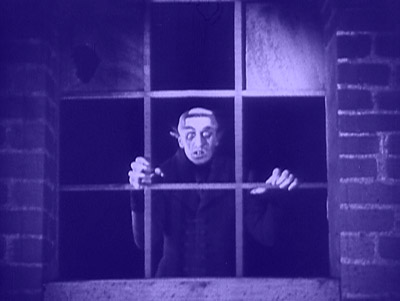
The conductor's call goes out over a black screen; the scene opens on passengers boarding a train. The titles begin as the train approaches a crossing, warning lights flashing, bell dinging. Inside, a POV shot: walking down a hall, approaching a hand protruding past a curtain, palm up, its owner apparently asleep. The film cuts to Martin: tall, thin, pale; he eases past the hand looking frightened. In the restroom he opens a kit and prepares a syringe; in the hall he crouches to listen at a door, syringe gripped between his teeth. He picks the lock; the film cuts to a black and white shot of Martin opening a door, a woman in bed turning to him, arms outstretched. The film cuts back to color as Martin opens the cabin door; the bed is empty. The passenger can be heard in the restroom. Martin hides behind the restroom door, waiting for her. When she goes to her bed he rushes forward and stabs her with the syringe. They struggle; she is loud, terrified, enraged, pleading, curious: what did he inject her with? He tells her not to worry; he is always careful with the needles. She is not comforted with this knowledge. Eventually she passes out and he cuts her wrist with a blade and drinks her blood. When he's done he cleans up the cabin, leaving the razor and adding a bottle of spilled pills. The film is clearly a modern vampire story, yet director George Romero is not interested in indulging in the conventions of vampire fiction over the last century.
The classic vampire story, heavily influenced by Bram Stoker's novel Dracula, is set in an isolated, foreboding setting indicating centuries of unminded wealth and indifference to public opinion. The story is typically told from the point of view of the potential victims; the vampire can not enter a victim's home without permission; and the vampire has a curious hypnotic power over his victims--typically buxom women in nightgowns--as well as a weakness against garlic and crucifixes, to be finished off by sunlight or a stake to the heart. Bram Stoker wrote Dracula just before the turn of the 20th century; the film Nosferatu blatantly plagiarised the novel and was nearly lost as a result--Stoker's widow filed a suit charging copyright infringement, and the court ordered all copies of the film destroyed.
Without becoming distracted by all the stakes, it's safe to bring Freud into the conversation. The classic vampire story is about sexuality and repression, the id and the superego: the vampires can't enter a room without permission and so their victims have to allow their desire to cloud their judgment, arranging their own destruction. Jonathan Harker, in one of his nights in Dracula's castle, finds himself tempted by three of Dracula's women; he admits to his "repulsive" urges in his journal, though he notes that the admission would hurt Mina's feelings if she were to find it. And it's easy to imagine the passage in question loosening Victorian collars:
I lay quiet, looking out from under my eyelashes in an agony of delightful anticipation. The fair girl advanced and bent over me till I could feel the movement of her breath upon me. Sweet it was in one sense, honey-sweet, and sent the same tingling through the nerves as her voice, but with a bitter underlying the sweet, a bitter offensiveness, as one smells in blood.
I was afraid to raise my eyelids, but looked out and saw perfectly under the lashes. The girl went on her knees, and bent over me, simply gloating. There was a deliberate voluptuousness which was both thrilling and repulsive, and as she arched her neck she actually licked her lips like an animal, till I could see in the moonlight the moisture shining on the scarlet lips and on the red tongue as it lapped the white sharp teeth.
Since Stoker's and Murnau's work, some authors have expanded the scope of the myth. Richard Matheson in the 1950s and Whitley Strieber in the 1980s both explored vampirism as a disease, Matheson in an ominous futuristic backdrop with a sole human survivor and Strieber in an elegaic examination of love and loss in the face of weakened immortality. Anne Rice gave the genre her own distinctive treatment, starting in the 1970s, in a series of gothic novels largely concerned with ambience and glamour*.
Romero's treatment of the myth, just a year after Rice's Interview with the Vampire, is decidedly low-key. Martin is not wealthy; he is not powerful; he is not particularly intriguing or charismatic. The story is set in working-class Pittsburgh; Martin meets his uncle, Cuda, at the train station. Cuda walks Martin to his house, the walk filmed in a series of handheld shots, piano and flute on the soundtrack.
The general tone of the film is one of melancholy and longing, informed by skepticism and aware of preceding myth. Martin can't get people to do what he wants, he's not repelled by garlic or crucifixes; he doesn't sleep in a coffin on cemetery dirt. There's nothing seductive about Martin's process, nothing darkly attractive about the results. He finds the vampire stories exasperating, like the people who believe them, including his uncle.
The story comes across as a slice-of-life drama, perhaps because of the emphasis on relationships: Martin's antagonistic relationship with Cuda, his cautious relationship with Christina, with his slightly freer relationship with Mrs. Santini. In the broadest sense, the story is about a confused, unhappy young man who longs for human companionship yet has an overwhelming need preventing it. The treatment of the subject is surprisingly deft, light, and leavened with a gentle humor, as in the first scene at Cuda's home ("Vampire," Cuda says. "First I will save your soul. Then I will destroy you. I will show you your room.") And the conclusion, when it comes, is sudden, neat, and unexpectedly ironic, almost Hitchcockian in temperament, as if to imply that the particulars are insignificant since everyone is guilty of something.
*Rice's vampire books, for all their faults, are not as silly as Joel Schumacher's campy suburban horror film Lost Boys--which itself comes across looking like cinematic high art in comparison to Mel Brooks' execrable Dracula: Dead and Loving It. There are clever and interesting things that can be done with the vampire myth still; Brook successfully avoided all of them.
[Blues By Lonnie Johnson]
[The Immortal Mississippi John Hurt]
This post is part of the Vampires blogathon and will be updated with links to additional entries as they are published.
- Andy Horbal: A Vampire In Pittsburgh
- Flickhead: Vampire Blog-a-Thon
- Silly Hats Only on Martin
- Coffee, Coffee, and More Coffee: Brides of Dracula
- Richard Gibson on Martin and The Addiction
- Modern Fabulosity on Klaus Kinski in Herzog's Nosferatu remake
- Pfangirl Through The Looking Glass: A bloody awesome trio
- Deep in Your Eyes on the Spanish-language Drácula
- Edward Copeland on Film: Fright Night
- Novaslim.com on Vamp
- Burbanked.com on three vampire films from the 80's
- My New Plaid Pants on Near Dark
- Certifiably Creative on Hammer Film Countess Dracula
- Low Resolution on From Dusk Till Dawn
- Stale Popcorn on sexy vampires
- Cinemathematics on vampiric imagery in Shadow of a Doubt
- As Little As Possible on Dracula: Dead and Loving It
- Forward to Yesterday! on Dracula: Pages from a Virgin’s Diary and Vampyr
- Culture Snob on Herzog's Nosferatu
- Queering the Apparatus on Vampyros Lesbos and Jesus Christ Vampire Hunter
- Cinema Fromage on Hammer Films' Dracula A.D. 1972
- Zoom In appealing for a DVD release of The Addiction
- StinkyLulu on Blacula
- Way of Words on women as victims and heroes in vampire stories
- Music Is My Boyfriend with vampire music
- Nick's Flick Picks: Bram Stoker's Dracula
- I am screaming and punching myself, also on Bram Stoker's Dracula
- Being Boring: Neil Jordan's Cautionary Tale of Homosexual Adoption
- The Horror Blog confesses to and explains a general disinterest in vampire stories
- The Boob Tubers pick between Angel and Spike
- european-films.net on Frostbiten, a Swedish horror-comedy
- popbytes on Christopher Lee in the Hammer Dracula films
- 100 films on Abbot and Costello Meet Frankenstein
- Glitterati on a Disney vampire film and its unbelievable casting
- Bright Lights After Dark in defense of Browning's Dracula
- Tim Lucas on his six favorite vampire films
- The Film Vituperatum on ninjas, vampires, and unwritten film rules
- Noel Vera on two Filipino vampire films
- Cinevistaramascope on Herzog's Nosferatu
- Auteur Lust on Persona's vampire metaphors
- The cutting room blog on Bram Stoker's Dracula
- Man about Town on homoeroticism in vampire films
Labels: blogathon, blues, horror, movies
posted by Tuwa @
01:57 | permalink |
8 comments
|
Blind Willie McTell -- Dying Crapshooter's Blues
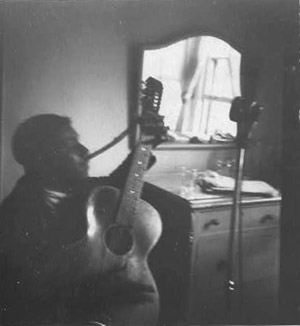
[Blind Willie McTell, with 12-string guitar, hotel room, Atlanta, Ga. Photo from The American Memory Collection]
Such a strange song--cadences flowing, changing paths, unpredictable yet non-negotiable--water running down an arid hill.
Blind Willie McTell -- Dying Crapshooter's Blues
Take one: young, hoarse, slow pace, melody like your grandfather's voice settling into a long story.
Blind Willie McTell -- The Dyin' Crapshooter's Blues (live)
Take two: Older, stronger, fiercer. Decades later, McTell in a casual concert, putting away a pint of bourbon.
Here's the long story, the song's background--a song written over the course of three years at the request of a friend shot by the police. The cadences (unpredictable, organic, non-negotiable) took some time to figure out. What do they want? What are they after? McTell didn't write the song; the song chose a venue to be written in. How many attempts at this did it take? How many bottles of bourbon am I listening to?
Both takes: bonus points for the funkky high-pitched strums which sound like NES sound effects.
[Atlanta Twelve String]
[Last Session]
...
Boingboing has an interesting post about This Film Is Not Yet Rated, a documentary about the MPAA's idiosyncratic and intermittently Puritanical ratings system.
...
Maybe it's the sci-fi aspect of this cartoon that distances it enough from current events to allow me to laugh at it.
...
The stolen election of 2004: a compelling report which is just as disgusting as it is enraging.
Labels: blues
posted by Tuwa @
06:48 | permalink |
3 comments
|
Lightnin' Hopkins: Another Fool in Town / Baby Please Don't Go
Lightnin' Hopkins -- Another Fool in TownLightnin' Hopkins -- Baby Please Don't Go
I'm not sure how it is that I haven't posted anything by Lightnin' Hopkins, but Google assures me that that's the case. Hopkins was a Texas bluesman with over a 40-year career; he played on both acoustic and electric and had a sort of loping, spontaneous sense of timing made more palatable by his voice and his guitarwork.
"Another Fool in Town" has Hopkins telling the story of a man whose school burned down, leaving him with no education. He moans that he can't write his name or say his ABCs. It's a simple story and a simple song, but that sound just makes it: the guitar rings out and the voice is pure blues rattling the mic. Excellent.
And then in "Baby Please Don't Go" the guitar flits about weaving melodies, harmonizing with itself, and occasionally dropping the funk, expecting you to pay attention and keep up. And you do, because it's both engaging and enjoyable.
[Blues Kingpins ]
[American Folk Blues Festival, 1962-1965] ($60 boxed set, or pick it up year by year from emusic.com. Hopkins' other track on the '64 disc is also quite good, a somber tune about being away from his wife.)
Labels: blues
posted by Tuwa @
00:01 | permalink |
2 comments
|
the mix part one
About that mix CD I made last year: I sent out a half-dozen copies; I got two reviews (a 50% and a 33%, if this were being graded); one person wrote back saying he liked it but didn't want to review it; one wrote back saying he didn't like it and didn't want to review it; and one review never arrived.Originally I liked all 14 tracks; in the time since it has dropped to 10. By which I mean, I made some bad choices. Feel free to laugh at them in the comments. No, seriously.
Thanks to Mike and Jerimee for their patience.
Whitey Markle -- Proletarian Football Blues
Mike Williams -- This song bemoans the commercialisation of (American) football. It reminds me of a famous Roy Keane remark. Keane was Manchester United's captain until a couple of weeks ago. His criticism of his own fans (who are universally reviled) won him many friends: "they have a few drinks and probably the prawn sandwiches, and they don't realise what's going on out on the pitch. I don't think some of the people who come to Old Trafford can spell football, never mind understand it."
Keane is the subject of a fabulous article by Sean O'Hagan, who usually writes about music in The Observer. The prawn sandwich is now the canonical status symbol in British football. And Manchester United is now owned by a Floridan.
This song is great. Imagine Bruce Springsteen with a sense of humour and The Vince Guaraldi Trio as a backing band.
Jerimee Bloemeke -- I don't like the country twang in the guitar, and I really find the singer's voice to be very annoying. But I kind of like the flute (?), because it reminds me of some '70s French Spy TV show theme, or something....
Picture Mark Twain in a bluegrass band with Marxist tendencies. This is one of Whitey Markle's slightly less whimsical numbers. Other standouts include "Cracker Stomp" and "Thinking About You," and "The Cracker Stomp."
The band broke up years ago; there's no official website. Here's a brief writeup of the CD this track came from, though.
Pig Iron -- Seminole Blues
Mike Williams -- This is a pretty and (pretty unsurprising) blues number. While I'd rather modern blues sounded like this than, say, Blueshammer (the hopefully fictional band that appears in Ghost World), I find it difficult to get worked up about such a direct facsimile of pre-rhythm-and-blues blues.
Jerimee Bloemeke -- This one has the same annoying country guitar twang and singer voice as the first song. I'm just not accustomed to this kind of country/blues stuff for some reason - it doesn't hit a nerve with me, or at least not a nerve that makes me like it.
Mike is right about this being pre-R&B blues. This is a song originally by Tampa Red; "Seminole" is the train. Pig Iron doesn't have a site, or at least not one credited in the CD and easily found through search engines.
The Sultanas -- Radio Song
Mike Williams -- Floridan surf guitar. Who knew? I don't care for the patronising piss-take of talk show listeners, something about this track caught my ear. Perhaps it was the fact that I listened as I was mentally preparing for the holiday season, and I've always associated surf with Christmas. Great fun.
Jerimee Bloemeke -- I dub this "hula-surf-rock," with a lounge singer. I kind of like it, but probably only in small doses.
[The Sultanas' site]
Hula -- Taking Pictures
Mike Williams -- There are plenty of songs that are short and aggressive or short and funny, but more songs should be 1:36 and beautiful. Hula sound like an adult pop Summer-Sun-era Yo La Tengo. (I see I'm not the first person to make this comparison.)
Jerimee Bloemeke -- How fitting that after the "hula-surf-rock" song there is a song by a band actually named Hula! The beginning of the song has a really echo-y guitar, and then comes in the bass and drums - really quite simple. Then the first, deep-voiced singer (who reminds of Dave Berman) comes in, backed by a female voice, a la Fleetwood Mac. But it's an indie-rock Mac, as the song is short and gets to the point quickly. No fancy stuff here. I really like it.
Most of Hula's tracks on the disc are not like this one; they tend to come across much more like Low: subdued, dreamy, spare, maybe a bit bleak. This one, though.... I snuck it onto the U.N. agenda and the vote came back unanimous: it's too short.
[Hula's site]
Labels: blues, folk, indie, rock
posted by Tuwa @
03:21 | permalink |
4 comments
|
Magic Sam -- That's All I Need
Magic Sam -- That's All I NeedThis song is a friend helping you carry your load, an umbrella for the rain, a board for tires stuck in mud. It's from Chicago bluesman Magic Sam's 1967 debut, West Side Soul--an awesome album I hadn't heard just a few weeks ago--a recording that's intense and original and sparking with life. The disc was recommended by someone who knew I liked Otis Rush and who thought I'd like Magic Sam, and I did, and I do.
The opening riff is a bit like "Pouring Water on a Drowning Man" and overall it's got a similar vibe--a soulful, melodic performance. The other tracks on the disc are grittier but no less impressive for it.
Magic Sam had a promising start to his career but died young--32, of a heart attack.
[Allmusic.com bio]
[BluesNotes bio]
[West Side Soul]
Labels: blues
posted by Tuwa @
11:45 | permalink |
1 comments
|
Screamin' Jay Hawkins and China Moses
Screamin' Jay Hawkins -- Yellow CoatScreamin' Jay Hawkins -- I Put a Spell on You
China -- On Tourne en Rond
Screamin' Jay Hawkins was the original macabre over-the-top singer/showman: before Marilyn Manson, before Alice Cooper, it was Screamin' Jay starting his concerts emerging from a coffin with a skull-tipped cane to sing "I Put a Spell on You." It was his most popular song, and probably for good reason--there's just something in that guttural desperation, the complete abandon, that's awfully appealing (probably because he's not singing the song to me).
Hawkins tried the same approach on other songs, to greater or lesser effect: manic delivery and some silly/serious occult bits which seemed, over the years, to have been folded into hard rock and heavy metal (but with less and less humor), becoming enough of a staple of the music that Spinal Tap took the chance to comment on pompous occult wankery.
"Yellow Coat" is a rocking early R&B tune--sax, piano, electric guitar--with Hawkins singing the praises for his garish clothes with typical humor, comparing himself to a two-legged goat and exaggerating everyone's reactions to him. And there, under the humor, I can't help wondering if that's real or imagined pathos. It reminds me of a teenager's green hair--something deliberately "too much," presented for people to reject to prevent them getting close enough to reject a personality instead. I wonder if Hawkins' persona didn't come about as a means of deflecting pain, or if it was all as spontaneous as the various writeups online suggest. It's a question better put to a biographer than to a casual fan; at any rate, I think "Yellow Coat" is a good song, even if I find Hawkins, and his body of work, a bit puzzling.
"On Tourne en Rond" is the title track from China's second CD, a confident, mellow, and soulful bit of multicultural R&B. On this one I love the waltzing vocals, the horns that come in towards the end, the way it all builds towards a gently skewed carnival atmosphere.
I posted a China track about six months ago; China found the post through her mother, Dee Dee Bridgewater, and mentioned her website and her newer work. The gears of the Shanty grind slowly.
Allmusic.com writeup on Hawkins
[Screamin' Jay Hawkins -- Cow Fingers & Mosquito Pie]
[China -- On Tourne en Rond]
China Moses' site
posted by Tuwa @
00:29 | permalink |
2 comments
|
Candy Man, Candy Man, Candy Man
Charlie McCoy -- Candy Man BluesPig Iron -- Candy Man
Taj Mahal -- Candy Man
Yesterday Jordan at Said the Gramophone posted Rev. Gary Davis' version of this blues classic, with a bit of puzzlement over the muddled delivery, which led me to remember I have a few different songs by that name. My first thought was that they'd all forked from Mississippi John Hurt's version, but on listening to them back to back I find that the Rev. Gary Davis version's lyrics are completely distinct from the Pig Iron one here (modelled on Hurt's song), with no lyrical overlap. Charlie McCoy's country-blues song is distinct from both of the others.
Are these candy men all the same? Not likely; if the songs share anything it's probably just a penchant for double entendre, which is hardly uncommon in early blues.
dictionary.com has it that a candyman is a person who sells or supplies illegal drugs; the Oxford English Dictionary has it that a candyman is a seller of candy or, in northern England, "bum-bailiff or process-server"; and urbandictionary.com is the only one to mention the man with the hook. Of all the possible meanings, I think that's the one least relevant to the songs.
[An exhaustive Charlie McCoy/Kansas Joe McCoy CD, which is only half as exhaustive as this one plus Vol. 2, and which in any case is probably too exhaustive for most people, including me on most days.]
[Pig Iron's CD is long out of print]
[Taj Mahal -- An Evening of Acoustic Music. I love this CD, unrepentantly, even the oomphing goofiness of "Cakewalk into Town," but most people I've played it for have found it a bit off-putting.]
Go to StG to pick up the Rev. Gary Davis version.
Labels: blues
posted by Tuwa @
14:43 | permalink |
7 comments
|
Jimmy Reed
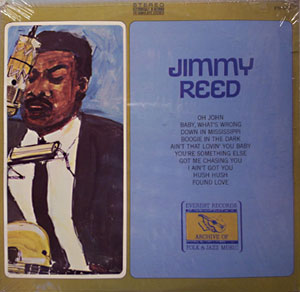
Jimmy Reed -- Down in Mississippi
Jimmy Reed -- Ain't That Lovin' You Baby
I just got back from a trip to the Bible Belt boondocks where I grew up: the kind of place where white men wear mullets and congregate on rebel-flagged porches and tailgates to drink Budweiser and talk about wrestling and NASCAR and football; they're real manly men who bear a simmering hatred towards Hilary Clinton and black people and Arabs, tossing out sexist and racist epithets like darts. I'd like to say that's all a stereotype, the kind of thing you find in lazy film making and lazy writing, but in this case at least it's true. The town is fairly interesting from a sociological perspective, except after a few days of it I get tired of going around trying to be a sociologist--I'd rather not be stared at; I'd rather be at home where I can order a vegetarian sandwich without getting a puzzled look or hearing about how some people just need to start eating meat.
Jimmy Reed was a seminal electric bluesman popular in the 1950s and 60s and known for a mumbling vocal delivery and a casual, unschooled approach on guitar and harmonica; his influence is apparent on musicians from Dylan to The Rolling Stones to The Yardbirds to (shudder) The Grateful Dead. If it sounds like he's probably drunk while singing these, it's because he probably was--he was a notorious alcoholic with a tendency to forget lines to his own songs--but I don't tend to listen to musicians for their private lives (or even their public lives), just their lives in the studio. The studio that Reed is in here sounds cavernous, echoey; his guitar lurches along gamely; his voice reverberates; his harmonica cuts through it all.
These are digitized off an LP I picked up sealed for $3; "Ain't That Lovin' You Baby" is commonly found on Reed compilations (and for good reason); "Down in Mississippi" is rarer, appearing only on the two "Boss Man" compilations--one at two discs and 36 tracks, the other at three discs and 75 tracks. I posted "Down in Mississippi" not because I went to Mississippi (I didn't) but because it's just such an odd story in it, like some elliptical Faulknerian saga where most of the interesting stuff is in the subtext. What does the boll weevil mean? Why the rapacious preacher? Is farm work really so hypnotic?
If it's not immediately apparent why I posted "Ain't That Lovin' You Baby" then, well, you probably don't like the blues.
[The Essential Boss Man: The Very Best of the Vee-Jay Years, 1953-1966]
[Boss Man: Best of Jimmy Reed]
Labels: blues
posted by Tuwa @
11:45 | permalink |
7 comments
|
So this is Christmas
Very brief writeups today, because my planned holiday posts aren't finished.A few days ago I got a Christmas gift from my sister overseas: a small box of German chocolates. In a show of restraint, I didn't open them for at least five minutes.
I'm heading out tomorrow and will be away until early January. If past experience is any indication, I'll be able to pull a camel through the eye of a needle easier than I can find an internet connection, so this is it till 2006.
I know you'll do the right thing and leave these unopened till Christmas. Or at least pace yourself. Or maybe not. I won't blame you if you don't.
Little Johnny Taylor -- If You Love Me (Like You Say)
Milk chocolate with almonds. You have to snap pieces off and eat them quickly, else they melt between your fingers.
This is a somewhat atypical Little Johnny Taylor tune; most of what I've heard by him is a grittier blues.
[Little Johnny Taylor's Greatest Hits @ amazon.com]
Keb' Mo' -- Am I Wrong
Dark chocolate/jalapeño cake. You can't decide if you love it or hate it, but you keep cutting another thin slice. It's hot, feisty; it wants to kick your ass; you're not sure if it is.
Keb' Mo's first CD is brilliant; the second is okay; the third is bad; the fourth rocketed past bad into sonic Ed Wood territory. I haven't listened to any after that. But damn what a good album that first is. ... I sent Sean a track from this CD a year ago, but here's another. That self-titled debut is just amazing, and why he fell off is just as puzzling.
[Keb' Mo' @ amazon.com]
Blind Gary -- You Got To Go Down
Chocolate-covered peanuts.
Public domain track I found somewhere ages ago. (One of the older file stamps on my system: late 1990s.) Early blues here, and great stuff. I love the clear, catchy guitar, and the man's scratchy voice, and his long bit in the middle about not making assumptions about drinkers.
Skylab -- Seashell
Chocolate with a high minty taste that lingers.
Most of this Skylab CD is so minimalist as to make me question my definition of music. This one's one of the more, er, ornate tracks, insofar as anything in a monastery might be called ornate. Drums, bit of keyboard, waves on a beach, and a bit of dialogue. Aural opium.
[Skylab -- #1 @ amazon.com]
Dead Can Dance -- Black Sun
Chocolate-covered caramel nougat.
I love it when this singer cuts loose from the emoting a bit and belts one out with his giant wodden sledgehammer voice. Which is not to say I don't like the rest, but this is better. Sock it to me.
[Dead Can Dance -- Aion @ amazon.com]
Pharoahe Monch -- The Light
Chocolate toffee.
Most of this disc is thuggish posturing, or maybe not posturing, but definitely not my cup of tea. Then there's this one, which is a very welcome change.
In retrospect it seems this disc was in and out of print as quick as a sneeze.
[Pharoahe Monch -- Internal Affairs @ amazon.com]
Talib Kweli & Hi-Tek -- Expansion Outro
Dark chocolate. Bitter but so good.
A reprise/commentary on Nina Simone's "Four Women," which I described in September 2004 as a lacy silk sock pulled over a brick. Nina Simone is awesome and so is this Talib Kweli/Hi-Tek CD. Very impressive work all around.
[Talib Kweli & Hi-Tek -- Reflection Eternal @ amazon.com]
Albinia Jones -- Give It Up Daddy Blues
Hot chocolate on a cold morning with fuzzy bunny slippers.
Another public domain track. I've no idea who Albinia Jones is, or what else she's done, but she's awfully saucy here. Apparently she played in the 1930s and 1940s (which doesn't prevent her works from being in the public domain, contrary to popular belief--prior to the 1970s in the U.S. the requirement was to list something as copyrighted, either with the full word or the c in the circle, then to list the year and the rightsholder, plus the statement "All rights reserved," for the copyright to be valid. Too bad that was changed so the legislators could have a land of copyrighted grocery lists on the backs of envelopes.)
Cheb Mami -- Yahamami
Chocolate wafer cookies that snap apart and leave crumbs everywhere.
Algerian electronica, complete with string section, flute, and birds.
[Cheb Mami -- Delalli @ amazon.com]
Domez M -- Born Again (Cycle Mix)
Chocolate chai that steams and burns your tongue, but you keep blowing on it and trying again.
Actually, no; if this one were any more chill it would give you a Slushee headache.
[Arabic Lounge compilation @ amazon.com]
Baaba Maal -- Senegale Ngummee
Orange chocolate with a shaved coconut center.
Baaba Maal steps up to the plate, swings, crack!, walks around the bases. His album with Mansour Seck is just as good; those two CDs are a force of nature.
[Missing You (Mi Yeewnii @ amazon.com]
Sukhwinder & Sapna Awasthi -- Chaiyya Chaiyya
White chocolate and ginger with ground cloves and chopped pecans.
There are a number of different mixes of this floating around, of different lengths. This one's from the Dil Se soundtrack, logically enough. Great scene, that, with them all on top of the train singing as it chugged along--something you'd see in the U.S. with a bad bit of bluescreen.
[Dil Se soundtrack @ amazon.com]
Charles Mingus -- Theme For Lester Young
An empty wrapper breezing down the street, and all the stores are closed and you're out of cigarettes.
Melancholy work from an irascible genius.
[Priceless Jazz @ amazon.com]
Happy holidays: Christmas, Kwanzaa, Hannukah, whatever celebration of light and companionship you gravitate towards in the coldest months.... Peace on earth and goodwill towards men, and other unfashionable wishes from a bloodthirsty nation. I'll be back with some vinyl finds in early January.
Labels: blues, electronica, hip-hop, jazz, rock, world pop
posted by Tuwa @
23:07 | permalink |
4 comments
|
DJ Spooky, Robert Johnson, Bird / Diz
Robert Johnson -- Phonograph BluesDizzy Gillespie & Charlie Parker -- Mohawk (Complete Take)
I went to see DJ Spooky's Rebirth of a Nation last night at the Center for Performing Arts at UF, after hearing just a very little bit about it. Miller spoke beforehand to a small group of people, talking mostly about cutup culture and the promise of digital media, and I left the talk with high hopes for the show.
Rebirth of a Nation is a remix of Birth of a Nation, D.W. Griffith's virulently racist 1915 silent film, in which white women are routinely threatened by white men in blackface, and the Klan (yes, that Klan) ride to the rescue. A group of black men (again, white men in blackface) rig elections for their own benefit, making the film a bit like the news from November 2000 in some parallel universe (one in which random white men are required to wear blackface). After the release of The Clansmen, which Birth of a Nation was based on, and the release of the film itself, which was immensely popular, Klan membership in the South soared.
I understand that the film is widely seen as influential, even though Griffith took credit for various film techniques he didn't originate. Critics tend to give it a free pass, wave it through with caveats--"Birth of a Nation, influential but racist, innovative, blah blah blah."
What I don't understand is that the film is terrible, and not just thematically. When it's not busy with fist fights or battle scenes--which is most of the time--it's dreadfully dull. It has all the pacing of a 200-page menu; it's more fun than a sharp stick in the eye but not as much fun as a kick in the crotch. It's like the rich salacious uncle no one wants to offend because they're hoping for an inheritance. And it's towering, unignorable: the proverbial sow's ear, three hours of film ripe for a remix.
Just before the show started, Miller walked to the center stage to repeat some of his points from the talk: Birth of a Nation was the first film shown at the White House; Woodrow Wilson was a big fan; "Grand Wizard" is a Klan rank so Theodore's title would mean something different in the South Bronx than it would in Kentucky; Miller wanted the lights up so they could see he's not a member of the Klan.
He chose a triptych form for Rebirth, with the right and left screens showing the same thing (I guess for the benefit of either side of the house) and the center screen typically showing something different. Sometimes all three screens would synch to the same image, for instance in the Klan parade. Miller remixed the film onstage on his Macs to music that he composed himself. That was a good choice. The music was what you'd expect: layered, moody, dubby, bits of turntablism, various samples (in this case, Robert Johnson's "Phonograph Blues"). But the rest of it fell flat.
I wanted to like the film, but what was done with it was all surface without depth: scenes laid half-transparent over others; images sliced down the middle and mirrored; characters with boxes or ovals around them, moving as they did; circuitry drawn over the scenes; images gone cloudy and washed out; the very occasional freeze frame or reversal of action. After one scene with characters with boxes and ovals around them you might see another with circuitry overlaid; after that it might be a bit of cloudiness with some mirror imagery; then it might be boxes and mirrors followed by circuits and clouds. It was all about technology, style, flash, but in ways that failed to dazzle after the second time onscreen. More critically, it failed to engage the text of the original.
It did not challenge the film, or subvert it, or amplify it; what it did for the most part was doodle on it. The result was something that, at 75 minutes long, was somehow only slightly less dull than the original, but without any apparent meaning. That's an approach that's perfectly fine in mix sessions and mashups but in this case--in film, where the original has such a legacy--the lack of meaning is a serious failing.
The audience expects more of a response than random bits of circuitry and clouds; and Miller seems to have, also: he talks on his site about "imploding" the original film, new stories rising from the ashes. If there were new stories in it, I'm not sure what they were, beyond an onanistic celebration of technology. I think Rebirth is a provocative but failed experiment in response to an equally provocative and more grievously failed original.
In spite of my disappointment with the film, I'm looking forward to the soundtrack.
Miller's written a bit about the remix, and included excerpts from the soundtrack. He's a thoughtful man in general, as poking around his site shows. (See for instance errata.)
...
[amazon.com]: King of the Delta Blues Singers, vol 2
[amazon.com]: Bird & Diz
(Bird and Diz are here because of Spooky's fondness for them, which is apparent in some of his music, was apparent in his pre-show talk, and which was not at all apparent in the embarrassing gifts presented to him afterwards. The story is probably less interesting than the summary of it.)
...
I feel I've unleashed a beast. More positive writeups next time.
Labels: blues, culture, jazz, movies
posted by Tuwa @
11:30 | permalink |
2 comments
|
Son House
Son House -- Walking BluesSon House -- Empire State Express
Son House -- Grinnin' in Your Face
Son House is one of those artists I was surprised to find I hadn't posted yet. He was a bluesman active from the 1930s to the early 1970s, and was very influential on the course of Delta Blues. He was raised Southern Baptist and spent his early life as a preacher (making the rancorous "Preachin' Blues," from his 1960s recordings, all the more interesting), then began playing blues when he realized he could make some money at it. Allmusic.com claims he killed a man and spent some time in prison for it (two years, with his family insisting it was in self-defense and he should be shown lenience); the Biograph notes gloss over that without stating outright whether it was true ("such stories--although often untrue--are so commonly woven into blues biographies that they have almost come to be regarded as career requirements.")
After he got out of prison/never was in prison, House travelled a bit with Charley Patton, then cut some sides for Paramount. The liner notes to this Biograph disc have it that Robert Johnson was originally a bad guitarist whose playing improved dramatically after he travelled with Son House, studying his guitar playing. It's hard to tell on some of the old blues stories what's true, what's exaggerated, and what's simply false, but House's influence on both Johnson and Muddy Waters is generally acknowledged.
House didn't hit it big from the Paramount recordings and disappeared awhile, working menial jobs until Alan Lomax showed up in August 1941 to record some of his music for the Library of Congress (the version of "Walking Blues" posted here is from those Lomax recordings). Lomax recorded him again shortly after and House continued at his menial jobs for the next twenty years; the story goes that when he was rediscovered in the blues revival in the 1960s he hadn't played guitar in so long that Alan Wilson had to teach him how to play again in his own former style.
"Walking Blues" is on Delta Blues (the compilation of Lomax recordings) twice, the first one with Willie Brown, Fiddlin' Joe Martin, and Leroy Williams, and the second one recorded a year later with only House and his guitar. "Empire State Express" is a solo number--just House and his guitar--and "Grinnin' in Your Face" is a cappella--just House's vocals and handclaps. These two are from Son House's 1960s recording Original Delta Blues. I like his later recordings a lot; they tend to be fiery and energetic.
Allmusic.com has it that House died of Parkinson's and Alzheimer's; the Biograph liner notes say he died of cancer of the larynx. They agree that he died on October 19, 1988.
[Amazon.com]: Delta Blues
[Amazon.com]: The Original Delta Blues
Labels: blues
posted by Tuwa @
16:55 | permalink |
0 comments
|
Leadbelly and Lonnie Donnegan: Rock Island Line
Leadbelly -- Rock Island Line
Lonnie Donegan -- Rock Island Line
"Rock Island Line" is a traditional song with an arrangement made famous by Leadbelly. It's been covered by a number of big names including Johnny Cash and Carl Perkins, but I think the versions I'm most interested in are the ones by Leadbelly and Lonnie Donegan. Leadbelly's is a cappella with somewhat angular group harmonies the Golden Gate Jubilee Quartet; the vocals chug along, in no hurry, alternating leads stepping up for a bit, then stepping back to support. The Golden Gate Jubilee Quartet are mostly known for carefully rehearsed, refined harmonies; Leadbelly was more known for a sort of raw, spontaneuos enthusiasm. Here the Quartet seems to force him to square his shoulders and tighten his tie; the results dial his intensity back a bit from 11 but the results are still impressive.
What the song's about, though, is something else entirely. Legend has it that Leadbelly heard a prisoner singing it and adopted it as his own, rearranging the song (and, I'm betting, also the lyrics). The song seems to be about Christianity, about Moses, about hiding, about a comfortable train, and about leaving a woman. The melody's nice but I can't make heads or tails of the words; the song's either heavily metaphorical or I'm a bit dense. Maybe the meaning has been lost over the generations--what ties it all together? Anything?
Donegan's version is based on Leadbelly's, but with a few judicial additions and excisions the lyrics have come clear. The story's about a train conductor who lies about what he's carrying so he can go through without paying a toll. In Donegan's version the instrumentation is different as well: the group added bass and acoustic guitar, upped the tempo, and made the melody a bit more dynamic.
Donegan's version was a surprise hit in England in the mid-1950s, selling a metric tonne of copies and almost single-handedly starting a skiffle craze, stirring up dreams of fame in four young men from Liverpool.
[Amazon.com]: Leadbelly -- Take This Hammer (When the Sun Goes Down v. 5)
[Amazon.com]: Lonnie Donegan -- Rock Island Line (or, if you prefer, volume 3 of the Hard to Find 45s on CD series)
posted by Tuwa @
19:05 | permalink |
0 comments
|
even catfish get the blues
Skip James -- Catfish BluesTaj Mahal and Toumani Diabaté -- Catfish Blues
Jimi Hendrix -- Catfish Blues
The songs here are three different versions of the blues standard "Catfish Blues," about a man who wishes he were a catfish, swimming at the bottom of the sea, because then all the women would be fishing after him. If you think it's metaphorical, you're uh, wrong. He really would like to be a catfish, and find some appetizing bit of food drifting past, and find a hook inside it. Also, the bit about two trains leaving a station, one at midnight, one during the day, that's not a metaphor either. Similarly, bluesmen who sang about squeezing lemons typically did so because they were chefs, each with a penchant for making pies and pastries and so forth. (For some reason they kept forgetting to ask to have the lemon cut in half. Maybe it just goes without saying.)
Right. Well, Skip James' version is traditional; it's a muted performance, soft-spoken, understated.
Taj Mahal's version is off Kulanjan, his collaboration with Toumani Diabaté. It's a somewhat louder song, with lovely interplay between guitar and kora; the album as a whole is a solid fusion of African music with its stepchild the blues. The album opens with "Queen Bee," which is just drop-dead gorgeous, seriously one of the most beautiful songs I've ever heard.
Jimi Hendrix' version is, well, typical Jimi.1 I like it, but then, I like his work in general. That said, nothing in the song really surprises me. (The same from someone less talented would, though ... no doubt I'm indulging in a double standard). (Oddly enough, I found the acoustic track on this disc wonderful and unexpected, and wish I could have heard more of his acoustic work).
On the subject of catfish, a former coworker mentioned once that he knew someone who claimed to go fishing for catfish and to take old bits of soap as bait. From this, the coworker concluded that catfish were stupid. My take on it was that if it's true (and effective) that you can catch catfish with soap, maybe catfish just have a different sense of taste. Birds at least do; they love hot peppers for some reason--just scarf them down one after another. That said, catfish do try to eat quite a wide range of things. They are, on the whole, not picky.
Below: pictorial evidence that even catfish get the blues.

Found at http://www.techimo.com/forum/t137704.html, with the explanation that the catfish had tried to swallow the basketball and then exhausted itself trying (and failing) to dive. Someone caught it, cut the ball, and set the fish free.
1: A good, but possibly (probably?) apocryphal, story about Hendrix: I've heard the owner of Hyde & Zeke's in Gainesville say that his sister-in-law used to work at the building next to Electric Ladyland Studios, and that she used to go out to lunch with Hendrix--just friendly, nothing romantic. He says that she says that Hendrix said that he wanted to retire from the limelight for awhile and take guitar lessons--that Hendrix felt he'd gone as far as he could as a guitarist, and that also Miles Davis had invited him to jam with the band, which left Hendrix excited and intimidated. Supposedly Hendrix felt that Davis really knew what he was doing, and that he himself didn't. So his plan was to finish his contract and take a year off and then start playing with Davis. Which, as you know, never happened.
Now. Is it true? I don't know. It's a good story, though.
[Amazon.com]: Skip James -- Hardtime Killing Floor Blues
[Amazon.com]: Taj Mahal and Toumani Diabaté -- Kulanjan
[Amazon.com]: Jimi Hendrix -- Blues
Labels: blues
posted by Tuwa @
15:57 | permalink |
0 comments
|
 XML
XML


