Tuesday, December 12, 2006:
Some more songs tangentially related to the Body Snatchers stories, and more about the stories (with spoilers) below that:
Jimmy Bo Horne -- Get Happy
There's something here that reminds me of much of George McCrae's work, probably in the simple composition and the repetition, but also in the reliance on a sweet hook and an energetic horn section in a poppy R&B track with high-flying vocals. Another happy song, appropriately enough.
[The Legendary Henry Stone Presents: Jimmy Bo Horne @ emusic or @ amazon]
Shirley Bassey -- Hey Big Spender (Wild Oscar mix)
Bassey likes to make these big brassy music numbers that go well with Bond films (Goldfinger, Moonraker, Diamonds are Forever) and that get a deft parody in The Life of Brian ("He had arms ... and legs ... and hands ... and feet / This boy whose name was Brian"). The remix here decides that brassy isn't brassy enough, and so kicks it up a notch: adding breakneck percussion, muted guitar, vocal effects, and tempo changes.
[Shirley Bassey - The Greatest Hits]
J.J. Cale -- Call the Doctor
Countrified blues-rock, subdued delivery, plodding bass, sour horns, and electric guitar swelling into a stoned melancholy solo. The description sounds horrible but Cale pulls it off somehow.
[Naturally]
Eddie Floyd -- Bring It on Home To Me
Easy-going R&B, not pining, not pleading, not arguing a case so much as pointing out what a good time you could be having--hoping you'll come to your senses and come join in.
[Eddie Floyd - Chronicle: Greatest Hits]
Lou Rawls -- Bring It on Home
Nevermind the showboating at the beginning; give the song a minute (actually, 45 seconds). Let the bass come in and the funk get dropped; let Lou gather his evidence and practice his line of argument. It's a smooth-talking dapper performance, pitch-perfect and with just enough edge on it to let you know he's serious, but not so serious as to keep the jurors from clapping.
[Anthology]
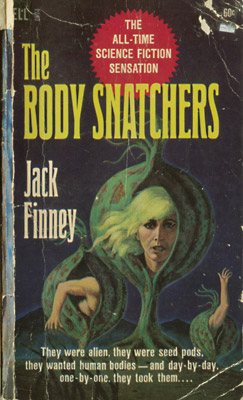
Jack Finney has published at least three different versions of Body Snatchers: first as serialized in Collier's in November and December 1954, then as a book in 1955 (expanded and given a different climax) and then with further edits in 1978 to coincide with Philip Kaufman's second film version of the story.
The three have strong similarities, as could be expected. The text versions take place in Santa Mira, a small town outside San Francisco, and feature a doctor named Miles Bennell, a former flame named Becky Driscoll, a psychologist friend named Mannie Kaufman, a writer friend named Jack Belicec, and his wife Theodora. At the start of the story, Becky approaches Miles and tells him of her cousin Wilma who's become convinced that her Uncle Ira is not actually Uncle Ira; when they visit Wilma, she explains that her aunt hasn't noticed because she is also not her aunt. From there the details accrue suggesting that the humans are being besieged by aliens intent on replacing them, and the small group of humans decide to fight.
Along the way Becky and Miles, both divorced, find themselves increasingly attracted to each other. Becky has divorced recently and Miles five years earlier, yet Miles continues to be bothered by his divorce, taking it as a sign of some shameful defeat. There are scattered mentions throughout the novel, most of them wry, and others which seem either self-deluding or callous and sexist:
So early on Miles seems like a big spender, maybe a bit arrogant, maybe living a lavish lifestyle, with no time for Becky. In the 1978 version the passage is changed: "I drive a 1973 Mercedes two-seater, a nice fire-engine red job, bought used, to maintain the popular illusion that all doctors are rich." (Finney '78, p. 13)
Yet most of the differences between the two versions are subtle, perhaps inconsequential--instead of golf and swimming, Miles plays tennis, things like that. (In fact, the two versions seem so similar that the cynic in me suggests that the 1978 revisions were published simply to allow an extension on the copyright--copyright terms at the time were much more limited and the one on Body Snatchers had nearly run out.)
In the two novel versions Miles, Becky, Jack, and Theodora are increasingly persecuted, then flee town only to find that they don't know where to go or what to do. So they return to town, where they are split up. Becky and Miles hide in a field just outside town--the field where, it turns out, a professor had discovered what he thought was most likely an alien plant, and then a few days later retracted his story. It is here where the aliens are growing their pods for distribution, and Miles and Becky make a desperate last stand, setting fire to the fields and smashing pods. The aliens recognize their defeat and the pods detach from the plants, fly up off the ground, and leave the planet. Miles and Becky reunite with Jack and Theodora and discover that the aliens have a curiously short lifespan; most of them die off within a few years.
The serial version is apparently much different: Robert Shelton in "Genre and Closure in the Seven Versions of Invasion of the Body Snatchers" mentions that the 1955 Dell paperback "is based on, and twice the length of, the serial" and that "in the 1954 serial, a posse of FBI agents armed with 'riot guns' and 'small, light, almost dainty-looking machine guns'" arrives on site, attracted by Miles' fire, and helps fend off the alien invasion.
What does it mean that the endings are so different? What point was Finney trying to make, or deciding not to make? Catherine Jurca, in "Of Satire and Sofas," calls the novel "an allegory of postwar suburbanisation," yet the article is too brief to offer much supporting evidence and it's left to the reader to remember the United States' postwar population boom and the move from the cities to the suburbs.
Michael Parkes, in "There Will Be No Survivors," takes the novel as a metaphor for a different kind of encroaching conformity, and the pods as representing a different threat to identity: the introduction of television into American culture. Parkes notes that "between 1948 and 1955, television was installed in nearly two-thirds of the nation's homes and became the mythic and ideological unifier of the fragmented post-war family" and served "as a sign of suburban achievement," yet one that moved the family away from the hearth and conversation to the television and silent viewing. Parkes notes the effect of television on bars and cafes, as well, and its corollary to the cafe scene in the novel when Miles and Becky go to the Sky Terrace in the Siegel film to find few customers and no live music, but instead a jukebox: "the artistry and individuality of the original band has been 'snatched' and replaced by an inferior technological substitute." In this reading, Parkes considers the story's message somewhat ironic, calling it "an anti-media discourse which in itself is contradictory, as the film [and book] itself exists within the media."
This interpretation of the book as an anti-media, Luddite response to technological innovation is interesting; yet by far the most common reading of the story is as a metaphor for the political climate in the United States during the Cold War--whether as one about McCarthyism or as one about the Red Scare. More on that, and on Finney's and Siegel's reactions to it, next post.
body snatchers mix, part 3
Some more songs tangentially related to the Body Snatchers stories, and more about the stories (with spoilers) below that:
Jimmy Bo Horne -- Get Happy
There's something here that reminds me of much of George McCrae's work, probably in the simple composition and the repetition, but also in the reliance on a sweet hook and an energetic horn section in a poppy R&B track with high-flying vocals. Another happy song, appropriately enough.
[The Legendary Henry Stone Presents: Jimmy Bo Horne @ emusic or @ amazon]
Shirley Bassey -- Hey Big Spender (Wild Oscar mix)
Bassey likes to make these big brassy music numbers that go well with Bond films (Goldfinger, Moonraker, Diamonds are Forever) and that get a deft parody in The Life of Brian ("He had arms ... and legs ... and hands ... and feet / This boy whose name was Brian"). The remix here decides that brassy isn't brassy enough, and so kicks it up a notch: adding breakneck percussion, muted guitar, vocal effects, and tempo changes.
[Shirley Bassey - The Greatest Hits]
J.J. Cale -- Call the Doctor
Countrified blues-rock, subdued delivery, plodding bass, sour horns, and electric guitar swelling into a stoned melancholy solo. The description sounds horrible but Cale pulls it off somehow.
[Naturally]
Eddie Floyd -- Bring It on Home To Me
Easy-going R&B, not pining, not pleading, not arguing a case so much as pointing out what a good time you could be having--hoping you'll come to your senses and come join in.
[Eddie Floyd - Chronicle: Greatest Hits]
Lou Rawls -- Bring It on Home
Nevermind the showboating at the beginning; give the song a minute (actually, 45 seconds). Let the bass come in and the funk get dropped; let Lou gather his evidence and practice his line of argument. It's a smooth-talking dapper performance, pitch-perfect and with just enough edge on it to let you know he's serious, but not so serious as to keep the jurors from clapping.
[Anthology]
Jack Finney has published at least three different versions of Body Snatchers: first as serialized in Collier's in November and December 1954, then as a book in 1955 (expanded and given a different climax) and then with further edits in 1978 to coincide with Philip Kaufman's second film version of the story.
The three have strong similarities, as could be expected. The text versions take place in Santa Mira, a small town outside San Francisco, and feature a doctor named Miles Bennell, a former flame named Becky Driscoll, a psychologist friend named Mannie Kaufman, a writer friend named Jack Belicec, and his wife Theodora. At the start of the story, Becky approaches Miles and tells him of her cousin Wilma who's become convinced that her Uncle Ira is not actually Uncle Ira; when they visit Wilma, she explains that her aunt hasn't noticed because she is also not her aunt. From there the details accrue suggesting that the humans are being besieged by aliens intent on replacing them, and the small group of humans decide to fight.
Along the way Becky and Miles, both divorced, find themselves increasingly attracted to each other. Becky has divorced recently and Miles five years earlier, yet Miles continues to be bothered by his divorce, taking it as a sign of some shameful defeat. There are scattered mentions throughout the novel, most of them wry, and others which seem either self-deluding or callous and sexist:
I'd seen Becky at least every other night all the past week, but not because there was any romance building up between us. It was just better than hanging around the pool hall, playing solitaire, or collecting stamps. She was a pleasant, comfortable way of spending some evenings, nothing more, and that suited me fine.Then there's this more telling passage as Miles is shaving:
--Body Snatchers, '55, p. 24
'You handsome bastard,' I said to my face. 'You can marry them, all right; you just can't stay married, that's your trouble. You are weak. Emotionally unstable. Basically insecure. A latent thumb-sucker. A cesspool of immaturity, unfit for adult responsibility." ... I cut it out, and finished shaving with the uncomfortable feeling that for all I knew it wasn't funny but true, that having failed with one woman, I was getting too involved with another, and that for my sake and hers, she should be anywhere but here under my roof.Both the paperback versions share Miles' self-doubt following his divorce, his penchant for prescribing sedatives, his passive wait-and-see attitude in the face of an obviously mounting crisis, and the curious marker of the body-snatched: an indifference to neighborhood upkeep. A visiting salesman complains that it's hard to get into and out of the town; coffee is hard to come by and tastes bad when a restaurant has it; and Miles notes that his Coca-Cola is warm. And outside the restaurant, on a littered street:
--Body Snatchers, '55, p.76
"Miles," she said in a cautious, lowered tone, "am I imagining it, or does this street look--dead?"Of the three versions, the Collier's version is probably the hardest to find: so far as I know it was never collected and published separately without changes, and it doesn't seem to be available in various academic databases, so finding it most likely requires access to the original magazines. I haven't read this version but I have the other two, and they're fairly similar. One of the more striking differences between the two novels happens early on when Miles mentions his car: "I drive a '52 Ford convertible, one of those fancy green ones, because I don't know of any law absolutely requiring a doctor to drive a small black coupé." (Finney '55, p. 13)
I shook my head. "No. In seven blocks we haven't passed a single house with as much as the trim being repainted; not a roof, porch, or even a cracked window being repaired; not a tree, shrub, or a blade of grass being planted, or even trimmed. Nothing's happening, Becky, nobody's doing anything. And they haven't for days, maybe weeks."
--Body Snatchers '55, p. 108
So early on Miles seems like a big spender, maybe a bit arrogant, maybe living a lavish lifestyle, with no time for Becky. In the 1978 version the passage is changed: "I drive a 1973 Mercedes two-seater, a nice fire-engine red job, bought used, to maintain the popular illusion that all doctors are rich." (Finney '78, p. 13)
Yet most of the differences between the two versions are subtle, perhaps inconsequential--instead of golf and swimming, Miles plays tennis, things like that. (In fact, the two versions seem so similar that the cynic in me suggests that the 1978 revisions were published simply to allow an extension on the copyright--copyright terms at the time were much more limited and the one on Body Snatchers had nearly run out.)
In the two novel versions Miles, Becky, Jack, and Theodora are increasingly persecuted, then flee town only to find that they don't know where to go or what to do. So they return to town, where they are split up. Becky and Miles hide in a field just outside town--the field where, it turns out, a professor had discovered what he thought was most likely an alien plant, and then a few days later retracted his story. It is here where the aliens are growing their pods for distribution, and Miles and Becky make a desperate last stand, setting fire to the fields and smashing pods. The aliens recognize their defeat and the pods detach from the plants, fly up off the ground, and leave the planet. Miles and Becky reunite with Jack and Theodora and discover that the aliens have a curiously short lifespan; most of them die off within a few years.
The serial version is apparently much different: Robert Shelton in "Genre and Closure in the Seven Versions of Invasion of the Body Snatchers" mentions that the 1955 Dell paperback "is based on, and twice the length of, the serial" and that "in the 1954 serial, a posse of FBI agents armed with 'riot guns' and 'small, light, almost dainty-looking machine guns'" arrives on site, attracted by Miles' fire, and helps fend off the alien invasion.
What does it mean that the endings are so different? What point was Finney trying to make, or deciding not to make? Catherine Jurca, in "Of Satire and Sofas," calls the novel "an allegory of postwar suburbanisation," yet the article is too brief to offer much supporting evidence and it's left to the reader to remember the United States' postwar population boom and the move from the cities to the suburbs.
Michael Parkes, in "There Will Be No Survivors," takes the novel as a metaphor for a different kind of encroaching conformity, and the pods as representing a different threat to identity: the introduction of television into American culture. Parkes notes that "between 1948 and 1955, television was installed in nearly two-thirds of the nation's homes and became the mythic and ideological unifier of the fragmented post-war family" and served "as a sign of suburban achievement," yet one that moved the family away from the hearth and conversation to the television and silent viewing. Parkes notes the effect of television on bars and cafes, as well, and its corollary to the cafe scene in the novel when Miles and Becky go to the Sky Terrace in the Siegel film to find few customers and no live music, but instead a jukebox: "the artistry and individuality of the original band has been 'snatched' and replaced by an inferior technological substitute." In this reading, Parkes considers the story's message somewhat ironic, calling it "an anti-media discourse which in itself is contradictory, as the film [and book] itself exists within the media."
This interpretation of the book as an anti-media, Luddite response to technological innovation is interesting; yet by far the most common reading of the story is as a metaphor for the political climate in the United States during the Cold War--whether as one about McCarthyism or as one about the Red Scare. More on that, and on Finney's and Siegel's reactions to it, next post.
Labels: about fiction, body snatchers, country blues, horror, RnB, vocal
posted by Tuwa @
21:41 | permalink |
1 comments
|

Thursday, December 07, 2006:
I guess I should have explained a bit more about the mix last time: most of the songs are tangentially related to the Body Snatchers stories at best, and the mix isn't limited to what could fit on a CD (mostly because I'm not one to make tough decisions). Along the way we'll see some songs with a passing resemblance and others that are different from how we remembered them.
Betty Everett and Jerry Butler -- Love Is Strange
I've written about Betty Everett twice before. This one is one of the better tracks off Together--sweet lyrics and a sweet duo, but what sells it for me is when each of them take it solo towards the end. And then I'm completely sold, yes.
(As for the rest of the LP ... no. It's mostly middling, with tracks that tend to stop at competent without making it to genuinely affecting, and I'm not surprised it's gone out of print. I can't speak for the CD linked below, though--haven't heard it and it's awfully pricey for me to pick up.)
[They're Delicious Together]
Little Milton -- If You Love Me
If guitars were animals, PETA would stage a protest about this song.
[Anthology 1953-1961 ]
Little Johnny Taylor -- If You Love Me (Like You Say)
Keeping with the Chicago blues, the horns, the electric guitars, and the general theme--this one has a smoother melody on the vocals, less grit on the delivery, more syncopation on the horns, and an organ buried in the mix.
[Greatest Hits]
Muddy Waters -- I Feel So Good
Blues piano with a harmonica and a drumset rocking the joint, letting the public know that feeling good can be contagious.
[At Newport]
Ann Peebles -- Slipped, Tripped, and Fell in Love
Three great things about this song: the bass, the organ, the background vocals. The first one runs throughout; the next two stop in for tea and leave right after. You'd consider it rude, except now you're friends and you just hope they can stay longer next time.
[The Best of Ann Peebles: The Hi Records Years]
Dreaming permits each and every one of us to be quietly and safely insane every night of our lives.
--William Dement of the Stanford University Sleep Research Centre, Newsweek, November 30 1959
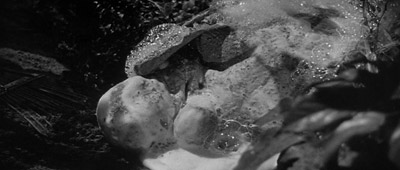
A bare-bones plot description of the Body Snatchers stories (all of them): residents of a community come to suspect that certain loved ones are not themselves, but are perfect physical replicas without any genuine emotional responses. They discover that people are in fact being destroyed and replaced by impostors hatched from alien pods, one by one, as each one of them sleeps. A small group of people decide to fight the aliens, and at least two of them are in love.
From there the details differ--in the characters, locations, resolution, and treatment of themes, with implications about each story's beliefs. But fundamentally the story is about love and vulnerability and the loss of individuality. It's about being human and getting tired and needing to sleep. We're no more vulnerable than when we sleep, as Wes Craven knows, but Finney didn't create a sardonic villain to dispense gory deaths; instead he poses the more psychological question: who will we be when we wake up?
It seems a silly question, easy to laugh off, yet sleeping itself is somewhat troublesome. "We all go a little mad sometimes," sure. We might go a bit unhinged on hearing some devastating news, but that's not all, is it? It's a truism that no one wants to hear about anyone else's dreams, and probably even psychiatrists are faking it, but what are these things? Our brain tells us the earth is a swamp and that people drive Yugos over fallen mossy trees past dully interested brontosauri, and then we get up in the morning and yawn and stretch and go make tea or cofee. Our brain sorts out the desk and dusts the bookshelves and dumps the dreams in the trash. We go around with this tacit agreement that dreams are mostly meaningless, yet the brain keeps making them; and we go to bed knowing that we'll go a bit insane but that it's no big deal, really, that in the morning breakfast and a shower will set us right again. And it does.
Yet in the Body Snatchers stories, sleep doesn't make people temporarily insane; it makes them perfectly and utterly sane, endlessly and coldly logical. It destroys the identity in a more permanent way; falling asleep leads to being replaced by an alien being who has all the same memories but none of the emotion. The consciousness is transfered to another body, the humanity left behind somewhere in the gray fluff, to be swept away and thrown in the trash.
The stories feature alien characters encouraging humans to quit struggling, to give up and accept their fate. It's a conversation that enhances the horror and the sense of betrayal: former friends have changed--changed horribly--and don't mind at all; in fact they want us to join them. Given that humans are fond of thinking that emotions are distinctly human (a dodgy proposition given the evidence that dogs, primates, and countless other mammals show grief, insecurity, jealousy, and indignation), the stories can also be read as an exploration of the fear of evolution. The pods are much more efficient at reproducing than humans are, and they seem to get along much better; and in each version of the story the chances of human survival begin to look slim. Perhaps each story is asking if it's not merely an accident that humans have reigned so long, and if we truly deserve our self-proclaimed perch at the top. If so, it's no surprise that the stories have proved enduringly horrifying.
body snatchers mix, part 2
I guess I should have explained a bit more about the mix last time: most of the songs are tangentially related to the Body Snatchers stories at best, and the mix isn't limited to what could fit on a CD (mostly because I'm not one to make tough decisions). Along the way we'll see some songs with a passing resemblance and others that are different from how we remembered them.
Betty Everett and Jerry Butler -- Love Is Strange
I've written about Betty Everett twice before. This one is one of the better tracks off Together--sweet lyrics and a sweet duo, but what sells it for me is when each of them take it solo towards the end. And then I'm completely sold, yes.
(As for the rest of the LP ... no. It's mostly middling, with tracks that tend to stop at competent without making it to genuinely affecting, and I'm not surprised it's gone out of print. I can't speak for the CD linked below, though--haven't heard it and it's awfully pricey for me to pick up.)
[They're Delicious Together]
Little Milton -- If You Love Me
If guitars were animals, PETA would stage a protest about this song.
[Anthology 1953-1961 ]
Little Johnny Taylor -- If You Love Me (Like You Say)
Keeping with the Chicago blues, the horns, the electric guitars, and the general theme--this one has a smoother melody on the vocals, less grit on the delivery, more syncopation on the horns, and an organ buried in the mix.
[Greatest Hits]
Muddy Waters -- I Feel So Good
Blues piano with a harmonica and a drumset rocking the joint, letting the public know that feeling good can be contagious.
[At Newport]
Ann Peebles -- Slipped, Tripped, and Fell in Love
Three great things about this song: the bass, the organ, the background vocals. The first one runs throughout; the next two stop in for tea and leave right after. You'd consider it rude, except now you're friends and you just hope they can stay longer next time.
[The Best of Ann Peebles: The Hi Records Years]
Dreaming permits each and every one of us to be quietly and safely insane every night of our lives.
--William Dement of the Stanford University Sleep Research Centre, Newsweek, November 30 1959
A bare-bones plot description of the Body Snatchers stories (all of them): residents of a community come to suspect that certain loved ones are not themselves, but are perfect physical replicas without any genuine emotional responses. They discover that people are in fact being destroyed and replaced by impostors hatched from alien pods, one by one, as each one of them sleeps. A small group of people decide to fight the aliens, and at least two of them are in love.
From there the details differ--in the characters, locations, resolution, and treatment of themes, with implications about each story's beliefs. But fundamentally the story is about love and vulnerability and the loss of individuality. It's about being human and getting tired and needing to sleep. We're no more vulnerable than when we sleep, as Wes Craven knows, but Finney didn't create a sardonic villain to dispense gory deaths; instead he poses the more psychological question: who will we be when we wake up?
It seems a silly question, easy to laugh off, yet sleeping itself is somewhat troublesome. "We all go a little mad sometimes," sure. We might go a bit unhinged on hearing some devastating news, but that's not all, is it? It's a truism that no one wants to hear about anyone else's dreams, and probably even psychiatrists are faking it, but what are these things? Our brain tells us the earth is a swamp and that people drive Yugos over fallen mossy trees past dully interested brontosauri, and then we get up in the morning and yawn and stretch and go make tea or cofee. Our brain sorts out the desk and dusts the bookshelves and dumps the dreams in the trash. We go around with this tacit agreement that dreams are mostly meaningless, yet the brain keeps making them; and we go to bed knowing that we'll go a bit insane but that it's no big deal, really, that in the morning breakfast and a shower will set us right again. And it does.
Yet in the Body Snatchers stories, sleep doesn't make people temporarily insane; it makes them perfectly and utterly sane, endlessly and coldly logical. It destroys the identity in a more permanent way; falling asleep leads to being replaced by an alien being who has all the same memories but none of the emotion. The consciousness is transfered to another body, the humanity left behind somewhere in the gray fluff, to be swept away and thrown in the trash.
The stories feature alien characters encouraging humans to quit struggling, to give up and accept their fate. It's a conversation that enhances the horror and the sense of betrayal: former friends have changed--changed horribly--and don't mind at all; in fact they want us to join them. Given that humans are fond of thinking that emotions are distinctly human (a dodgy proposition given the evidence that dogs, primates, and countless other mammals show grief, insecurity, jealousy, and indignation), the stories can also be read as an exploration of the fear of evolution. The pods are much more efficient at reproducing than humans are, and they seem to get along much better; and in each version of the story the chances of human survival begin to look slim. Perhaps each story is asking if it's not merely an accident that humans have reigned so long, and if we truly deserve our self-proclaimed perch at the top. If so, it's no surprise that the stories have proved enduringly horrifying.
Labels: about fiction, blues, body snatchers, horror, movies, RnB
posted by Tuwa @
21:59 | permalink |
4 comments
|
Tuesday, December 05, 2006:
So I've made a Body Snatchers mix which I'll be posting over the next week and a half or so.
Harold Melvin & The Blue Notes -- Wake Up Everybody
Philly soul wearing its heart on its sleeve, confident in its sincerity and optimism and urging positive change. Sing it, Teddy.
The Beatles -- I'm Looking Through You (alt version)
This one is probably one of the most thematically related to the Body Snatchers stories, though written for quite different reasons: "I'm looking through you / where did you go? / I thought I knew you / What did I know? / You don't look different but you have changed / I'm looking through you; you're not the same." It's the alt take off Anthology 2, naturally enough, and it says something for the general quality of the Beatles' work that for most bands this version would have been a perfectly acceptable release.
Sam Roberts -- Paranoia
Radio-friendly pop-rock, the kind of track I wouldn't usually post, but there's something about this one that keeps bringing me back to it. Maybe it's the ooooooohs.
[If You Don't Know Me by Now: The Best of Harold Melvin & the Blue Notes ]
[Anthology 2]
[We Were Born in a Flame]
A brief philosophy of horror fiction: horror is deliberately transgressive and cheerfully untactful; it's not interested in chitchat about the weather, instead it wants to talk (metaphorically, or literally) about taboos. A good horror writer is like a tough-love psychiatrist, finding our most vulnerable spots and prodding them; the horror story is like Ingmar Bergman with optional religious iconography, yet it has no pre-defined point of view and no social obligations beyond investigating and reporting. It may or may not advocate social revolution and may even be reactionary--Night of the Living Dead is not advocating cannibalism; Frankenstein would be a poor witness for science--but it's speculative fiction and it must address taboos, regardless of whether doing so will shock any of the audience.
It's probably an oversimplification to say that horror fiction is about death, since there are some perfectly horrifying horror stories in which no one dies and since, in any case, death is the result of vulnerability. Yet "vulnerability" covers a lot of ground: it's a theme common to the shower scene, being lost in the woods, being chased by a plane, and having an eyeball sliced with a razor.
Of all the kinds of vulnerability, there are a number of horror films about a threat to current identity, about the threat of continuing life in a radically different form: films as diverse as Dracula, The Howling, and Night of the Living Dead; The Fly, The Thing, and The Exorcist; Misery, Rosemary's Baby, and The Invasion of the Body Snatchers.
The ghost, vampire, werewolf, and zombie films have centuries of legends behind them and have the most variants as a result, but Invasion of the Body Snatchers gives a fair showing considering its relative youth. The story was first serialized in Collier's in late 1954 under the title Body Snatchers; Jack Finney expanded it and rewrote the ending for publication as a novel in 1955, and the book was republished with more trivial changes in 1978. As of 2006 the story has had three authorized film versions (with four different endings among them); a fourth film version was finished in October 2006 but was rewritten so much after the novel was optioned that the producers decided it was not actually a version of Finney's work.
All these stories--the body snatchers and the rest--are fertile soil for a writer (any writer, including satirists like Terry Pratchett and the Futurama crew) and are firmly a part of the culture. But what do they mean as cultural artefacts? What do they say about the environment they were made in; what kinds of changes did people fear, and what cultural and historical backgrounds help explain those fears?
I doubt I'll find the answer to all of these questions, but in exploring them I can at least see what other questions crop up along the way. So. The start of the Body Snatchers mix. More later on Finney's three versions, Siegel's two versions, Kaufman's 1978 film, and Ferrara's 1993 film.
body snatchers mix, part 1
So I've made a Body Snatchers mix which I'll be posting over the next week and a half or so.
Harold Melvin & The Blue Notes -- Wake Up Everybody
Philly soul wearing its heart on its sleeve, confident in its sincerity and optimism and urging positive change. Sing it, Teddy.
The Beatles -- I'm Looking Through You (alt version)
This one is probably one of the most thematically related to the Body Snatchers stories, though written for quite different reasons: "I'm looking through you / where did you go? / I thought I knew you / What did I know? / You don't look different but you have changed / I'm looking through you; you're not the same." It's the alt take off Anthology 2, naturally enough, and it says something for the general quality of the Beatles' work that for most bands this version would have been a perfectly acceptable release.
Sam Roberts -- Paranoia
Radio-friendly pop-rock, the kind of track I wouldn't usually post, but there's something about this one that keeps bringing me back to it. Maybe it's the ooooooohs.
[If You Don't Know Me by Now: The Best of Harold Melvin & the Blue Notes ]
[Anthology 2]
[We Were Born in a Flame]
A brief philosophy of horror fiction: horror is deliberately transgressive and cheerfully untactful; it's not interested in chitchat about the weather, instead it wants to talk (metaphorically, or literally) about taboos. A good horror writer is like a tough-love psychiatrist, finding our most vulnerable spots and prodding them; the horror story is like Ingmar Bergman with optional religious iconography, yet it has no pre-defined point of view and no social obligations beyond investigating and reporting. It may or may not advocate social revolution and may even be reactionary--Night of the Living Dead is not advocating cannibalism; Frankenstein would be a poor witness for science--but it's speculative fiction and it must address taboos, regardless of whether doing so will shock any of the audience.
It's probably an oversimplification to say that horror fiction is about death, since there are some perfectly horrifying horror stories in which no one dies and since, in any case, death is the result of vulnerability. Yet "vulnerability" covers a lot of ground: it's a theme common to the shower scene, being lost in the woods, being chased by a plane, and having an eyeball sliced with a razor.
Of all the kinds of vulnerability, there are a number of horror films about a threat to current identity, about the threat of continuing life in a radically different form: films as diverse as Dracula, The Howling, and Night of the Living Dead; The Fly, The Thing, and The Exorcist; Misery, Rosemary's Baby, and The Invasion of the Body Snatchers.
The ghost, vampire, werewolf, and zombie films have centuries of legends behind them and have the most variants as a result, but Invasion of the Body Snatchers gives a fair showing considering its relative youth. The story was first serialized in Collier's in late 1954 under the title Body Snatchers; Jack Finney expanded it and rewrote the ending for publication as a novel in 1955, and the book was republished with more trivial changes in 1978. As of 2006 the story has had three authorized film versions (with four different endings among them); a fourth film version was finished in October 2006 but was rewritten so much after the novel was optioned that the producers decided it was not actually a version of Finney's work.
All these stories--the body snatchers and the rest--are fertile soil for a writer (any writer, including satirists like Terry Pratchett and the Futurama crew) and are firmly a part of the culture. But what do they mean as cultural artefacts? What do they say about the environment they were made in; what kinds of changes did people fear, and what cultural and historical backgrounds help explain those fears?
I doubt I'll find the answer to all of these questions, but in exploring them I can at least see what other questions crop up along the way. So. The start of the Body Snatchers mix. More later on Finney's three versions, Siegel's two versions, Kaufman's 1978 film, and Ferrara's 1993 film.
Labels: about fiction, body snatchers, horror, movies, RnB, rock
posted by Tuwa @
15:52 | permalink |
0 comments
|
 XML


