the hands of a government man
Talking Heads -- Born Under Punches (live in Rome, 1980)On the cusp of Remain in Light, before Speaking in Tongues, Talking Heads explored moody funk: dark, brooding, and danceable, as evidenced by this Metafilter post about a concert in Rome in 1980 with Adrian Belew (formerly of Frank Zappa and David Bowie, soon to be of King Crimson).
Belew's work here hints at an influence on Byrne's guitar work which showed up as early as Stop Making Sense but, more importantly, the songs stand on their own merits: featuring a meaty slapping bass, ethereal laments, wailing feedback.
The lyrics are elliptical, as any Talking Heads fan could tell you: perhaps they're about shallow consumption; perhaps they're about drug use; perhaps they're a paranoiac nightmare of an encroaching surveillance state. If they are, does it undercut the exuberance that the performance is at least partly planned, calculated to be worth recording? (And what does it mean that it was recorded and passed around in increasingly inferior versions--from broadcast TV to videotape to glitchy upload on Youtube to glitchy lossy mp3? Byrne could write something clever and pointed about it; for my part I'll just hope the concert gets a professional DVD release.)
Other highlights on that concert: "Drugs," "Crosseyed and Painless," "The Great Curve."
Labels: rock
posted by Tuwa @
11:29 | permalink |
1 comments
|

The Octopus Walks Across the Coral
Morningbell -- The Octopus Walks Across the CoralMorningbell has a new album out. It's a Choose Your Own Adventure album; the adventure I chose was to listen to the tracks in numerical order, and then to give it some time and listen again. I'm happy for the ways it shows the group stretching out, expanding their sound, and while there aren't any tracks on it I dislike, I think the two being promoted are not the two I would have picked: my money is on "Utopian Fantasy at the Center of the Earth" and "The Octopus Walks Across the Coral."
I've written about Morningbell twice before, once for kicks and out of general excitement, and once as part of a failed experiment. What I haven't written much about is octopuses.
What can you say about octopuses that doesn't involve ink or the lack of a skeleton? They can camouflage themselves amazingly well, sometimes to ambush a shark; they can open jars for food and climb onboard boats to get at food stored in the hold; they can walk on two legs, six arms wrapped around them so they look like a coconut taking a stroll, or hold the other six arms up, twisted about so they look like algae. They can also regrow an arm, unless the budget doesn't allow it. And they can play the guitar but not the bagpipes.
[Morningbell's site]
[Morningbell's MySpace page]
[This was a Team Clermont promotion, but I would have picked it up anyway given my fondness for the band.]
posted by Tuwa @
02:28 | permalink |
6 comments
|
stop, hey, what's that sound?
College was a culture shock: going from true poverty to an artificial poverty with secure housing and a clear end, from a small town where I was considered brilliant to a college town where I was surrounded by people who were, from oversight that was vindictive and capricious to authority that were indifferent, all of it coupled with an exhilerating and terrifying freedom. My first roommates were from Boca Raton, the three of us sharing the second-cheapest room on campus, built for four, their friends coming over to drink or smoke, one of them once memorably complaining about being given a car which cost more than my mother's house but wasn't what he wanted.I was a teetotaller losing his faith, bitter and angry and self-righteous, and took comfort in my arrogance. Cypress Hill was a fixture in the room that year, even before "Insane in the Brain" hit MTV; I heard their first two CDs constantly and hated them for their stoner vibe and the gangsta theatrics, but still I wondered if it was a deeply ironic word choice or a sly wink and a bit of hiding in plain sight that--among the machismo and claims to murder--they'd drop lines like "I'm a chicken hawk huntin' for a chicken."
Some time back I remembered the group with some fondness, and bought Black Sunday, and found that their sound on the CD was actually fairly interesting. In trying to describe it, I thought it would be like a pitchfork: deep prominent bass, high far-off (far-out) sounding noises, vocals in the middle. And going back a bit further, to high school, to Young MC, I stumbled onto what seemed like a precursor to their sound; a track with all that lethargy and sonic separation yet from someone who, from his lyrics, would clearly not approve of Cypress Hill's lifestyle. I'm not sure if Young MC has changed his attitudes towards drugs since 1989, as mine did, and did again, since 1993; his first CD was the only one I listened to, and I listen to it still: I enjoy the beats and the facility with rhyme (even silly rhyme) ("I'm sloppy like Oscar but neat like Tony Randall"?) and the general party atmosphere of it, which is light and fun as long as it's not taken seriously. In this regard it's like the early Tribe records, which also have some green lyrics, some clumsy seductions and misplaced wallets.
But the more I think of it, the more I notice songs flirting with this Cypress Hill sound, this same sound predated by Young MC's track: decades earlier, in Bill Wither's "Ain't No Sunshine"; and a few years later, in The Coup's "Fat Cats, Bigga Fish," in Louise Attaque's "Du Nord Au Sud"* and, to a lesser extent in Radiohead's The National Anthem (the vocals at the high point, the horns starting in the middle ... but too thick a sound overall, too much overlap and chaos) and in The Cure's remix of "Fascination Street" (the bass needs to be thicker, the middle thinner).
The more I think of it, the more I think I hear it (Pink Floyd, Depeche Mode, Baaba Maal), leading me to wonder if it's everywhere or if it's anywhere at all. It's possible I'm imagining it: representative samples in a frequency analyzer show some similarity, but not the separation of sound I thought I'd heard:

But quite distinct songs (Tears for Fears' "I Believe," The Beatles' "Helter Skelter") don't show nearly as much difference as I'd expected:

In '93 I'd probably bend over backwards, making any contortions necessary to prevent saying "I don't know" or "I was wrong." I don't know, and I may be wrong. Yet I'm not sure that recognizing that puts me any closer to finding what the similarities are, if they even exist.
Readers, if you care to comment (musicians, music theorists, music historians and/or critics--anyone with a clue really), is there actually any similarity between the Young MC track and the Cypress Hill track? If there is, how would you go about finding more of it?
[Stone Cold Rhymin' @ amazon, @ emusic]
[Genocide & Juice: out of print]
[Black Sunday @ amazon]
[Comme on a Dit]
[Mixed Up]
[Kid A]
* First posted 63 years ago in internet years on my guest post to Said the Gramophone.
Labels: hip-hop, out of print, personal, rock, world pop
posted by Tuwa @
22:26 | permalink |
7 comments
|
White Elephant Blogathon: Bill and Ted's Excellent Adventure
This post is part of the White Elephant film Blogathon, in which volunteers throw a movie suggestion into the hat for someone else to review. The only restriction was that the movie be widely available; and the implication was that most of them would be bad because bloggers could already use their site to review good movies. I ignored that implication, as I didn't have the heart to recommend a film I thought was truly bad; instead I recommended one I thought was quite good but somewhat obscure.And in return I got Bill and Ted's Excellent Adventure. I'd remembered it fondly, but I'd last seen it in high school, when it probably spoke to me more, and I'd seen it with a group of friends, which can shore up a mediocre comedy. It's a truism that actors in a comedy should act as if they're in a drama; else the comedy becomes less about situation than about actors showing out. The performances here are oversold and the timing poor, each joke delivered with a wink and a beat after it as if to slot in a laugh track. This is not Howard Hawks direction with a Ben Hecht script, though the script does have potential.
The story is about two exceptionally ignorant and lazy but good-natured bad musicians who are on the verge of failing their history class and, hence, flunking out of high school. At a convenience store the night before they have to give the history presentation that could help them pass the class, a phone booth falls from the sky. In it is a man named Rufus who came from the future and takes them back in time to see Napoleon Bonaparte. From there Bill and Ted jaunt through history collecting historical figures and nearly getting killed in various ways. If Ted doesn't graduate he'll be sent to military school, so it's clear why they want to get a good grade on the presentation, but it's less clear why they have any interest in being musicians since it's clear they never practice.
The movie has a few moments that work and a lot more that don't; for every nice touch like Napoleon cheating on his bowling score there are more attempted jokes which fall flat, such as the notion that Joan of Arc is Noah's wife. Many of the scenes may have worked on paper but don't work on screen; in one of them, Bill's father and stepmother kick Bill out of his room so they can get it on. The scene could have been very funny if handled right; instead it just seemed like a scene that could have been very funny if handled right. And some of the other jokes would have been better left for the viewer to discover, like Bill's Oedipus complex.
It's disorienting in a comedy to wonder if the cleverest jokes were intended as jokes--Rufus goes back in time to ensure that the past happens as it should, yet rather than going back in time far enough to allow Bill and Ted to research and prepare a proper presentation, he goes back to the night before it's due. Research would make for a dull comedy (or a much more cerebral comedy than the screenwriter wanted), so Rufus' choice may be a narrative necessity, or it may be a subtle joke about the culture Bill and Ted have inspired, in which everything is done at the last minute. (If I remember right, Bill and Ted devise a similar solution in the sequel, just before the competition when they still don't know how to play guitar: they go back in time to practice, then return to just a few seconds after they left.) The clever joke, or perhaps plot hole, is that Bill and Ted spend all night traveling through time rather than sleeping and that staying up all night would render most people exhausted and inarticulate, yet they are more eloquent in their presentation than they ever have been before.
I wondered more than once if the film were actually a personal fantasy written by a young man in high school with a project due very soon--I was never convinced that the future Rufus comes from would be one I would want to live in. And I couldn't help wondering also if Mike Judge didn't address the movie and its sequel twice: first in Beavis and Butthead, making the dimwitted teenagers petty and vicious, and then again in Idiocracy, making a future populated with dimwits a nightmare rather than a fantasy.
White Elephant Blog-a-thon:
The Ongoing Cinematic Education of Steven Carlson on Bio-Dome.
Flickhead on Teen Witch.
Zoom In Online on Tale of the Bunny Picnic.
Eddie's Blog-a-Thon Board on Purple Rain.
Ben @ Lucis Screening on Nude for Satan.
Andrew @ Lucid Screening on Troll 2.
Lazy Eye Theatre on Forbidden Games.
Filmsquish on Air Bud: World Pup.
As Cool As a Fruitstand on Picnic.
goatdogblog on Making the Grade.
Talk to Me Harry Winston on Riki-Oh: the Story of Ricky.
The Exploding Kintetoscope on The Texas Chainsaw Massacre: the Next Generation.
Ben @ Lucid Screening on The End.
Case @ Lucid Screening on Minoes.
Rufus @ Lucid Screening on Dark Harvest 2: The Maize.
Additional links to be added as I find them....
And two mp3s, since this is an mp3blog:
Primus -- Tommy the Cat
Primus -- Bob
"Tommy the Cat" is actually used in Bill and Ted's Bogus Journey, not the original, but the soundtrack to the original doesn't impress me at all and the soundtrack to the sequel outdoes it by having one song worth the time spent listening to it.
Primus are a divisive band; most people I've met either love them or hate them. For my part, I thought Sailing the Seas of Cheese and Pork Soda were good and the rest were not.
Les Claypool has a unique approach to playing bass, but what surprises me most about this track is Tom Waits as Tommy the Cat. The song is originally from Sailing the Seas of Cheese and tells an amusing story; "Bob" is from Pork Soda and is a sober track about a friend's suicide, aptly hinting at the darkness and obsession that surround the event but avoiding emo territory in its delivery.
[Sailing the Seas of Cheese]
[Pork Soda]
And, on the subject of comedies centering on research, some wonderful detective work at Making Light, about what looks roughly similar to an Elmore Leonard story set in the publishing business.
Labels: blogathon, movies, rock
posted by Tuwa @
05:04 | permalink |
10 comments
|
Of God and Science, Barton Carroll
Of God and Science -- America's QueenFuzzed guitar, booming drums, singalong melody, banjo mixed low: this song is like a three-piece hemp suit, the fabric woven just rough enough to be distinctive but tidy enough to get you into a nice restaurant.
Of God and Science are from Albuquerque and are Matthew Dominguez on guitar and vocals, Jeremy Fine on bass, Julian Martinez on piano, guitar, pedal steel, vocals, and banjo, and Ryan Martino on drums. They have an album coming out on May 1st.
[Of God and Science's official site, record label, and Myspace page]
Barton Carroll -- Scorched Earth
Brushed drums and violin, melody in leg-irons, a quiet charm to a forlorn track: the kind of thing that reveals itself slowly, weary but determined, hurt but not bowed.
[Barton Carroll has more tracks up at his site and at his Myspace page. His Love & War is on Skybucket Records.]
Labels: folk rock, indie, PR, rock
posted by Tuwa @
00:02 | permalink |
0 comments
|
Lylas, Conner, Candy Bars
Got behind; now I'm playing catch-up. Here are three from the mail bag (more tomorrow):Lylas -- Tiny Echoes
It's possible that Lylas have more than a passing acquaintance with Alan Parker and that they most like Paul McCartney's work on the white album. It's also possible (always possible) that I'm wrong but that, even when you're tired and hungry and don't understand the lyrics, you can walk around in a relatively good mood humming this melody.
[Lylas' site]
[Lylas' Team Clermont page]
[Lylas @ Myspace]
Conner -- Cold Feelings
Conner were born at the intersection between danceable New Wave and artsy alt-rock, producing head-bobbing smile-making music that sounds like a summer road trip.
[Conner's site]
[Conner's Team Clermont page, with additional mp3s]
Candy Bars -- Violets
This song is dark and cold and beautiful, like a Polish winter landscape seen from indoors. If it were a film it would be Decalogue Eleven: make a joyful noise unto the Lord. In this film Candy Bars would strive for, and never reach, catharsis, the film's text implying that pain is perpetuated in its expression, its cultural context implying the reverse: the audience would experience catharsis, happy to have known about the pain but not lived it, able to turn off the television and go make a sandwich.
[Candy Bars seem not to have an official site or Team Clermont page.]
...
Team Clermont sent me these songs; I don't always remember to say who sent me what but I think I have labeled all the IODA/promonet, band-sent tracks, and other PR (or partly PR) posts here, in case anyone's interested.
I'm not always prompt about looking over tracks sent to me but I do try to give them all a chance; and I'm always happy to find new (or new-to-me) good music.
posted by Tuwa @
21:52 | permalink |
2 comments
|
body snatchers mix, part 10
Helen Merrill -- What Is This Thing Called Love? (1988)A leisurely paced version with subdued instrumentation giving it a somber and somehow chilly feel. There are a number of ways to deliver the lyrics, with or without the wink; Merrill opts for without, performing it as high drama.
[from Helen Merrill Sings Cole Porter, out of print]
Hank Jones -- What Is This Thing Called Love? (Nov 1990-1991)
The bass and drums are steps up a hill; the piano carries the melody them; the strings sprint ahead like a cat, looking back, weaving between the piano's feet, affectionate or maybe just hoping to trip it.
[Hank Jones with the Meridian String Quartet, used for a dollar]
Keely Smith & Nelson Riddle -- What Is This Thing Called Love? (released Aug 1991)
If Shirley Bassey were to sing the song, this is how she'd do it: swinging for the fences, horns and drums like something lifted from the soundtrack to a retro spy film.
[Capitol Sings Cole Porter: Anything Goes]
Mandino Reinhardt and Note Manouche -- What Is This Thing Called Love? (January 1, 1994)
What do I know about Mandino Reinhardt? It wouldn't fill the back of a postage stamp: he's from Alsace; he's a well known guitarist there; he has the same surname as Django. Related? Biologically, maybe. Musically, yes.
[Gypsy Swing From Alsace @ emusic]
A very brief writeup on Mandino Reinhardt.
Dan Barrett -- What Is This Thing Called Love? (Jul 23, 1997-Oct 28, 1997)
This is a very muted presentation, and not just in the trumpet. It swings, yes, but it's the swing of a grandfather clock in slow motion. Barrett follows it not with a security guard explaining the rules of the game but with a jog past a lake with distant sailboat and setting sun reflected in ripples, complete with lakeside dog jumping to catch a frisbee.
[Melody in Swing, also @ emusic]
Dick Hyman and Derek Smith -- What Is This Thing Called Love? (1998)
Dick Hyman and Derek Smith turn in the spiritual brother to the Freddie Hubbard/Jimmy Heath version, except on piano instead of horn: the two in competition for how quickly they can play while holding a rhythm and how hard they can bang the keys as they do.
[Dick & Derek at the Movies ]
Beegie Adair -- What Is This Thing Called Love? (Feb 2001)
This one starts off sounding like it's going to be a typical sleepy approach, but Adair shows more imagination than that, giving it a driving rhythm and dropping bits of the melody as she sees fit. I'm not sure how much of the tune was improvised, but from the starts and stops I get the feeling that some of it was but that she has a perceptive band in tune with each other and having fun.
[Dream Dancing: Songs of Cole Porter]
Lemar -- What Is This Thing Called Love? (2004)
Allmusic.com describes this one as "swell-egant," which leads me to suspect I'm not a big fan of swell-egance. I hoped for a more dynamic range on the vocals though I'm not sure why: I don't have that reaction to Billy Holliday's version or to Lena Horne's, though they're arguably working within an equally narrow range.
I'm sure it's just a matter of taste; Lemar has a successful career across the pond.
[De-Lovely soundtrack]
And a song not by Cole Porter!
Tom Waits -- Earth Died Screaming
This is a bizarre and sinister track with funky guitar, off-kilter percussion, and snarling slurred vocals proclaiming death and doom: John the Revelator with a sense of melody and a junkyard band.
[Bone Machine]
Thanks again to Girish and Rev. Frost for suggestions and for helping me track down many of these covers.
Labels: body snatchers, jazz, rock, vocal
posted by Tuwa @
23:55 | permalink |
1 comments
|
body snatchers mix, part 5

Lightnin' Hopkins -- Feel So Bad
Acoustic country-blues with Hopkins' distinctive reedy voice and some banging piano backup.
[Blues Kingpins]
Waylon Jennings -- Crying
Jennings is not quite up to the melody; his reach isn't as agile as Orbison's, his touch not as deft. He's like a blackhat hacker whose social engineering fails and so he decides to brute force it. It's inelegant but it works.
[Country Giant @ emusic]
Rebekah Del Rio -- Llorando (Crying)
This one's from Mulholland Drive; supposedly it was a one-take recording, which (if true) is all the more amazing considering how well it turned out. This performance is like an angel, watching mute for six thousand years, then deciding it has something to say about sadness.
[Mulholland Drive: Original Motion Picture Score]
Lee Dorsey -- Tears, Tears and More Tears
Lee Dorsey just sounds so damn affable in his songs, like somebody's hip grandfather in sharp shoes and a fedora, incorrigible, bawdy, a metric ton of fun. He's known for working with Allen Toussaint and also the Meters; this one is a Toussaint production with the bass and muted guitars holding down the rhythm and pianos low in the mix accenting it. The horns are in tiptop shape and the vocals give them a run for their money.
[Yes We Can/Night People]
James & Bobby Purify -- You Don't Love Me
Uptempo soul number from James and Bobby Purify, most known for "I'm Your Puppet." This one's a rowdy track with knockout vocals.
[Shake a Tail Feather]
Bo Diddley -- You Don't Love Me (You Don't Care)
Bo Diddley can sing songs that don't contain the words "Bo Diddley," and they're often good, too. Love the harp on this one, especially the echo, and the pounding piano solo is good too. The song has an interesting structure: several verses, a solo, an outro.
[Bo's Blues ]
Oingo Boingo -- Imposter
This song is not afraid. Not afraid of you, or your mama, or your cyborg from the future with the chip in the head. It's from Only a Lad, an album with a gleefully creepy song about a pedophiles, but this isn't that one. This one's about music critics, who are painted less sympathetically than pedophiles. "You take the credit while others do all the work / You like to think you discovered them first / We all know you moved in after it was safe / That way you can never get hurt / You like to play God / You don't believe what you write / You're an imposter" and later, "Your head is firmly lodged way up your butt / Where it belongs."
[Only a Lad ]
(Discussion of Kaufman's film, with spoilers, follows.)
Philip Kaufman, in his remake of Invasion of the Body Snatchers, changed the setting from a small town outside San Francisco to San Francisco itself: at the start of the film, pods drift up off the surface of a barren planet, float through space, and descend on earth, the Golden Gate Bridge in the background. There they cover various plants with a gelatinous, translucent substance and begin putting out first roots and then flowers.
Elisabeth Driscoll finds one of the flowers, picks it, gets stared at by a teacher encouraging her young students to pick them, and goes home, where she tells her boyfriend Geoffrey that it might be a completely new species of plant that cross-pollinated from two others, something invasive and dangerous. Unlike in the first film and in the text versions, Elisabeth (the Becky character) is not divorced, but there are signs early on that their relationship is in trouble--the first thing Elisabeth says to Geoffrey is "Too much trouble to pick the mail up off the floor, Geoffrey?" She goes over to him and he pulls her into his lap; they kiss, and Geoffrey interrupts it to shout about the basketball game on the TV behind her.
Matthew Bennell, for his part, is not a doctor but a health inspector working for the Department of Health; he angers the wrong restaurant workers with a promise to have their permit revoked and then spends the rest of the film driving a car with a busted windshield. Elisabeth also works at the Department of Health, and though it's not clear if they've dated before, it is clear that they are attracted to each other. This attraction lends a certain tension to the early scenes in the film, when Elisabeth is still trying to make her relationship with Geoffrey work.
For someone who's seen the original film and noticed the teacher's interest in getting the children to take the flowers home it's probably no surprise that the next morning Geoffrey isn't acting like himself, that Elisabeth is curious and alarmed about it, and that Matthew has a psychologist friend with a number of fairly convincing explanations about why they might be imagining things. In this case the friend is David Kibner, played by Leonard Nimoy. It's an unusual casting choice, especially given the success of the original Star Trek series: Kaufman no doubt expected audiences to be unsurprised at his coolly logical demeanor and perhaps to wonder if it's too obvious that he would be a pod person.
Kaufman also makes a few recontextualizations: not just in changing the setting from suburban to urban but also in making explicit comparisons to disease, evolution, and pollution. All of the topics are covered in dialogue, generally more than once; so the subjects are not subtext but text itself. The change in Matthew's job is interesting, as it shifts him from private practice to civil servant, implying a certain amount of faith in the government yet maintaining the character's interest in contagion and infection. And while Jack is still an author (in this film a poet), he and his wife Nancy also own a mud bath. Nancy is explicitly concerned about environmental damage, at one point commenting that they don't know how the aliens invade humans--"We would never even notice it, not from the impurities we have. I mean we eat junk, we breathe junk--" And Elisabeth's interruption: "Look, I don't know where they're coming from. But I feel as though I've been poisoned today. We've got to take those flowers in and have them analyzed. This is the only thing we know; there is something here."
A number of critics and horror fans have commented that the new urban setting doesn't work (Stephen King, for instance, stating in Danse Macabre that Kaufman lost more than he gained in the change), but I suspect that's a matter of taste. Kaufman is not working on the same scale as Siegel or Finney: Finney's story is a somewhat harrowing but ultimately hopeful story. Siegel aimed for something darker--more loss, more betrayals, a grimmer ending--but had a more hopeful ending (or faux-hopeful ending, depending on your interpretation) forced onto the film. Kaufman states very calmly that there is no reason for hope and will be no survivors.
The aliens in this version sweep up and dispose of their human remains, and throughout the film we see garbage trucks compressing grey fluff in clouds of dust. The first vehicle seen in the film is a garbage truck; and the morning after Elisabeth takes home the flower, Geoffrey is already awake, sweeping something up when the alarm clock goes off. He ignores Elisabeth's questions and takes the trashcan downstairs to a waiting garbage truck. They're everywhere in the film, a constant reminder of both consumption and waste.
The film is also concerned with media, like the Siegel version and the various texts: at Matthew's house on top of a hill, Jack can't pick up any radio stations. Matthew tries several times to call for help, and while some of his later calls are intercepted, most of them go through because the people he's contacting have already been changed. They're careful to appear to help, at least until it no longer matters. When it's clear that the aliens are tired of waiting and are going to force the four of them to be changed, Matthew, Elisabeth, Jack, and Nancy flee Matthew's house, chased by a horde of pod people emitting a hair-raising, thoroughly alien, klaxxon-sounding alarm. The four humans run through dark city streets casting giant shadows, chased on foot and by motorcycle police, tracked by helicopter, and once they're cornered Jack decides to split up from them to find help. Nancy runs after him, leaving Matthew and Elisabeth to go in a different direction.
Eventually they hear some music coming from a ship, giving Matthew the idea to sail away. He goes to investigate, as in the previous film; and what he sees is a ship being loaded with pallets of pods. When he returns, Elisabeth has fallen asleep and won't wake up. He tells her comforting lies as her body disintegrates; and then her replacement sits up and tells him he should quit resisting. This scene is similar to the one near the end of the original film, except that in the original Siegel didn't dare show or imply that Becky was naked (most likely the Hayes code wouldn't allow it). As a result, in Siegel's film we're supposed to believe that the pod person came to life, took the clothes off the remains of the original, put them on itself, and then lay down to pretend to be tired for when Miles returned. No, in this one Elisabeth is naked and she doesn't care: not as she stands up, not as she follows Matthew to the greenhouse nearby, not as she walks through it with dozens of workers milling about, paying her no attention whatsoever. Some people take the nudity as gratuitous, but it strikes me as both logically consistent and purposeful, underscoring the complete alienness of the invaders. It's here in the greenhouse that Matthew makes his final stand, destroying some of the pods and causing a fire before fleeing again to hide.
Throughout the film, Matthew and Elisabeth have been the holdouts in government, trying to maintain their humanity against soul-crushing odds. At the very end we see Matthew at work, appearing dispassionate around the pod people, then in his office cutting out an article, as he did at the beginning of the film. And as the pod people begin to leave the Department of Health, Matthew does too: outside, to the plaza where those strange twisted unforgettable trees are growing, where he hears a voice behind him calling his name. It's Nancy. She steps forward, looking stressed and tearful and relieved to find him, and Matthew raises his arm and emits that klaxxon alarm. In a film explicitly concerned with the environment, starring two civil servants, this ending could be read as both a statement about the effectiveness and integrity of government and as a death knell for hippie idealism: the world is doomed; your government will make sure of it.
Labels: blues, body snatchers, country music, horror, movies, RnB, rock, soundtrack
posted by Tuwa @
10:59 | permalink |
4 comments
|
body snatchers mix, part 1
So I've made a Body Snatchers mix which I'll be posting over the next week and a half or so.
Harold Melvin & The Blue Notes -- Wake Up Everybody
Philly soul wearing its heart on its sleeve, confident in its sincerity and optimism and urging positive change. Sing it, Teddy.
The Beatles -- I'm Looking Through You (alt version)
This one is probably one of the most thematically related to the Body Snatchers stories, though written for quite different reasons: "I'm looking through you / where did you go? / I thought I knew you / What did I know? / You don't look different but you have changed / I'm looking through you; you're not the same." It's the alt take off Anthology 2, naturally enough, and it says something for the general quality of the Beatles' work that for most bands this version would have been a perfectly acceptable release.
Sam Roberts -- Paranoia
Radio-friendly pop-rock, the kind of track I wouldn't usually post, but there's something about this one that keeps bringing me back to it. Maybe it's the ooooooohs.
[If You Don't Know Me by Now: The Best of Harold Melvin & the Blue Notes ]
[Anthology 2]
[We Were Born in a Flame]
A brief philosophy of horror fiction: horror is deliberately transgressive and cheerfully untactful; it's not interested in chitchat about the weather, instead it wants to talk (metaphorically, or literally) about taboos. A good horror writer is like a tough-love psychiatrist, finding our most vulnerable spots and prodding them; the horror story is like Ingmar Bergman with optional religious iconography, yet it has no pre-defined point of view and no social obligations beyond investigating and reporting. It may or may not advocate social revolution and may even be reactionary--Night of the Living Dead is not advocating cannibalism; Frankenstein would be a poor witness for science--but it's speculative fiction and it must address taboos, regardless of whether doing so will shock any of the audience.
It's probably an oversimplification to say that horror fiction is about death, since there are some perfectly horrifying horror stories in which no one dies and since, in any case, death is the result of vulnerability. Yet "vulnerability" covers a lot of ground: it's a theme common to the shower scene, being lost in the woods, being chased by a plane, and having an eyeball sliced with a razor.
Of all the kinds of vulnerability, there are a number of horror films about a threat to current identity, about the threat of continuing life in a radically different form: films as diverse as Dracula, The Howling, and Night of the Living Dead; The Fly, The Thing, and The Exorcist; Misery, Rosemary's Baby, and The Invasion of the Body Snatchers.
The ghost, vampire, werewolf, and zombie films have centuries of legends behind them and have the most variants as a result, but Invasion of the Body Snatchers gives a fair showing considering its relative youth. The story was first serialized in Collier's in late 1954 under the title Body Snatchers; Jack Finney expanded it and rewrote the ending for publication as a novel in 1955, and the book was republished with more trivial changes in 1978. As of 2006 the story has had three authorized film versions (with four different endings among them); a fourth film version was finished in October 2006 but was rewritten so much after the novel was optioned that the producers decided it was not actually a version of Finney's work.
All these stories--the body snatchers and the rest--are fertile soil for a writer (any writer, including satirists like Terry Pratchett and the Futurama crew) and are firmly a part of the culture. But what do they mean as cultural artefacts? What do they say about the environment they were made in; what kinds of changes did people fear, and what cultural and historical backgrounds help explain those fears?
I doubt I'll find the answer to all of these questions, but in exploring them I can at least see what other questions crop up along the way. So. The start of the Body Snatchers mix. More later on Finney's three versions, Siegel's two versions, Kaufman's 1978 film, and Ferrara's 1993 film.
Labels: about fiction, body snatchers, horror, movies, RnB, rock
posted by Tuwa @
15:52 | permalink |
0 comments
|
Hey, why are you so happy?
Dear and Glorious Physician -- Spooky Action
Fugazi -- Waiting Room
Bob Dylan -- Idiot Wind
"Spooky Action": the punctuating grunts are cheesy and the vocals dip into emo but I can't stop listening to this track. I think it's partly the bass and partly the guitar but mostly where the vocals snarl and pop.
"Waiting Room": withdrawal, inertia, the laying of plans: the end of paralysis or a comforting fantasy?
"Idiot Wind,": the bitterest of breakups and recriminations.
[Dear and Glorious Physician's site]
[13 Songs]
[Blood on the Tracks]
posted by Tuwa @
00:50 | permalink |
0 comments
|
Jonathan Richman & The Modern Lovers
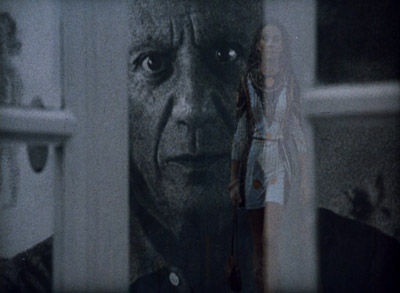
[Pablo Picasso and a girl who never called him an asshole.]
The Modern Lovers -- Pablo Picasso
Jonathan Richman & The Modern Lovers -- The Bank Teller
Jonathan Richman & The Modern Lovers -- Affection
I looked for Orson Welles' F for Fake for about five years before finding it. Gainesville is a smallish place, and Criterion did the world a service re-releasing the film last year. The film is a documentary about an art forger and his biographer, who himself begins forging documents. The film has stuck with me, not just because of the surprise ending but also because of the basic questions of expertise, reliability, trust, and sincerity. It's thoughtful and thought-provoking work, presented accessibly--yet its method is avant-garde (thanks for pointing that out, Girish!)--and it's only now occurring to me how much my last post owes to it.
Jonathan Richman & the Modern Lovers is not the same band as The Modern Lovers, though they do have the same Jonathan Richman. The Modern Lovers were a rock&roll/punk band and lasted from late 1970 to late 1973; after they broke up, Jonathan Richman continued recording with a different band under the same name.
Lyrically, Richman is a goofy geeky fellow with the occasional spark of nastiness. "Pablo Picasso" probably serves as a good example:
Well the girls would turn the color of avocado
When he would drive down their street in his El Dorado
Funny, right--cheesy? Then:
He could walk down your street
And girls could not resist his stare
Pablo Picasso never got called an asshole
Not like you
Is this a commiserating "Not like you"? No; the delivery makes that clear; it appends a mental "you asshole." It still doesn't fill out the meter, but meter isn't Richman's forte anyway.
"The New Teller" is an ode to the new bank teller, with handclaps, a rockin' country solo, and more cheesy rhymes ("teller" and "tell her", "There's only three in the other line / but in mine I count eleven / well, that's fine 'cause I'm in Heaven").
And then "Affection" is a simple, somber look back at Richman's earlier days, pointing out that being a snob makes you unhappy and that people need to risk pain for love. You could fault Richman for his sincerity and cheesiness, and plenty of people do, but I'm not one of them....
I posted The Modern Lovers last year as part of the jogging mix, but I find that the longer I post the less I'm concerned about if I've posted someone before. I doubt that that is Sturgeon's Law coming into play; if anything it's more a reflection of how much awesome music I still haven't heard.
[The Modern Lovers]
[Back in Your Life]
[Jonathan Richman & the Modern Lovers]
...
"It was a hot day when the horse came in and I was shocked at first because I have never run a pub before."
...
Sock puppets invade LJ. I was eager to see The Science of Sleep, but the studio falling back on sockpuppetry, astroturfing, and asshattery to promote it tells me that it's maybe not so very good after all.... Or maybe they just don't know how to market it (though God knows why that would be the case, with Michel Gondry, Gael García Bernal, and an arthouse theme).
...
Tone Memory, from which I deduce that I do not have perfect pitch, or possibly even any pitch at all.
posted by Tuwa @
14:24 | permalink |
6 comments
|
Musical Family Tree
Chevy Downs -- Jesus, Heal My HangoverFar be it from me to say someone was doing miracles by halves, but it's written that Jesus turned water into wine yet there's no record of him healing anyone's hangover. Chevy Downs wants to set that straight. They want to set that straight with a bluegrass stomp, because Jesus is a sucker for catchy music, especially if it makes him tap his foot in a steady two-four beat underlying some fancy fretwork.
[Chevy Downs' site]
Tremendous Fucking -- Every Fucking Time I Believed In You
This song sounded somehow familiar when I first heard it, so of course I had to grep the hard drive to see if it had been posted as part of John's "Fuck" mix (starting here and going through the next four posts). Apparently not. The song is a cross between The Pixies and being thumped by the Hulk. And there's someone else it reminds me of, but I can't place it.
[TremFu's site]
Both of these tracks are releases from Musical Family Tree, which focuses on indie music in Indiana. Their CD release Delicious Berries is ace, but neither of these tracks are on it. (Highlights on the disc include Heidi Gluck's "Wake Up,"Brando's "Your Nelson Now," and Emperor Penguin's "Overboogie," but there's enough diversity on the disc that everyone will probably have different favorites.
Labels: country music, PR, rock
posted by Tuwa @
00:27 | permalink |
0 comments
|
Syl Johnson -- Concrete Reservation
Syl Johnson -- Concrete ReservationHere's Syl Johnson with a song about living in the ghetto. This isn't the maudlin Mac Davis ghetto, and Syl Johnson isn't most interested in mamas crying because they had a baby; he's more interested in mamas crying because they lost a baby, in couples fighting becaue they're jealous, and in people burning to death because there's no back door on the apartments. The vocals are, appropriately, not mournful but full of a simmering rage; the guitar snaps, the strings stab, the lyrics sting:
Here in the ghetto, it's a bad situation / Call it what you want to; it's just a concrete reservation.
Johnson's also known for his track "Is It Because I'm Black?" which I have by Johnson only in a version that drags on a bit too long for my interest, though Ken Boothe also recorded an impressive version of it.
"Concrete Reservation" is off Is It Because I'm Black?, which is also available in a pricy re-release with Dresses Too Short; or you can pick it up on the greatest hits comp Twilight and Twinight.
...
More HiFi finds: "I Am a Demon and Will Swallow Your Soul," "Olivia," and "Ocean Bottom," another track from The Scarring Party. It's my favorite song about writer's block at the bottom of the ocean with percussion by a typewriter.
...
Monday last week I got a promotional email for an indie rock band--not at all uncommon for an mp3blog--but the music was good, which is somewhat less common. Gentleman Caller's track "Bomb the Castle" seemed likely to be an A-B-A-B-C construction with chunky distorted guitar on the bridge, with people screaming into the mic, and it wasn't, and I liked it for it. They have other tracks up, mostly with a dreamy pop-rock vibe with countryish vocal stylings. They self-compare to Okkervil River and Rilo Kiley.
...
Secretly Canadian sent me an email about a new release from Jason Molina, and I enjoyed the track there for download, and so I'm passing it along.
...
Vindaloo, the fight song, and the response: a writer's fight song. 99/100 for that, -1 for failure to include "B.I.C."
Labels: dance, indie, pop, PR, RnB, rock
posted by Tuwa @
21:16 | permalink |
0 comments
|
Metafilter Music
A new branch of the Metafilter family: as if Ask Metafilter and Metafilter Projects weren't cool enough, mathowie recently resurrected Metafilter Music. Some picks from that, then: (I'm posting these here because Matt already mentioned high bandwidth bills and I don't want to leach off his bandwidth; if you like the tracks please consider sending the original authors a message.)Diamond Joe, a drunken country tune with fiddle, acoustic guitar, galloping drums, and drunk musicians. A match made in heaven. Greg Nog at Metafilter nails it: This is what whisky would sound like, if whisky was music.
["Diamond Joe" @ HiFi)]
[No site for this band? Was this a one-off? Say it ain't so, Jack; say it ain't so.]
Criminal is slow, moody, deliberate work with a subdued vocal melody. The guitar cuts in with a muted intensity like a bright painful memory announcing itself in the middle of a stunned grief. The song is not for all moods, maybe, but damn is it beautfiul.
["Criminal" @ HiFi)]
[Edlundart's site]
Light On is folksy jangly acoustic pop in waltz time, with an accordion that sneaked out of City of Lost Children so it could come pick your soul up and dust it off and straighten its tie. Everyone should have a neighbor who plays accordion.
["Light On" @ HiFi)]
[No site for Chococat?]
Making Me Nervous is a bouncy electro-pop tune rivalling "Diamond Joe" in energy, except "Diamond Joe" makes me want a beer and a concert and "Making Me Nervous" makes me want to dance down the street singing badly and making an ass of myself. I've listened to this song half a dozen times trying to figure out what it is I like so much about it--is it the snap in the percussion? The ridiculous fake bassline? The distorted guitar? The driving beat? ... Frenetic says it's ironic, which is fine, but I thought I was tired of irony and apparently I'm not.
["Making Me Nervous" @ HiFi)]
[Brad Sucks' site]
No More Room in Hell is one of my favorites so far, a jaunty tune with banjo, tuba, and vaudevillian vocals, like a cross between Squirrel Nut Zippers and Triplets of Belleville. This is the happiest apocalypse I've ever heard.
["No More Room in Hell" @ HiFi)]
[The Scarring Party's site]
Labels: country music, dance, indie, pop, rock
posted by Tuwa @
01:18 | permalink |
2 comments
|
the mix part three
Cyne -- Nothing's SacredMike Williams -- The second hip hop track is loads better. The vocal sample is great, and it has (nu-)soul. A keeper.
Jerimee Bloemeke -- The production sounds like something Kanye would do. I'm not a big fan of rap, but this is not bad. I can't really get into it, though, because it has no chorus.
This is from a disc that got a fairly bad writeup on allmusic; their second disc got a much better review (and I think the second disc probably is more solid all-around).
[Cyne's official site]
Popcanon -- Ballyhoo
Mike Williams -- I think this song is about religion and science. It finds in favour of the latter, which is fine by me, but there are better forums for such a discussion than a song with humorous instrumentation. It sounds like a number from The Producers musical.
Jerimee Bloemeke -- No, no, no. The back-up singers said it so well.
Say, what do we really use from science?
"E=mc2"
Are reason and faith an unholy alliance?
"I don't know and I don't care."
A lot of my family has a sincere love for kitsch--Precious Moments bells, cow-spotted milk jugs, etc.--and I've only just now realized that I probably do too. This is a very nerdy, goofy song.
[Popcanon's official site]
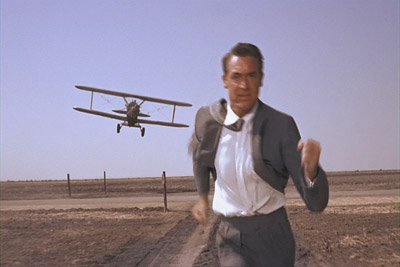
Whoreculture -- Crop Duster
Mike Williams -- Ridiculously entertaining and very Southern rock. This song takes an idea (what it's like to be a cropduster) and solves it. The result is a McSweeney's article set to music by George Thorogood and the Destroyers. If joycore was people having fun for a reason (rather than no reason) it would sound like this.
Footnote: Whoreculture is probably one of the top five band names ever.
Jerimee Bloemeke -- With a name like Whoreculture, how can anyone take you seriously? The music doesn't help either....
I like this song; I think it's a lot of fun. Whoreculture's Join strikes me as more rock-oriented; Boondocked is slower and heavier but equally impressive. I've been unable to find anything more by the band, as they broke up years ago. They don't seem to have a site up.
Lars Din -- Ness City Bank Job (Yer So Sweet)
Mike Williams -- This is singer-songwriter storytelling that manages to be poetic and avoid the literal hectoring that can easily befall a song about Events. The Band were good at this. Bruce Springsteen is good at this when he isn't too busy being awful at this. Lars Din is good at this, and I want to hear more of his stuff.
This is my favourite track on the CD.
Jerimee Bloemeke -- This is soothing. The singer is like an unironic Morrissey at times. And he plays nice acoustic guitar.
[Lars Din's (older) site]
[Lars Din's newer site]: lyrics, tour dates, songs.
The lyrics are in five sections: a series of vignettes, some choice details, activity in the ellipses. Who are these four people? Or are they two? And that valentine--why for her mother?
This song is not the best-sung song you'll hear. Lars is nearing the end of a concert and his voice is tired. He aims high and misses, aims high and misses, aims high and misses ... aims high and nails it, nails it when it counts the most.
It's a quiet number, exhausted--on the ropes, maybe about to give up. And then, out of nowhere: left hook, stars, roofbeams on a tilt. Mat.
Labels: folk rock, hip-hop, indie, pop, rock
posted by Tuwa @
00:31 | permalink |
2 comments
|
the mix part two
In my hurry to get the last post up, I completely forgot to introduce Mike and Jerimee (sorry for that, fellas! and thanks for your patience).Mike Williams lives in Oxford, UK, and runs Dreamboat Records, home to The Rollercoaster Project (which you might have caught on Said the Gramophone some time back).
Jerimee Bloemeke is not a black-belt ninja; his skills are so advanced the universe is afraid to let his jacket flap open. He can kill birds, small mammals, and frail humans with the briefest of glances; healthy humans sometimes take a second and a half. He also reviews music, as at Kill All Artists and as below. For that, and for not giving me The Stare of Doom, I thank him.
Returning to the mix:
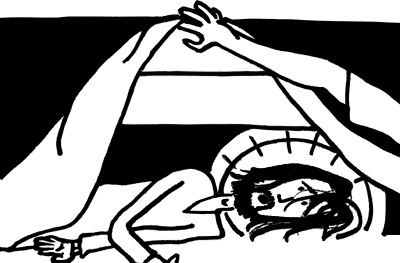
Morningbell -- I Found Jesus (Hiding Underneath the Bed)
Mike Williams -- A promising title, but the overwrought arrangement and silly instrumentation (are those oboes!?) is distracting. I'm probably not the right audience for psychedelic prog-pop though.
Jerimee Bloemeke -- When I first saw this song on the mix I knew I would love it. For some reason, I like any song about Jesus, especially ones that do not take the whole idea of a martyr who dies on a cross too seriously, evidenced in this song’s title, where Jesus hides underneath a bed. And also by this amazing lyric, out of Jesus's mouth: If you’re tryin' to impress me, don't bother/ You think you're so great, well, I'd like to see you walk on water/ I invented that shit. The whole song is about a Jesus that is hiding from all his troubles and is tired of having to listen to the troubles of others.
The song starts with acoustic guitar strumming, and a wailing, double-tracked vocal. The instrumentation in this song is all over the place: trumpets, banjo, synthesizer, saxophone, piano, etc. This is great stuff. And I can't wait to get more of it from this band.
Is this prog-pop? Really? I'd always associated it with 1970s wankery: ten-minute song codas, flutes and acoustic guitar and songs about the Lord of the Rings, album covers showing vibrantly-colored woodlands and "mysterious" hooded figures and whatnot.
[Morningbell's official site]
[Morningbell Myspace account]
Maxwell Edison -- Cheap Airfare
Mike Williams -- Eek. If you're my age and British, you’ll have been subjected to the Charlatans. This track reminds me of them, but with the Hammond organ replaced by a Casio keyboard. These guys are session musicians and this is for a car advert, right?
iTunes tells me I've listened every track on this CD at least a dozen times, except this one, which I've got through twice. Awful.
Jerimee Bloemeke -- This track starts out with a quickened Radiohead piano beat, with a singer that sounds like Paul Rodgers. The piano is definitely the centerpiece of this band - their website says it all: "maxwell edison - the best gainesville piano rock." I can't find fault in that. And they follow the Radiohead comparison with some Johnny Greenwood-esque guitar soloing at 3:17.
I did like this song when I first put it on the mix. I still liked it after I sent the mix out. Sometime after that I began not to like it, and then I began to despise it. Your mileage may vary.
[Maxwell Edison's official site]
[Maxwell Edison's Myspace account]
Towers of Hanoi -- Torn Jeans
Mike Williams -- At first I thought this was ludicrous epic rock that sounds like a sincere version of the Darkness. Then I realised it sounds like an unhappy White Stripes. Not my cup of tea at all.
Jerimee Bloemeke -- The singer is a cross between P.J. Harvey, Alanis Morissette, and Signe Anderson. And the band is a cross between Death From Above 1979 and a less progressive Mars Volta.
Not a happy track, no, but I like it.
[Towers of Hanoi's official site]
[Towers of Hanoi's Myspace account]
Against Me! -- I Still Love You Julie
Mike Williams -- Post-Pistols punk has never really meant much in the UK. Sure, it has a scene, which is presumably vibrant, but that scene is relatively isolated. And sure, people profess to liking Minor Threat and Black Flag, but I'm not convinced anyone except actual punks actually do. For myself, my only knowledge of punk comes from a regrettable phase of playing Tony Hawk’s Pro Skater.
That notwithstanding, I love this song. Against Me! are apparently a punk band with alt.country, folk and blues influences. I just hear a band a punk band having a good time. This track is now on heavy rotation.
Jerimee Bloemeke -- Ah! The snare drum ruins this song - it just pops way too loudly and it takes away from everything else. Otherwise, the band is reminiscent of Wolf Parade, but with more yelling.
These guys are pissed off. I saw one of them several years ago, strumming an acoustic guitar on UF campus and singing/screaming himself hoarse about worker exploitation. I don't know anyone who can rock an acoustic guitar that hard. Maybe Rev. Frost.
[Against Me!'s site]
Big Oil -- Pot of Gold
Mike Williams -- This alt.rock dirge threatens to be interesting, but then the lyrics start. "Come on over here and let me hold you near, let me kiss you all over your face / It's been so long since you've been so near, this is such a lovely place." Jesus wept. It's impossible to take this song seriously after that. Maybe that's what Big Oil wanted.
Jerimee Bloemeke -- The singer's voice ruins it for me: sounds like someone I heard on the radio in the mid-'90s.
This is another one I used to like (I have a knack for listening to songs without listening to the lyrics, and Mike is right; the lyrics are god-awful. To think I used to mock that Lenny Kravitz song about the butterfly up in the sky....)
[Big Oil's official site]
MC Intellekt -- More Than Meets the Ear
Mike Williams -- The first of the two hip hop tracks tracks on the CD doesn't do much for me. If you use strings you risk sounding like either Puff Daddy or a horrorcore act. The whiny patois which starts around 1:30 is difficult on the ear. They also make the mistake of talking about themselves and their abilities. I've never understood the popularity of meta-wank in hip hop.
Maybe I'm just out of the hip hop loop. I used to listen to a lot of hip hop. I remember vividly the innocent joy of ejecting a finished Jim O'Rourke CD and replacing it with Dr Octagon's Dr Octagonecologyst. But I am an idiot and a terrible person, so I followed fashions towards beardy alt.country to the exclusion of a lot of other genres, not least hip hop. It’s only recently that I've begun to rehabilitate myself.
Jerimee Bloemeke -- The production and beat on this song is great, but the rapper reminds me of Eminem. And dare I say: Ludacris. ...shudder.... And that chorus? Why?
Intellekt gives a lot of concerts in town, and he's got fairly literate stream-of-conscious rhymes with a sense of humor. But that chorus--I'm puzzled too; it's like watching a David Lynch film. I don't get it, and I'm more than a bit disturbed by it, but I can't look away.
Also, "meta-wank" is my new favorite musical descriptor.
[MC Intellekt's official site]
This was the worst part of the mix, I think--lots of tracks here I wouldn't pick again. The next (and last) part is better.
Labels: alt country, hip-hop, indie, punk, rock
posted by Tuwa @
00:17 | permalink |
5 comments
|
the mix part one
About that mix CD I made last year: I sent out a half-dozen copies; I got two reviews (a 50% and a 33%, if this were being graded); one person wrote back saying he liked it but didn't want to review it; one wrote back saying he didn't like it and didn't want to review it; and one review never arrived.Originally I liked all 14 tracks; in the time since it has dropped to 10. By which I mean, I made some bad choices. Feel free to laugh at them in the comments. No, seriously.
Thanks to Mike and Jerimee for their patience.
Whitey Markle -- Proletarian Football Blues
Mike Williams -- This song bemoans the commercialisation of (American) football. It reminds me of a famous Roy Keane remark. Keane was Manchester United's captain until a couple of weeks ago. His criticism of his own fans (who are universally reviled) won him many friends: "they have a few drinks and probably the prawn sandwiches, and they don't realise what's going on out on the pitch. I don't think some of the people who come to Old Trafford can spell football, never mind understand it."
Keane is the subject of a fabulous article by Sean O'Hagan, who usually writes about music in The Observer. The prawn sandwich is now the canonical status symbol in British football. And Manchester United is now owned by a Floridan.
This song is great. Imagine Bruce Springsteen with a sense of humour and The Vince Guaraldi Trio as a backing band.
Jerimee Bloemeke -- I don't like the country twang in the guitar, and I really find the singer's voice to be very annoying. But I kind of like the flute (?), because it reminds me of some '70s French Spy TV show theme, or something....
Picture Mark Twain in a bluegrass band with Marxist tendencies. This is one of Whitey Markle's slightly less whimsical numbers. Other standouts include "Cracker Stomp" and "Thinking About You," and "The Cracker Stomp."
The band broke up years ago; there's no official website. Here's a brief writeup of the CD this track came from, though.
Pig Iron -- Seminole Blues
Mike Williams -- This is a pretty and (pretty unsurprising) blues number. While I'd rather modern blues sounded like this than, say, Blueshammer (the hopefully fictional band that appears in Ghost World), I find it difficult to get worked up about such a direct facsimile of pre-rhythm-and-blues blues.
Jerimee Bloemeke -- This one has the same annoying country guitar twang and singer voice as the first song. I'm just not accustomed to this kind of country/blues stuff for some reason - it doesn't hit a nerve with me, or at least not a nerve that makes me like it.
Mike is right about this being pre-R&B blues. This is a song originally by Tampa Red; "Seminole" is the train. Pig Iron doesn't have a site, or at least not one credited in the CD and easily found through search engines.
The Sultanas -- Radio Song
Mike Williams -- Floridan surf guitar. Who knew? I don't care for the patronising piss-take of talk show listeners, something about this track caught my ear. Perhaps it was the fact that I listened as I was mentally preparing for the holiday season, and I've always associated surf with Christmas. Great fun.
Jerimee Bloemeke -- I dub this "hula-surf-rock," with a lounge singer. I kind of like it, but probably only in small doses.
[The Sultanas' site]
Hula -- Taking Pictures
Mike Williams -- There are plenty of songs that are short and aggressive or short and funny, but more songs should be 1:36 and beautiful. Hula sound like an adult pop Summer-Sun-era Yo La Tengo. (I see I'm not the first person to make this comparison.)
Jerimee Bloemeke -- How fitting that after the "hula-surf-rock" song there is a song by a band actually named Hula! The beginning of the song has a really echo-y guitar, and then comes in the bass and drums - really quite simple. Then the first, deep-voiced singer (who reminds of Dave Berman) comes in, backed by a female voice, a la Fleetwood Mac. But it's an indie-rock Mac, as the song is short and gets to the point quickly. No fancy stuff here. I really like it.
Most of Hula's tracks on the disc are not like this one; they tend to come across much more like Low: subdued, dreamy, spare, maybe a bit bleak. This one, though.... I snuck it onto the U.N. agenda and the vote came back unanimous: it's too short.
[Hula's site]
Labels: blues, folk, indie, rock
posted by Tuwa @
03:21 | permalink |
4 comments
|
Stray Cats and the cat bus

Stray Cats -- Rock This Town
The Stray Cats formed in New York in the late 1970s and had some success spearheading a rockabilly revival during the New Wave period, though their early album Built for Speed sold the best and their popularity tapered off afterwards. Their guitarist was Brian Setzer, whom you'll probably remember from the swing revival some time back; the man loves his roots music. I haven't heard most of his solo music, and I bought this LP on a lark (actually not true--I've never done anything on a lark, though I used to dine on a turkey), wondering if it could possibly be any good. And I think that it is.
[Stray Cats -- Built for Speed, or a more reasonably priced Greatest Hits comp]
...
In spite of having had plenty of time to prepare for an announced Miyazaki blogathon, my attentions were mostly elsewhere between then and now. So I'll just talk briefly about one of my favorite Miyazaki films, My Neighbor Totoro. It's a story about two girls (Mei and Satsuki) moving to a house near the forest; their father works at a university and their mother is in the hospital being treated for an unidentified illness. Like most of Miyazaki's work, it's got a fairly simple plot but takes some unexpected and wonderful turns: for instance, there are these odd black sooty creatures living in the house, which their father identifies as mak-kuro kurosuke, the spots you see when going from darkness to bright light, and which their elderly neighbor identifies as susu-atari, the creatures that live in old, empty houses and make dust.
On Satsuki's first day at school, Mei discovers an odd ghostly creature moving through the grass. She chases it through a low passage in the trees, almost a tunnel made of interleaved branches, then tumbles through a hole and meets Totoro, the king of the forest. I won't give the whole story away, but I wanted to post the following screenshots to give some idea of what it is I like about Miyazaki. I'm sure they'll explain it much better than I can--this sequence would be magic even if it weren't about a girl lending her father's umbrella to the keeper of the forest.

He has claws, yes. He takes the umbrella carefully, and Satsuki shows him how to use it.
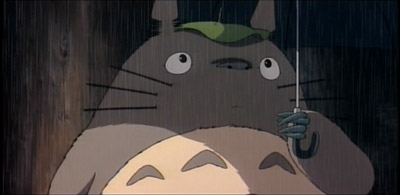
He decides he likes the sound the rain makes on the umbrella:




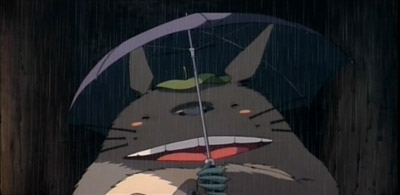






Aside from its quirkiness and its frequent mixture of menace and wide-eyed wonder, Miyazaki's work also shows a loving attention to detail. For instance, in My Neighbor Totoro there are the mice lights on the cat bus (the running lights at top), the dragonflies landing on garden posts, the discarded bottle at the bottom of a stream, the snail crawling up a plant's stalk, and the irises and lilies scattered in the landscape even in brief shots where the attention is directed elsewhere.
It's fun and fascinating work--even his earliest work in television has been worthwhile--and I'm happy that his films are widely available and in their original formats.
[Site dedicated to Hayao Miyazaki's work]
[Interview with Hayao Miyazaki: "It's not me who makes the film. The film makes itself and I have no choice but to follow."]
[Roger Ebert's writeup on Miyazaki and My Neighbor Totoro]
update: Quiet Bubble has writeups for Miyazaki's most recent three films, Princess Mononoke, Spirited Away, and Howl's Moving Castle. The first two are perceptive, but I can't speak to the third--I haven't yet seen the movie so I didn't read it. ^_^
Also see: Noel Vera on Howl's Moving Castle, cinemarati on On Your Mark, and CultureSpace on Spirited Away.
New at Quiet Bubble: writeups on Porco Rosso, Kiki's Delivery Service, Nausicaa, Lapute, and My Neighbor Totoro.
I'll be posting additional links to other posts in the Miyazaki-thon (Miyazaki-san-athon?) as I find them.
...
In other news, I'd like to recommend new mp3blog MadPriest-UK. First post: awesome soul mix. Second: Latin tracks. It's a good start.
Labels: blogathon, movies, rock
posted by Tuwa @
15:15 | permalink |
6 comments
|
Black Merda -- The Folks from Mother's Mixer
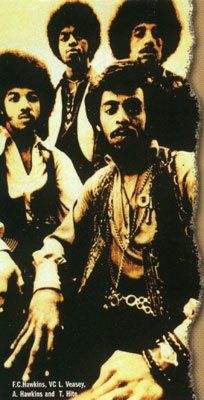
Black Merda -- The Folks from Mother's Mixer
Black Merda are the self-proclaimed "first black rock group," a psychedelic funk-rock outfit out of Detroit who recorded two albums (in 1967 and in 1971) which for various reasons fell off the map. Musically, they're a bit like Hendrix crossed with Funkadelic, with dips into Curtis Mayfield, The Stylistics, and acoustic blues.
Their first album was on Chess, at a time when the label was being sold to GRT Corp and Marshall Chess had flown to the U.K. to work with the Rolling Stones. It's a safe bet the first album didn't get the attention it deserved, and the liner notes say that the second album didn't either. Black Merda have been getting plenty of respect lately, though, with the Beastie Boys, Mojo Magazine, and Rolling Stone all singing their praises.
The band were originally VC L. Veasey on bass and acoustic guitar, Charles Hawkins on guitar, Anthony Hawkins on guitar, and Tyrone Hite on drums, with the band sharing vocals. Hite left the band after the first album and was replaced with Bob Crowder.
Their first two albums have been re-released on one comp; I started out picking favorites but it ended up being half the album so I'll skip all that.
And no, Merda here is not what you might be thinking if you speak Italian, Spanish, or French--it's pronounced like "Murder." The group's name was a pointed comment about the political climate at the time; they thought "Murder, Incorporated" sounded too gangster, then they decided to change the spelling from "Black Murder" to make it less negative.
Veasey and the Hawkins brothers are still together, welcoming the renewed press attention, and hoping to tour as a result. Awesome.
[The Folks from Mother's Mixer ]
[Official site]
[Good lengthy writeup at the Detroit Metro Times]
Labels: rock
posted by Tuwa @
13:30 | permalink |
3 comments
|
Spread the Good Word!
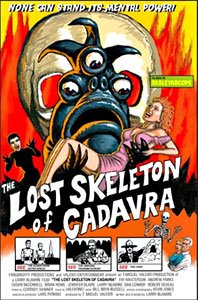
Rev. Tom Frost -- All the Way Home
The good Reverend has a CD out, a ten-track gallop through roots rock and outlaw country. It's the aural equivalent of Leone's Man with No Name, a rock star Man with No Name who plays chunky distorted electric guitar and sings like a cross between Tom Waits and Link Wray, backed with rollicking barhouse piano or funhouse organ.
It's a bold CD--you've guessed this already--bold and gritty and a lot of fun, with some remarkable tracks on it, most of them covers of songs that have been taken apart and rebuilt to get there faster and more dangerously.
[Pick the record up here for $7.]
...
Two amazing videos I found today:
VD Is for Everybody, which has a rather cheerful tune and montage that, coupled with the lyrical content, is effectively beyond description. (via Neil Gaiman's blog)
And Stop the Madness, an unspeakably bad music video featuring New Edition, Whitney Houston, David Hasselhoff, Nancy Reagan, and Arnold Schwarzenegger encouraging you not to use drugs. Did I mention that it's bad? It's bad. It's the kind of bad that makes you feel guilty for laughing, because you're horribly embarrassed for the director, but you can't help laughing anyway. (via BoingBoing)
posted by Tuwa @
03:20 | permalink |
0 comments
|
 XML
XML


