Nancy Wilson and John Fahey
Nancy Wilson -- A Brand New MeA Sunday drive, holding hands. Maybe you'll stop somewhere for a leisurely brunch, maybe you'll trade friendly in-jokes, wink at each other behind the waitress's back, maybe you'll drive home with a pleasant anticipation.
[Can't Take My Eyes Off You, out of print]
John Fahey -- Summertime
Summertime, yes: early morning before it's hot, sunrise through a screen door, golden light crosshatched over floorboards. An owl in the woods hooting still, the crows not yet awake.
[Red Cross @ amazon.com or @ emusic]
Labels: folk, out of print, vocal
posted by Tuwa @
14:02 | permalink |
13 comments
|

IODA: Wailin' Jennys
The Wailin' Jennys -- Long Time Traveller


[Jericho Beach Music @
 iTunes Music Store, and @
  eMusic]
posted by Tuwa @
10:40 | permalink |
0 comments
|
the mix part one
About that mix CD I made last year: I sent out a half-dozen copies; I got two reviews (a 50% and a 33%, if this were being graded); one person wrote back saying he liked it but didn't want to review it; one wrote back saying he didn't like it and didn't want to review it; and one review never arrived.Originally I liked all 14 tracks; in the time since it has dropped to 10. By which I mean, I made some bad choices. Feel free to laugh at them in the comments. No, seriously.
Thanks to Mike and Jerimee for their patience.
Whitey Markle -- Proletarian Football Blues
Mike Williams -- This song bemoans the commercialisation of (American) football. It reminds me of a famous Roy Keane remark. Keane was Manchester United's captain until a couple of weeks ago. His criticism of his own fans (who are universally reviled) won him many friends: "they have a few drinks and probably the prawn sandwiches, and they don't realise what's going on out on the pitch. I don't think some of the people who come to Old Trafford can spell football, never mind understand it."
Keane is the subject of a fabulous article by Sean O'Hagan, who usually writes about music in The Observer. The prawn sandwich is now the canonical status symbol in British football. And Manchester United is now owned by a Floridan.
This song is great. Imagine Bruce Springsteen with a sense of humour and The Vince Guaraldi Trio as a backing band.
Jerimee Bloemeke -- I don't like the country twang in the guitar, and I really find the singer's voice to be very annoying. But I kind of like the flute (?), because it reminds me of some '70s French Spy TV show theme, or something....
Picture Mark Twain in a bluegrass band with Marxist tendencies. This is one of Whitey Markle's slightly less whimsical numbers. Other standouts include "Cracker Stomp" and "Thinking About You," and "The Cracker Stomp."
The band broke up years ago; there's no official website. Here's a brief writeup of the CD this track came from, though.
Pig Iron -- Seminole Blues
Mike Williams -- This is a pretty and (pretty unsurprising) blues number. While I'd rather modern blues sounded like this than, say, Blueshammer (the hopefully fictional band that appears in Ghost World), I find it difficult to get worked up about such a direct facsimile of pre-rhythm-and-blues blues.
Jerimee Bloemeke -- This one has the same annoying country guitar twang and singer voice as the first song. I'm just not accustomed to this kind of country/blues stuff for some reason - it doesn't hit a nerve with me, or at least not a nerve that makes me like it.
Mike is right about this being pre-R&B blues. This is a song originally by Tampa Red; "Seminole" is the train. Pig Iron doesn't have a site, or at least not one credited in the CD and easily found through search engines.
The Sultanas -- Radio Song
Mike Williams -- Floridan surf guitar. Who knew? I don't care for the patronising piss-take of talk show listeners, something about this track caught my ear. Perhaps it was the fact that I listened as I was mentally preparing for the holiday season, and I've always associated surf with Christmas. Great fun.
Jerimee Bloemeke -- I dub this "hula-surf-rock," with a lounge singer. I kind of like it, but probably only in small doses.
[The Sultanas' site]
Hula -- Taking Pictures
Mike Williams -- There are plenty of songs that are short and aggressive or short and funny, but more songs should be 1:36 and beautiful. Hula sound like an adult pop Summer-Sun-era Yo La Tengo. (I see I'm not the first person to make this comparison.)
Jerimee Bloemeke -- How fitting that after the "hula-surf-rock" song there is a song by a band actually named Hula! The beginning of the song has a really echo-y guitar, and then comes in the bass and drums - really quite simple. Then the first, deep-voiced singer (who reminds of Dave Berman) comes in, backed by a female voice, a la Fleetwood Mac. But it's an indie-rock Mac, as the song is short and gets to the point quickly. No fancy stuff here. I really like it.
Most of Hula's tracks on the disc are not like this one; they tend to come across much more like Low: subdued, dreamy, spare, maybe a bit bleak. This one, though.... I snuck it onto the U.N. agenda and the vote came back unanimous: it's too short.
[Hula's site]
Labels: blues, folk, indie, rock
posted by Tuwa @
03:21 | permalink |
4 comments
|
Blues Run the Game / Here Come the Blues
Jackson C. Frank -- Blues Run the GameJackson C. Frank -- Here Come the Blues
When Jackson C. Frank was 11 he was in a school fire which killed a number of the other students and left him convalescing from third-degree burns. He used the seven months in the hospital learning to play guitar, but he didn't receive an insurance settlement for another ten years. On receiving the settlement, he left the country for the burgeoning folk scene in the U.K., and on the boat over he wrote "Blues Run the Game," his signature song. It's a catchy bit of pop folk with a bittersweet melody, but the lyrics are not bittersweet. What they are is exhausted, almost ready to give up: "Some time tomorrow, someplace down the line / I'll wake up older / So much older, mama / I'll wake up older and I'll just stop all my trying."
"Here Comes the Blues" is in the same vein: a beautiful and poignant song, proto-Nick Drake, John Ashberry to music, despair laid bare in hopes of catharsis. The guitar work is very good: the low end chugs along sounding like a train, and the filigrees sound both improvised and perfectly considered, not a note out of place. Allmusic dismisses his vocals but I think it's great work here, strong and on point, a very commanding presence.
In England, Frank met up with Sandy Denny, Paul Simon, and Art Garfunkel, all of whom later covered his work (as did Tom Paxton, Nick Drake, and Bert Jansch). He and Denny began dating, and Paul Simon produced Frank's first album; Frank recorded it in just a few hours, from behind several screens to prevent him having to see anyone watching him play. That first album had both of the songs here on it, and in Europe it was a relatively big hit insofar as folk albums go, at least until Frank failed to come up with a follow-up.
The insurance money soon ran out and Frank felt increasingly withdrawn and anxious, suffering stage fright and creative paralysis; he returned to the United States, where his marriage broke up and his young son died. The album ran out of print, the royalty checks dried up, and Frank was homeless within a few years, spending most of the rest of his life either on the streets or in mental institutions. In 1997, T.J. McGrath published "Lost Singer Found," which ended speculation about whatever happened to Frank. The article led to renewed interest in his career, a re-release of his debut (which had been out of print for decades), and the release of some new material. At that point Frank had been suffering arthritis and a thyroid disorder for years, he was grossly overweight, and he'd been shot in the left eye.
Mentions of suicide pepper his work, both elliptical and obvious, and there's a general sort of weariness and anxiety throughout his work. Some of his music is so far in the doldrums it can't be arsed to come up with much of a melody, but these two posted today are more tuneful; though they might not be most typical of his work, they're the tunes that speak to me most right now. Other standouts include "Halloween Is Black As Night" "My Name Is Carnival," and "Goodbye to My Loving You."
Frank died in 1999, apparently of natural causes.
[Blues Run the Game: Expanded Deluxed Edition]--or, if that's too much melancholy for you, there's a shorter reprint of the original.
Game, Set, Blues:
Whatever happened to Jackson C. Frank
...
Newcomer Sabas sent an email mentioning his new mp3blog and threatening to flood my mailbox with V1/\GRÅ and mortgage spam if I didn't give it a mention. Under such duress, I had no choice but go check it out and to recommend Neko Case's "Star Witness," Kelley Stoltz' "Memory Collector," The Gossip's "Standing in the Way of Control," and Swearing At Motorists' "Lost Your Wig." And of course you can't go wrong with Cat Power or Belle & Sebastian. He's making some good picks (though myspace, as a music host, is running about a 50% failure rate on letting me download the tracks).
Labels: folk
posted by Tuwa @
12:00 | permalink |
1 comments
|
Tom Paxton, Karamelo Santo, Soft, Pet Politics, Calvanes

After months of humidity and stultifying heat, we had two days of fall--chilly mornings and brisk breezes--and then it snapped back into good weather for shorts and sandals. If Florida were a person it would be not be a Buddhist: it's quite attached to summer and stands terrified at the prospect of anything else: "what would it be like, this ... 'coldness' thing of which you speak? Sort of a humid heat, only ... without hurricanes? No? Oh. So ... sort of a humid heat, only ... less hot?"
Tom Paxton -- Bottle of Wine
Tom Paxton kicks us off with a very springy sort of song: picked guitar ringing out "life-fun-everything great," with lyrics that it would be easy to sing along to without paying much attention to: "Bottle of wine, fruit of the vine, when you gonna let me get sober? / Let me alone, let me go home, let me go back and start over." Tricksy, that: a cheerful-sounding song about a drinking problem.
Paxton has a strong voice--confident but not overpowering, giving just enough and not a bit too much. His work ranges from the bitterly satiric to the plaintive to the mellow and accepting. He started performing in the 1960s, often focusing on political themes (some of which, like "Lyndon Johnson Told the Nation," are more specific than universal; others, like "Daily News" or "What Did You Learn in School Today?," still have a clear relevance). Paxton is still performing, still releasing new albums.
Tom Paxton's site;
I Can't Help But Wonder Where I'm Bound @ amazon.com;
Karamelo Santo -- Fruta Amarga
Sylvie from Delanuca Records wrote some time back introducing me to Karamelo Santo, an Argentinean ska-punk band. "Fruto Amargo" is a Rubén Blades cover: stuttering funky bassline, horn section, slightly distorted rubber-wristed electric guitar, and a melody that telegraphs high noon, barbecues, volleyball on the beach. Good times.
Karamelo Santo's site;
Delanuca Records, which has a downloads section under "media/press";
Sylvie's blog;
Soft -- Higher
The rock band Soft, based in Brooklyn, wrote me a few days ago mentioning that their EP would be released soon. They have a good sense of composition and arrangement--when to add things, drop them out, bring them back--and a great sense of melody; I bet they put on good shows. I posted their track "You Make Me Wanna Die" about a year ago and I was glad to hear from them again.
The band Soft;
The Soft EP @ insound.com;
Pet Politics -- In My Head
Magnus from Pet Politics emailed me in late August; we swapped a couple of emails and then the conversation fell off. He had a round of postings in September but here he is again in case you missed him. Pet Politics is one of those "bands" that's just one person: that's Magnus arranging drums, playing guitar, singing. His music has sort of a wintry quality to it that I like quite a lot: it's like sitting in watching a film, cozy in your pile of blankets, cold creeping in around the curtains. There's something about the melodies he comes up with that's somehow both new and immediately familiar; it gives his sound a sense of nostalgia and oddness at the same time.
The Pet Politics site, with another mp3 up for download;
Calvanes -- Buzz Buzz Buzz
The Calvanes are a doo-wop group that cut a few sides in the 1950s and never put together a full album before 2001. In Harmony has some great tracks on it, especially this one, their Leiber/Stoller cover "Smokey Joe's Cafe," and their lead-off track "Travellin' Stranger". This one's exuberant, catchy, with an open love and a contagious joy broadcasting sunrise, dewy grass, tweeting birds, green twigs, flowers in bloom.
In Harmony @ amazon.com.
Labels: doo wop, folk, pop, PR, punk, rock
posted by Tuwa @
09:54 | permalink |
5 comments
|
Kingston Trio -- Tom Dooley
Kingston Trio -- Tom DooleyI went to sleep with a mix playing, set to "repeat all," that had Jimmy Dean's "Big Bad John" on it. I was plagued with dreams that I was Big Bad John but that, unlike John, I wasn't interested in sacrificing myself for others. I wanted out of the mine and I wasn't going down nobly.
John at Tofu Hut posted "Big Bad John" some time past so I'll go with another story-song, this one about someone facing certain death and, we assume, less stoic than John about it. This is the version by the Kingston Trio, the one that helped launch the folk revival in the U.S. in the late 1950s. The story's great; the harmonizing and the melodies all on point. It's easy to listen to this and see the attraction that people felt for it: the song feels immediately familiar, welcoming, something you'd want to seek more of. And if you do, well, the Kingston Trio have plenty in print.
This Geocities page has a bit of background about the historical Tom Dula, suggesting that the Kingston Trio's version is wrong, that the "love triangle" was a quadrangle, and that the other woman had killed Laura Foster and let Dula hang for it, going on to marry the Sheriff. Wikipedia mentions that story as a local legend, whereas snopes.com is mum on the subject.
Doc Watson and Lonnie Donegan both have covered the song, but I posted both of them in the 'train' mix so I'll skip them here.
[amazon.com]
...
Some days I get email that leaves me puzzled about how to respond. Yesterday was one of those days.
Labels: folk
posted by Tuwa @
16:35 | permalink |
0 comments
|
Doc Watson: Blue Railroad Train
Doc Watson -- Blue Railroad Train
This song tells a story of lost love--a simple story by a simple man riding a train. You can hear the creak of the boards, smell the coal outside, the hay inside, the corn in the hot sun nearly baked on the stalk. You watch the fields roll by; your baby rolls on down the line. You do too: in the same direction, in another, it doesn't matter. You want her back but she could be sitting across from you and it wouldn't change anything. She's after something better. It's over--no love left, no profound realization, no acceptance, no eureka.
So you sit in your railroad car with the door open, staring out at the passing blur. You flatpick a guitar and come up with a nice melody to put the words into; you repaint the story in sepia tones. Eventually the memories are freighted with a warm nostalgia. It takes the pain away, gives a proper distance, makes the relationship irreproachable and perfect. It also makes it completely unreal. You don't mind.
[Amazon.com]: The Essential Doc Watson: some solid work on display here.
Labels: folk
posted by Tuwa @
01:42 | permalink |
0 comments
|
Big Bill Broonzy
Big Bill Broonzy -- This Train
Big Bill Broonzy -- Going Down the Road
Prompted by an AskMe question about feeling sick after running, I dug out my old running shoes--I'd been jogging before coming to town and for one reason or another it quickly tapered off after I settled in here, shortly after buying a new pair. The shoes are eleven years old and barely used; they fit when I bought them, but last night they were a bit tight--too narrow and too short. Maybe they shrank somehow, or maybe my feet weren't done growing at 19.
I loosened the laces a fair bit and did some stretches and off I went: down a Florida hill, something so small it wouldn't earn the name "hill" in most states, and up the next. A third of a mile later I was stopped at the corner to catch my breath. I can ride my bicycle 15 miles to the next town without getting worn out, but I don't have the same skill with jogging. After about an hour of jogging and walking and jogging and, at the end, quite a lot of walking, I was back home. I slept soundly and, for some reason, dreamed of trains.
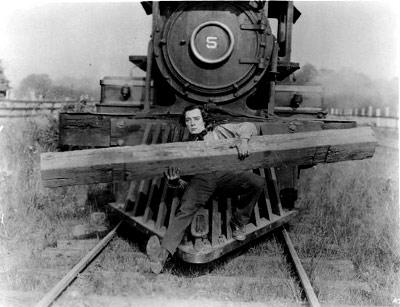
Johnny Gray is a character I've always identified with: in over his head, meaning well but not very competent, often succeeding in spite of himself. It's a solid comic concept, used in Inspector Clouseau and Inspector Gadget and any number of Terry Pratchett characters. It's a great film, though Gray's on the wrong side (but, what the hell--I love Das Boot too).
Big Bill Broonzy was a folk/blues/country gospel guitarist and singer. "This Train" is a gospel song about salvation--"This train you don't pay no transportation / There's no Jim Crow and no discrimination / This train is bound for glory, this train / This train don't carry white or black / Everybody ride it is treated just alike." It's a great song, and it's easy to take it as uplifting if you don't consider the history it comes from or the ongoing struggle for fairness and equality.
"Goin' Down This Road" is a song about a man who leaves his woman because he's too proud to eat beans and cornbread; he complains also about his two-dollar shoes ("takes a ten-dollar shoe to fit my feet"). It's surprisingly fun and funny considering the content.
These two tracks are from the Smithsonian Folkways compilation, which has some top-notch recordings with good liner notes, but in a font so small the CD should have come with a free magnifying glass. I'm not sure why they printed them on a folded insert unless they were trying to save on paper, but it was a poor decision to squeeze four columns of text in less than six and a half inches of space.
The tracks were recorded in the late 1950s, towards the very end of Broonzy's career; some of them were studio sessions and the others were in concert with Pete Seeger. It's a far cry from his early days share-cropping and laying tracks for railroads, but in spite of his success abroad, he died nearly broke; his friends were setting up a benefit concert for him when he died of cancer in 1958.
Other personal favorites on the disc include "Bill Bailey," "John Henry," and "The Glory of Love."
[Amazon.com]: Big Bill Broonzy Sings Folk Songs
posted by Tuwa @
18:00 | permalink |
0 comments
|
Dave Lippman
A number of miscommunications and non sequiters have led me to still have hosting until at least the 10th of March. (Yes, I wrote about it and yes, I cut it; it was not so interesting.)So. Another post.
Dave Lippman -- I Hate Wal-Mart
Dave Lippman -- Thank You
Dave Lippman is a satirical folk/anti-folk singer with a career going back to Bush the First's tenure as Preznint. Lippman's alter-ego (or at least the most popular of them) is George Shrub, the world's only singing CIA agent; Shrub is a cold-hearted and borderline sociopathic bastard. But that's the kind of person you get when you're working to maintain oligarchy in the face of struggles for fairness and egalitarianism.
Lippman is not his character. Dave Lippman strikes me as intensely moral and clear-headed; he's got principles, and he's pissed when they're violated, whether it's the government or a multinational corporation violating them.
Which brings us to these:
"I Hate Wal-Mart" is a satirical song about some of the (many) reasons to hate Wal-Mart, most of them centering on its relentless hegmenozing of the cultural and financial landscape. What's so great about it, aside from its humor and its catchiness, is that it also makes the occasional stop to skewer hypocritical activists as well. ([I hate] "Starbucks ... not so much.") Would worker oppression by any other name would smell as dank? ... Why yes, I think it would; thanks for asking.
"Thank You" is a sincere number, sweet and thoroughly charming. It's a very peaceful track, one I put on repeat sometimes when I'm chained to this desk doing computer stuff.
Both of these tracks are from Lippman's CD I Hate Wal-Mart, available at his site. Other favorites on that disc include "Roy Jordan and Ed Morgan," "In My Younger Days," and his cover of "Teenage Immigrant Welfare Mothers on Drugs." I haven't heard his other discs, though I think I will.
Lippman and the Shrub are on tour now; in some of his concerts Lippman performs a show called Star of Goliath, arguing in favor of a Palestinian state.
Why hate Wal-Mart?
Not enough reasons for you?
posted by Tuwa @
16:07 | permalink |
0 comments
|
 XML
XML


